Yes, there are better ways than reciting facts until they stick. Drill is not wrong. Fast, easy facts are useful, and they do need practice. The trouble is when drill comes first: a child who has memorised 8 + 5 = 13 without seeing why will be stuck on 18 + 5. Understanding first, then practice, works better for most learners.
Here are five ideas that many teachers use. Each one is small enough to try tonight.
1. Make ten
Ten is the easiest number to add to. So turn a hard sum into an easy one: top up the bigger number to 10, then add what is left.
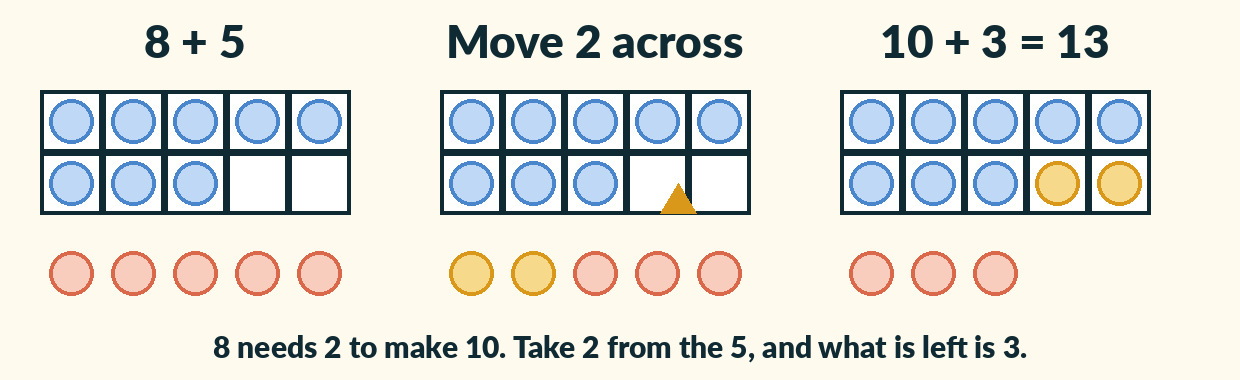
- Step 1. Look at 8 + 5. Which number is closer to 10? It is 8.
- Step 2. 8 needs 2 to reach 10, so borrow 2 from the 5. That leaves 3.
- Step 3. 10 + 3 is easy: 13. The same trick turns 9 + 6 into 10 + 5 and 28 + 7 into 30 + 5.
2. Think of subtraction as a gap
Taking away is one way to see subtraction. The other is asking how far is it from here to there? That second view is often kinder, because it turns subtraction into the adding the child already knows.
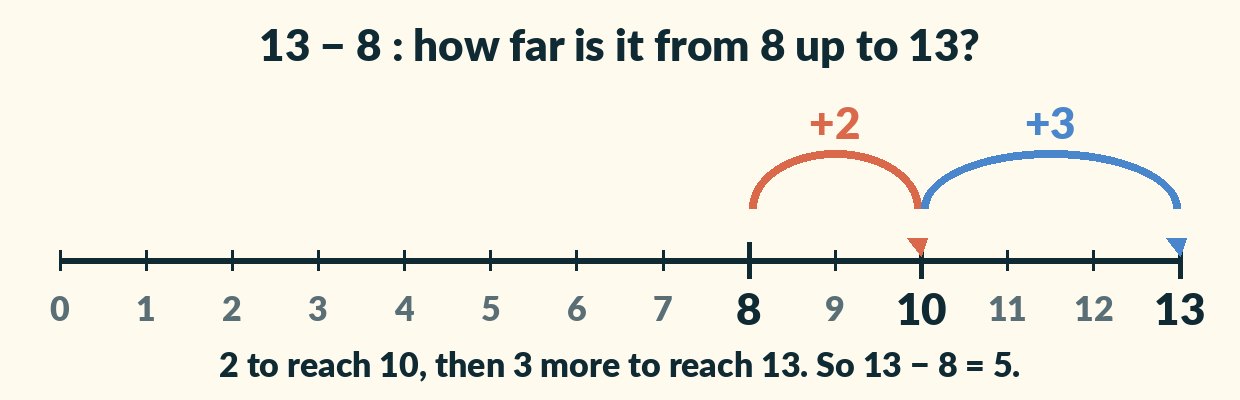
- Step 1. Start at the small number, 8. The goal is the big number, 13.
- Step 2. Jump to the nearest friendly number: 8 up to 10 is a jump of 2.
- Step 3. Jump from 10 to 13: that is 3 more. Add the jumps: 2 + 3 = 5. So 13 − 8 = 5.
3. See the number bonds
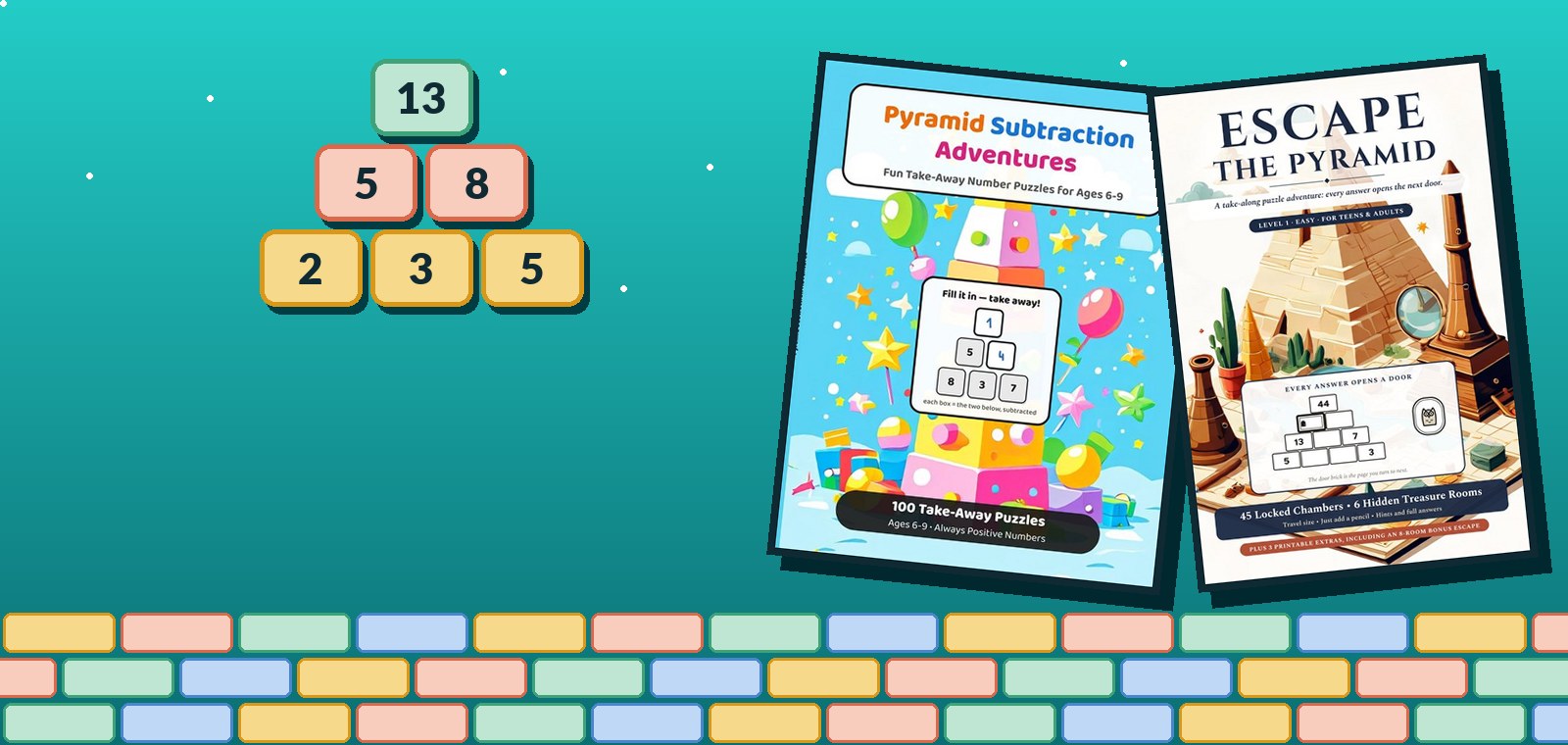
A number bond says that a whole is made of two parts: 8 is 3 and 5. Once a child sees that 3 + 5 = 8 also means 8 − 3 = 5 and 8 − 5 = 3, addition and subtraction stop being two separate topics. They are one family of facts. A number pyramid is just bonds stacked on top of each other, so it is a fine place to practise them.
Three parts on the bottom row
The bottom row holds 2, 3 and 5. Each brick above is the sum of the two bricks under it.
Join neighbours
2 + 3 = 5 and 3 + 5 = 8. Each is a bond: two parts joined into one whole.
Join once more
5 + 8 = 13 at the top. And going back down, 13 − 8 = 5 gives the part we started with. Same bond, read backwards.
4. Round, then fix
Numbers that end in 9 or 8 are close to a round number, and round numbers are easy. Round up, do the easy sum, then fix the small difference.
- 49 + 36: 49 is just 1 under 50. Add 50 + 36 = 86, then take the extra 1 back: 85.
- 73 − 38: 38 is 2 under 40. Take 40 away: 73 − 40 = 33. We took 2 too many, so give 2 back: 35.
Ask the child to explain why the 1 goes back. If they can say it in their own words, the idea has landed.
5. Practise in short, playful bursts
Once an idea makes sense, practice makes it fast. Short, regular sessions usually serve better than one long, tiring one. Five or ten minutes a day is plenty. A puzzle is good for this because the child wants the answer, so the sums become a means to something and not the point of the exercise.
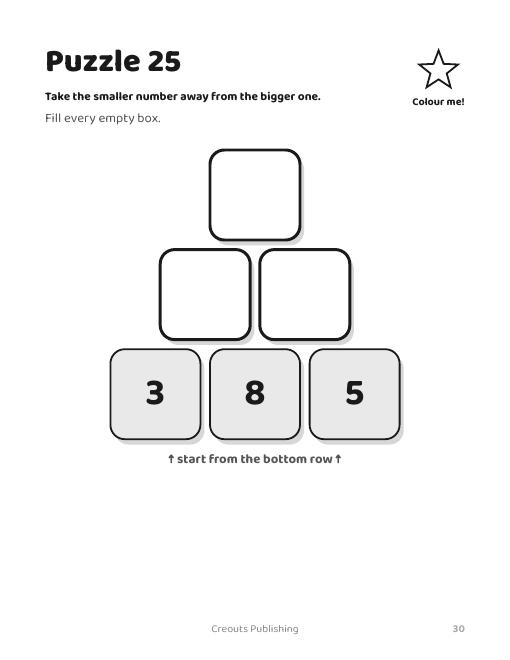
That is how a take-away pyramid works. Each brick is the bigger number minus the smaller one, and the child fills in from the bottom up.
The base is given
Bottom row: 9, 6 and 8. Rule: each brick above is the bigger number take away the smaller one.
Take away
Between 9 and 6 the gap is 3. Between 6 and 8 the gap is 2. These are two small take-aways, which is the whole skill.
Reach the top
Between 3 and 2 the gap is 1. One brick left, and the pyramid is done. Three take-aways, and no sum to feel scary.
What about the column method?
Written columns, where you carry and borrow, are still worth learning. They are reliable for big numbers. They just make more sense once a child can already see that 43 − 18 is a gap, or that 49 + 36 is 50 + 35. Strategies first, columns second, and each supports the other.
A short checklist for a grown-up
- Ask “How did you work it out?” and accept any method that is correct.
- Use real things: coins, buttons, steps on the stairs.
- Practise a little each day instead of a lot once a week.
- Praise the thinking, not only the answer.
Books mentioned
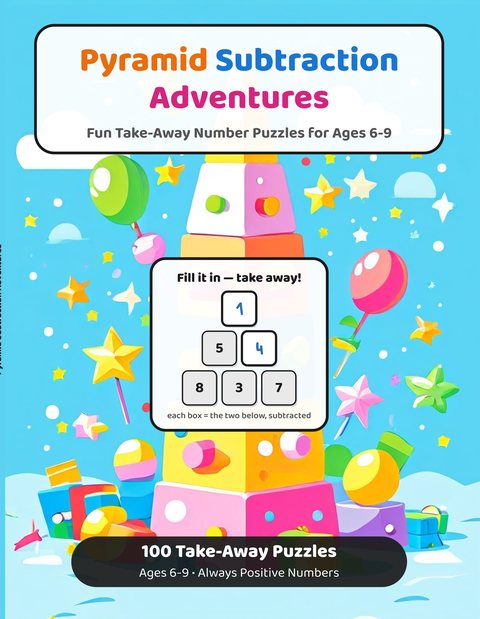
Pyramid Subtraction Adventures
The whole book is take-away practice: 100 fill-in pyramids for ages 6 to 9, where each brick is the bigger number minus the smaller. It gives practice, not lessons, so use it alongside the strategies above.
View on Amazon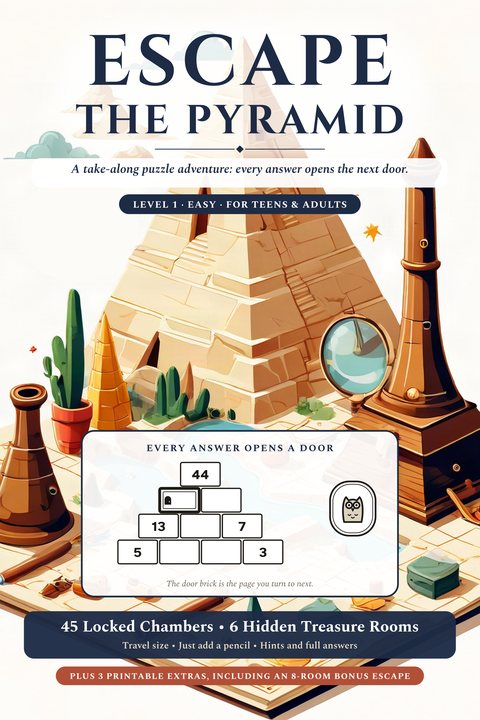
Escape the Pyramid, Level 1
For teens and adults who want their addition and subtraction to get a workout. Number pyramids are one of its 5 puzzle kinds, along with number trails, wrong-brick hunts, picture bricks and ink blots.
View on AmazonAs an Amazon Associate we earn from qualifying purchases. Cover images are the ones we have on file; the book you receive may show a slightly different cover.