
Short answer: yes, there are studies, and they are encouraging but not conclusive. Older adults who do puzzles and other mentally active things tend to think better, and some trials of structured mental training have shown lasting gains in the skill that was trained. Whether puzzles slow the decline that comes with age is much less certain. Here is what six studies found, and what each one cannot tell us.
Number puzzles and test scores: Brooker, 2019
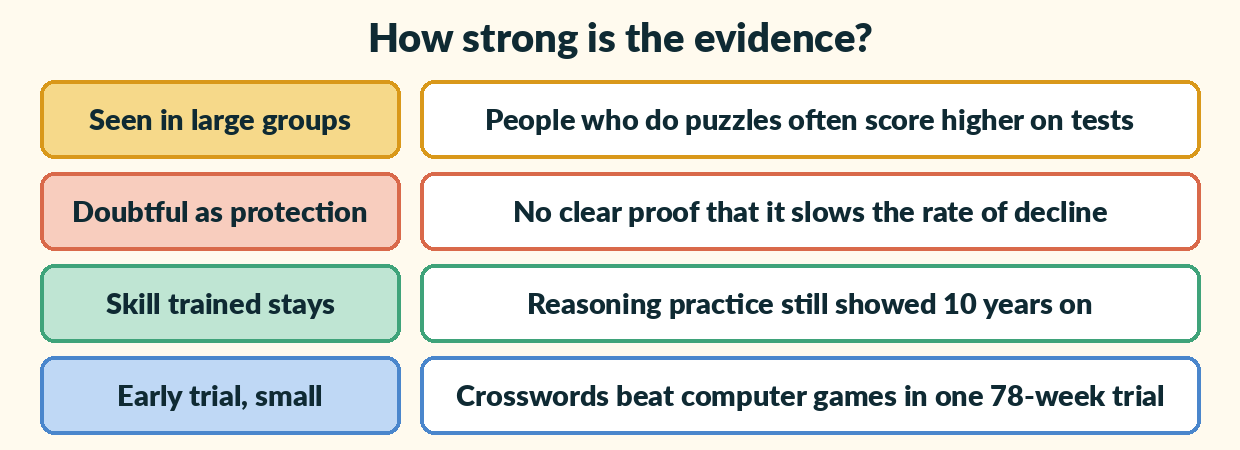
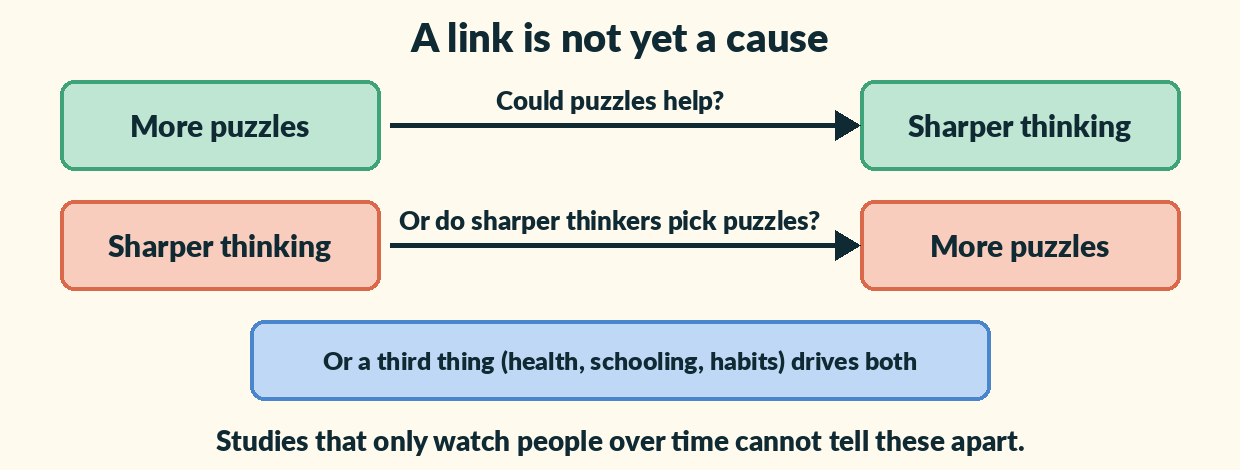
In an online study of 19,078 healthy people aged 50 to 93, the more often people said they did number puzzles, the better they scored on all 14 measures of thinking, such as reasoning, attention and memory. Those who did number puzzles more than once a day scored best on 10 of them (Brooker and colleagues, 2019). This is a snapshot taken at one time, so it cannot say which came first.
Activity and dementia: Wilson 2002 and Verghese 2003
Two older studies followed people over several years. In the first, more than 700 people aged 65 and over without dementia were followed for about 4.5 years. People who did more mentally stimulating things, such as reading, playing cards, checkers, crosswords and puzzles, were less likely to develop Alzheimer's disease: each one-point rise on the activity scale went with a 33 percent lower risk (Wilson and colleagues, 2002). The researchers themselves noted that people heading for Alzheimer's might have started doing fewer such things years earlier.
In the second, 469 people older than 75 were followed for a median of 5.1 years, and 124 developed dementia. A higher score for cognitive activities such as reading and board games went with a lower risk (hazard ratio 0.93 for each one-point increase), even after allowing for their starting level of thinking (Verghese and colleagues, 2003).
The sceptic: Salthouse, 2006
Timothy Salthouse reviewed the evidence on the idea that keeping mentally active slows mental ageing. He found that many studies show higher activity going with better thinking, but very few show that the rate of decline is slower for active people. He wrote that there was a lack of empirical evidence for the idea, while adding there may be personal benefits to acting as if it were true (Salthouse, 2006). That is a fair summary of where things stood, and the question is still open.
Trained skills can last: the ACTIVE trial
In ACTIVE, 2,832 older adults (average age 73.6) did ten sessions of training in memory, reasoning or speed and were followed for ten years. Ten years on, each trained group reported less difficulty with everyday tasks than people with no training, and the reasoning and speed groups still showed gains in what they had practised. The memory group did not keep its memory gain (Rebok and colleagues, 2014). The gain stayed with the skill that was practised.
Crosswords in mild cognitive impairment: Devanand, 2022
In a randomised trial, 107 people with mild cognitive impairment (average age 71) did 12 weeks of home-based training with either computer brain games or crossword puzzles, followed by booster sessions, and were followed for 78 weeks. Crosswords did better than the games on a standard cognitive scale (Devanand and colleagues, 2022). The researchers noted a small sample and no inactive comparison group, and called for a larger trial (NewYork-Presbyterian summary). These were word puzzles, not number puzzles.
Where puzzles sit among everything else
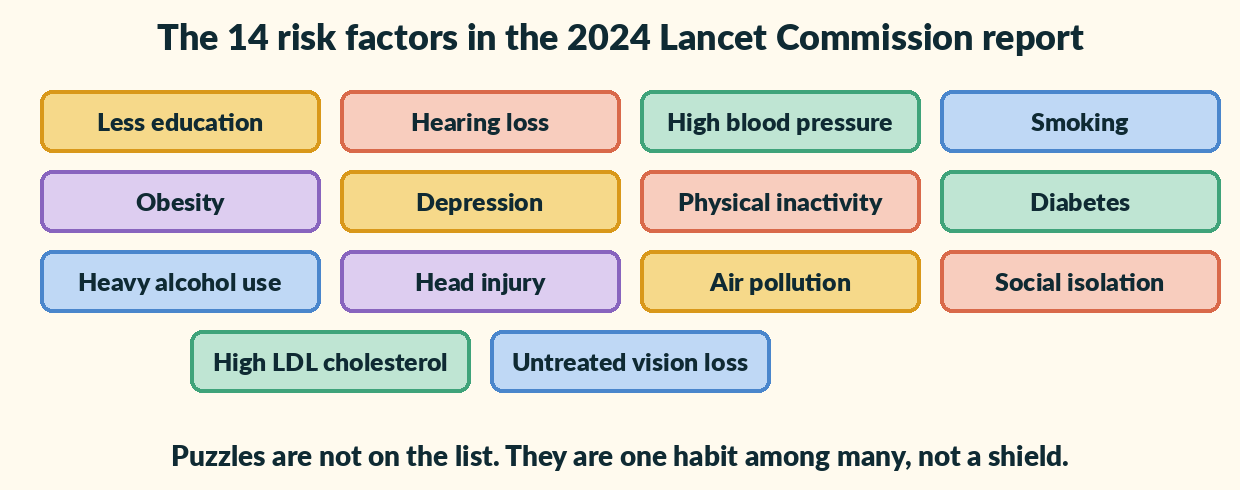
The 2024 Lancet Commission on dementia named 14 risk factors that can be changed, and estimated that 45 percent of dementia cases worldwide might be prevented or delayed if all of them were removed (Alzheimer Europe report). Puzzles are not on that list. Physical activity, hearing, blood pressure and social contact are.
So should you do puzzles?
If you enjoy them, yes. They give you something to look forward to, a small win each day and, with a puzzle book, a quiet hour. The studies above justify that much. They do not justify a promise that a puzzle habit will protect your memory, and nothing here replaces medical advice. If you are worried about your memory or a relative's, talk to a doctor.
- Pick something you enjoy. A habit you keep beats a perfect one you drop.
- Mix the kinds. Different puzzle types ask for different thinking, which is the idea behind mixed practice.
- Aim for hard but doable. If every puzzle is easy you are only colouring in.
- Do it with someone. Social contact is on the Lancet list, and puzzles are easy to share.
Where our books fit
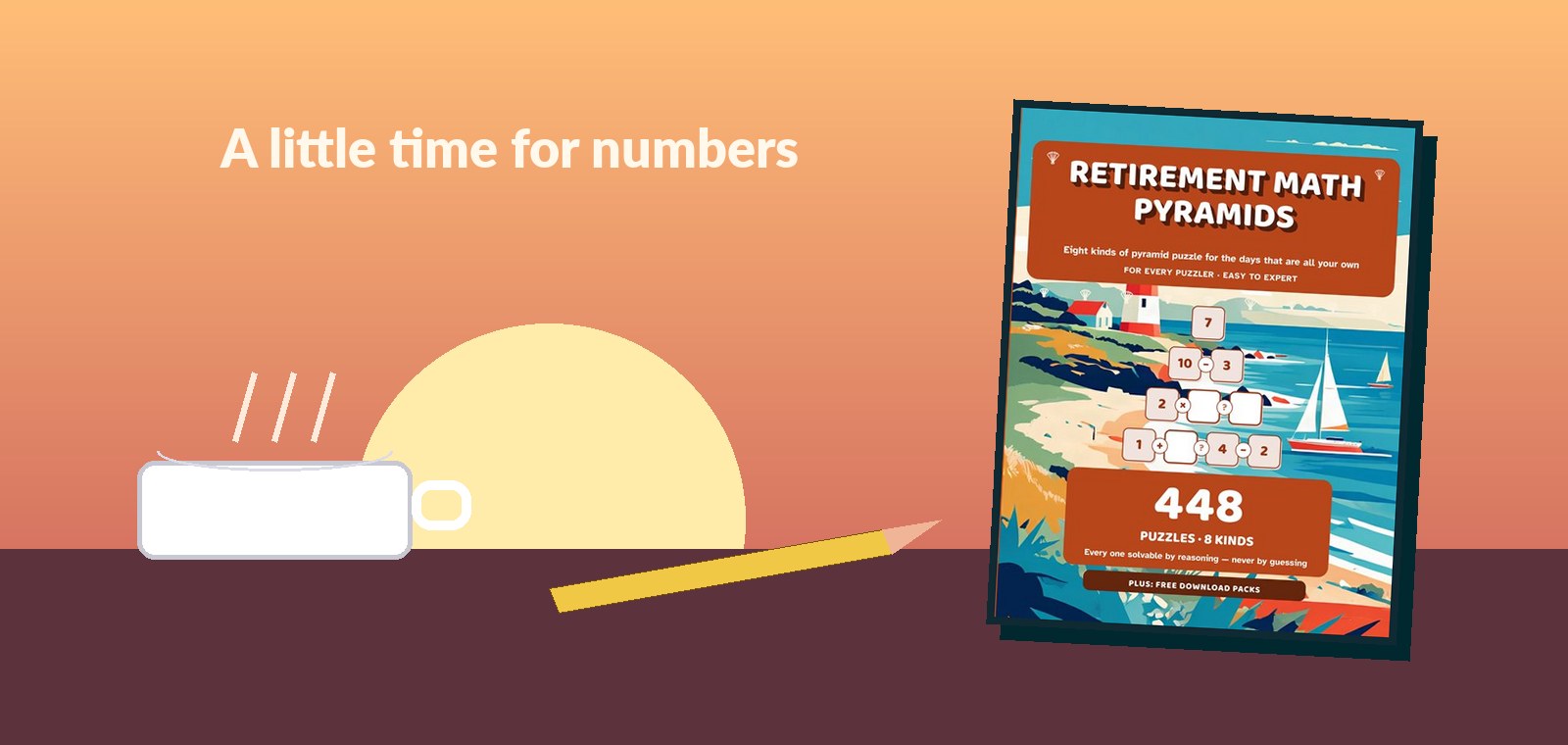
Retirement Math Pyramids is a puzzle book of 448 number pyramids in 8 kinds (classic addition, subtraction, Pyramidoku, four operations, integer, secret reveal, equation and linked pyramids), so you can mix the kinds as you go. Each chapter opens with the rules and a worked technique page, answers are at the back, and every puzzle can be solved by reasoning alone. The Big Book of Math Pyramids is the larger collection for adults. These are puzzle books, not a treatment, and none of the studies above tested them.
How a page looks in the book
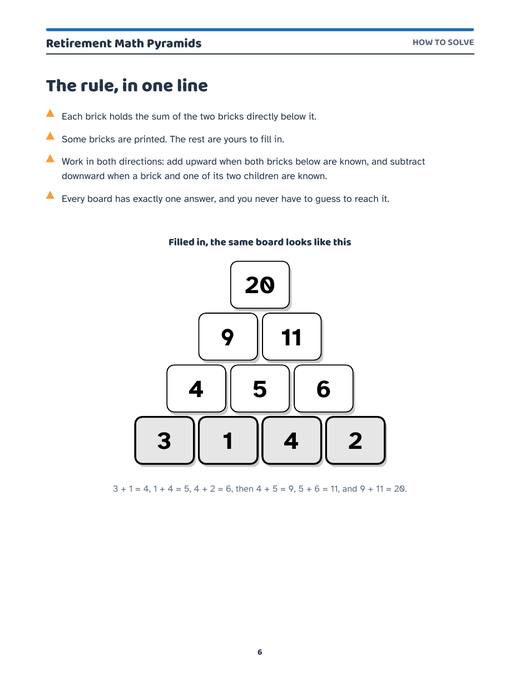
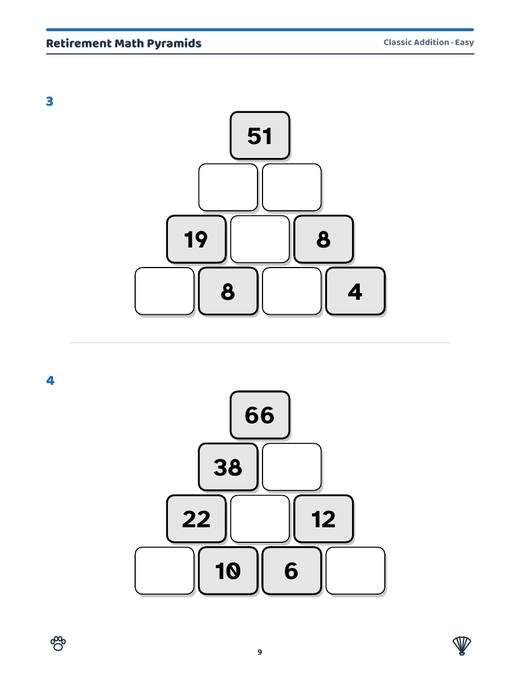
Low-resolution pages from Retirement Math Pyramids. The puzzles are unsolved.
Books mentioned
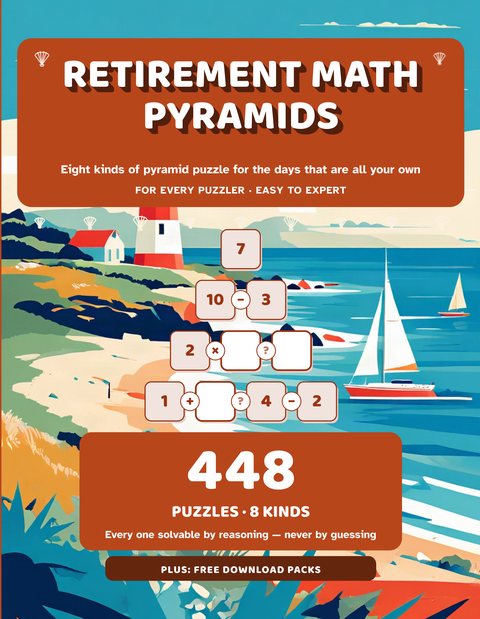
Retirement Math Pyramids
448 number pyramid puzzles in 8 kinds, easy to hard, with full solutions. Each chapter opens with its rules and a worked technique page.
View on Amazon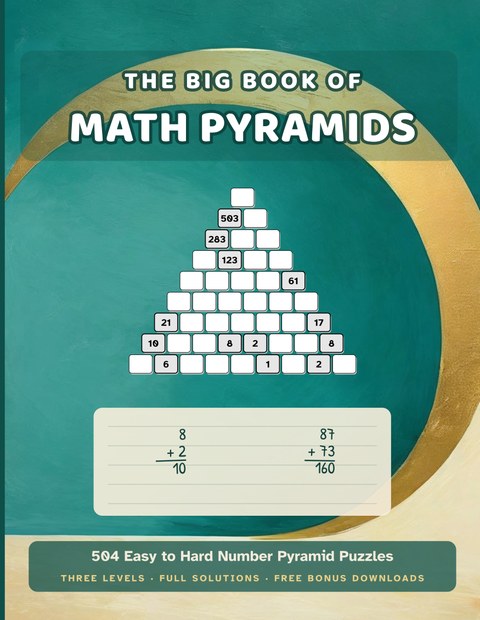
The Big Book of Math Pyramids
504 easy to hard number pyramid puzzles for adults, with full solutions.
View on AmazonAs an Amazon Associate we earn from qualifying purchases. Cover images are the ones we have on file; the book you receive may show a slightly different cover.
More field notes
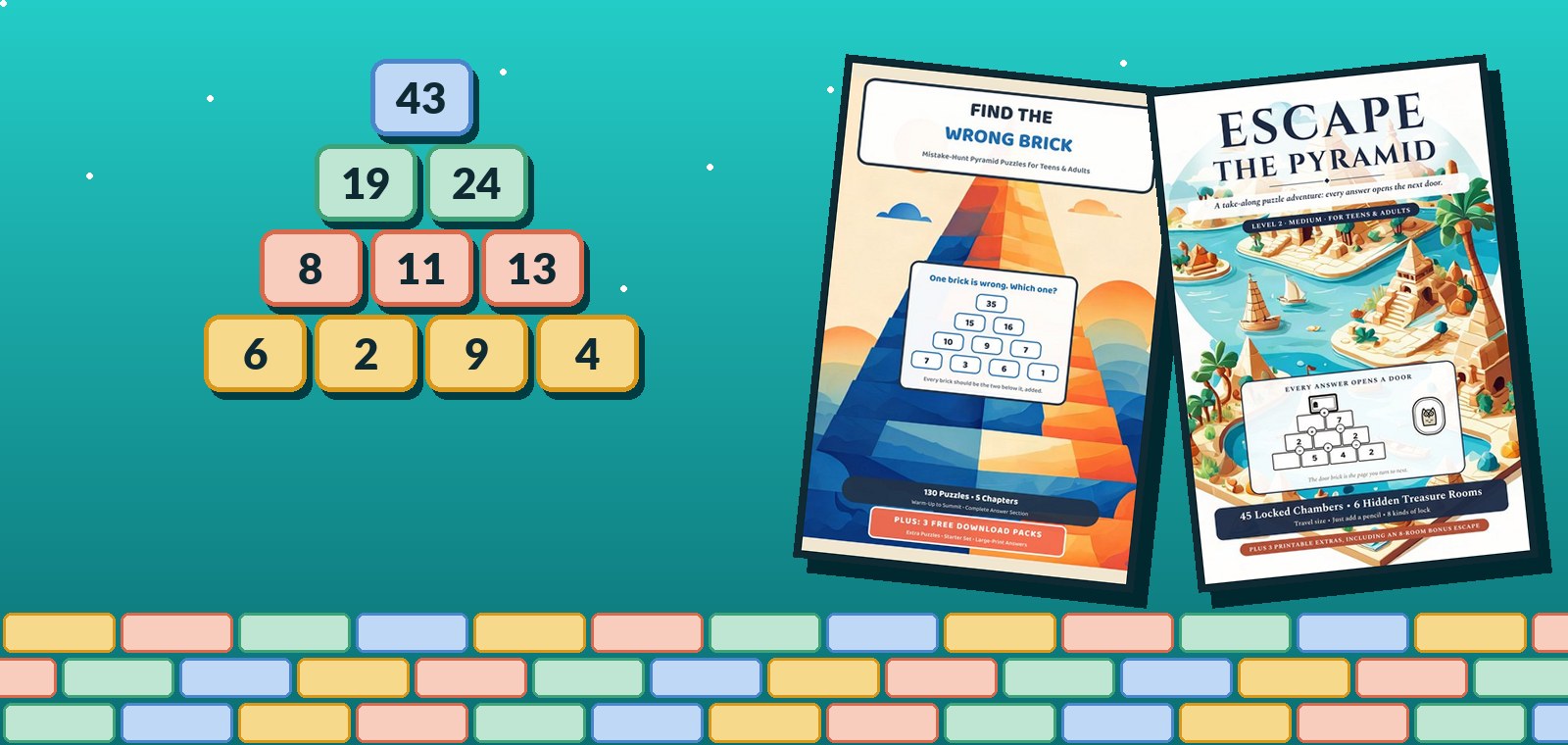
How to Find the Wrong Brick: Count the Complaints
One brick in the pyramid is wrong. Check every pair, count where the complaints meet, and you will find it every time.
The Best Way to Practise Maths: Mix It Up, Space It Out, Test Yourself
Three practice habits with real classroom evidence behind them, what the studies measured, and a ten-minute weekly routine.
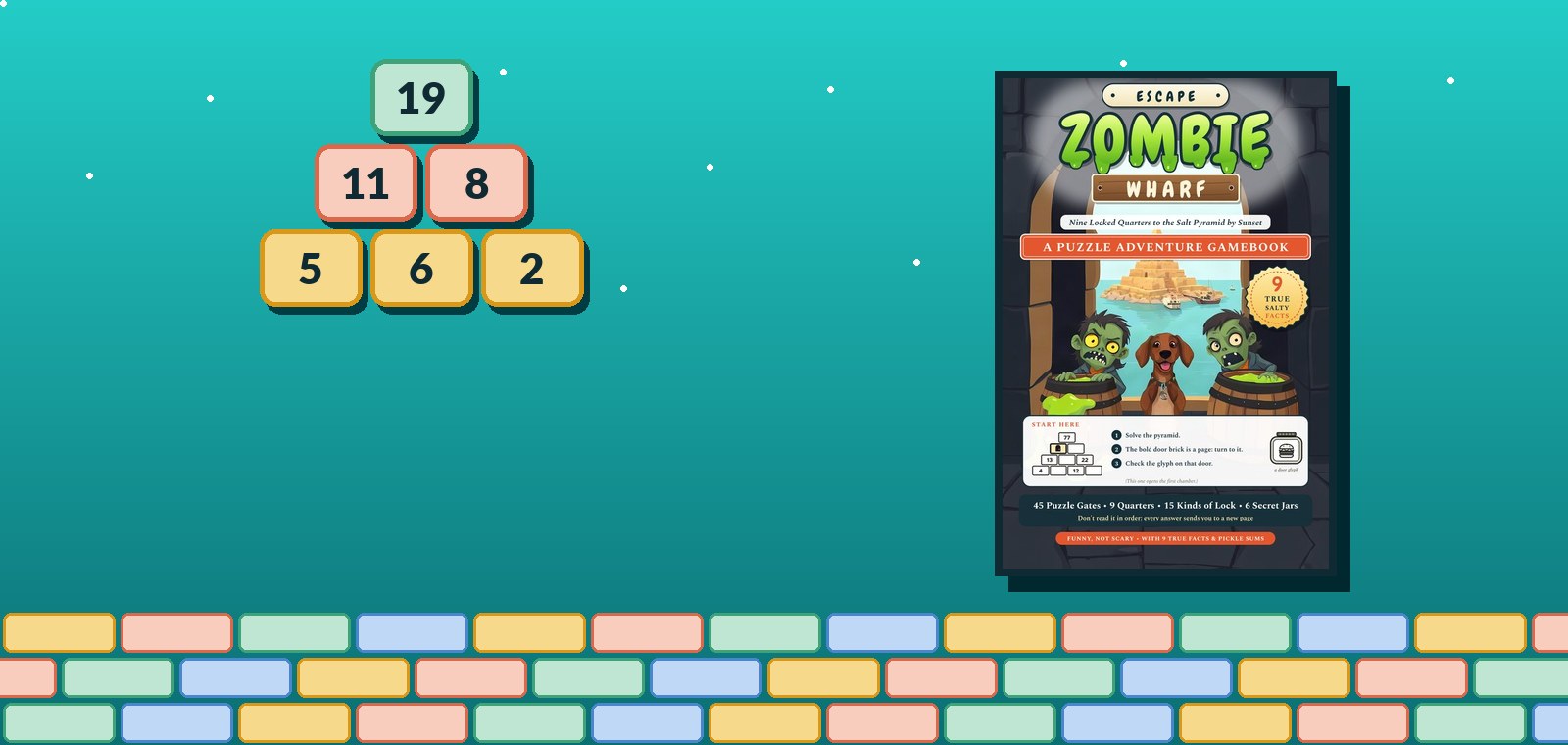
Escape Zombie Wharf: The Story and a Look Inside
Escape Zombie Wharf: the story, how a chamber plays and a look at a real page.
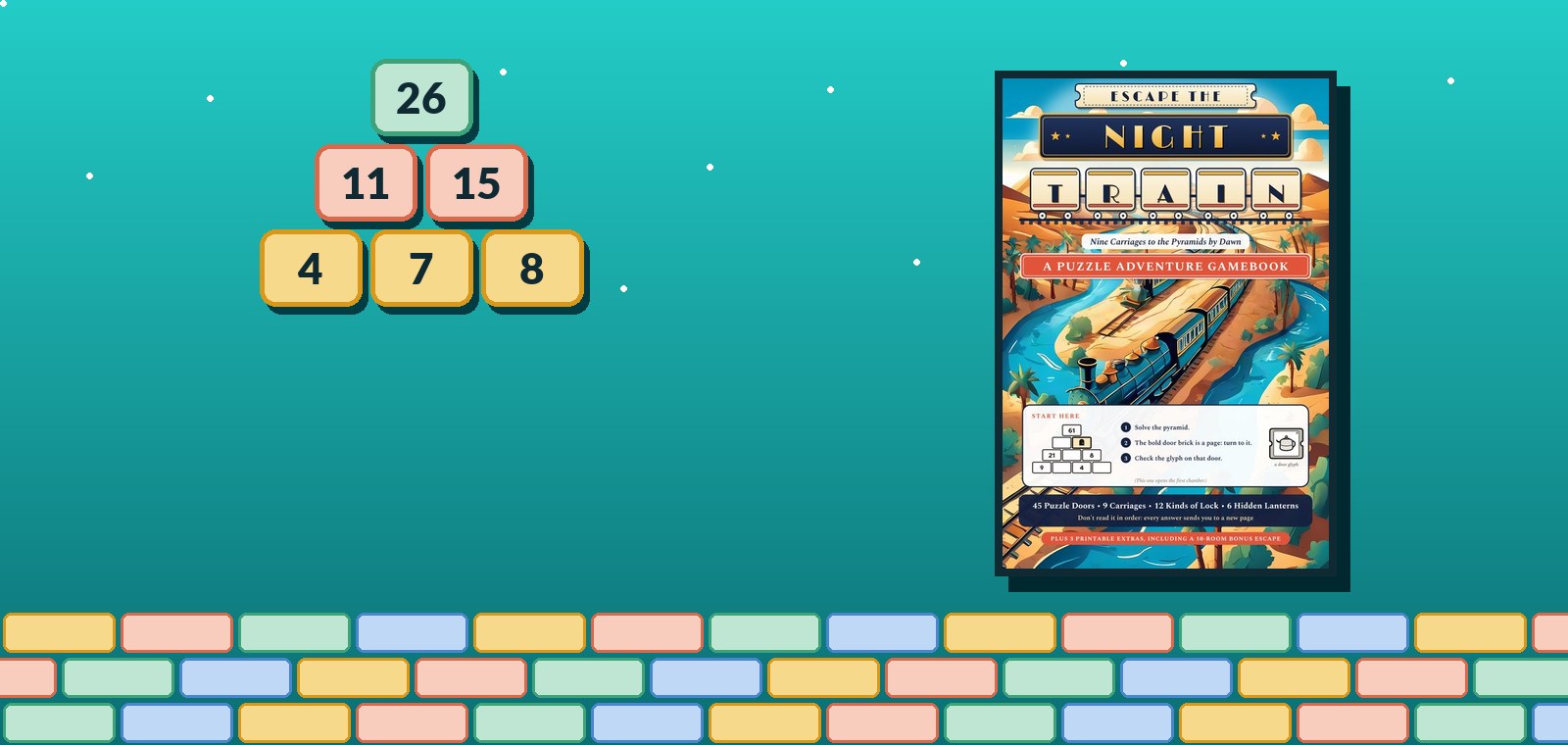
Carriage Lamps: The Lock That Tells You a Whole Row
A lamp at the end of a row shows the total of every brick in it. One quick subtraction fills in a hidden brick, and a neat check keeps you honest.
What Maths and Puzzles Can Do for Kids, Teens, Adults and Seniors
What research actually shows about puzzles and maths practice at four stages of life, what it does not show, and where to start.
Escape the Labyrinth: The Story and a Look Inside
Escape the Labyrinth: the story, how a chamber plays and a look at a real page.
Ice Cream Truck Meltdown: What It Can Do for Players
Ice Cream Truck Meltdown (Grades 3 and 4): what is in it, what players can get out of it and how to run it.
The Odd-Even Check: Spot a Mistake in Five Seconds
Odd plus odd is even. Three small facts let you test a brick without adding it up, and catch many mistakes at a glance.
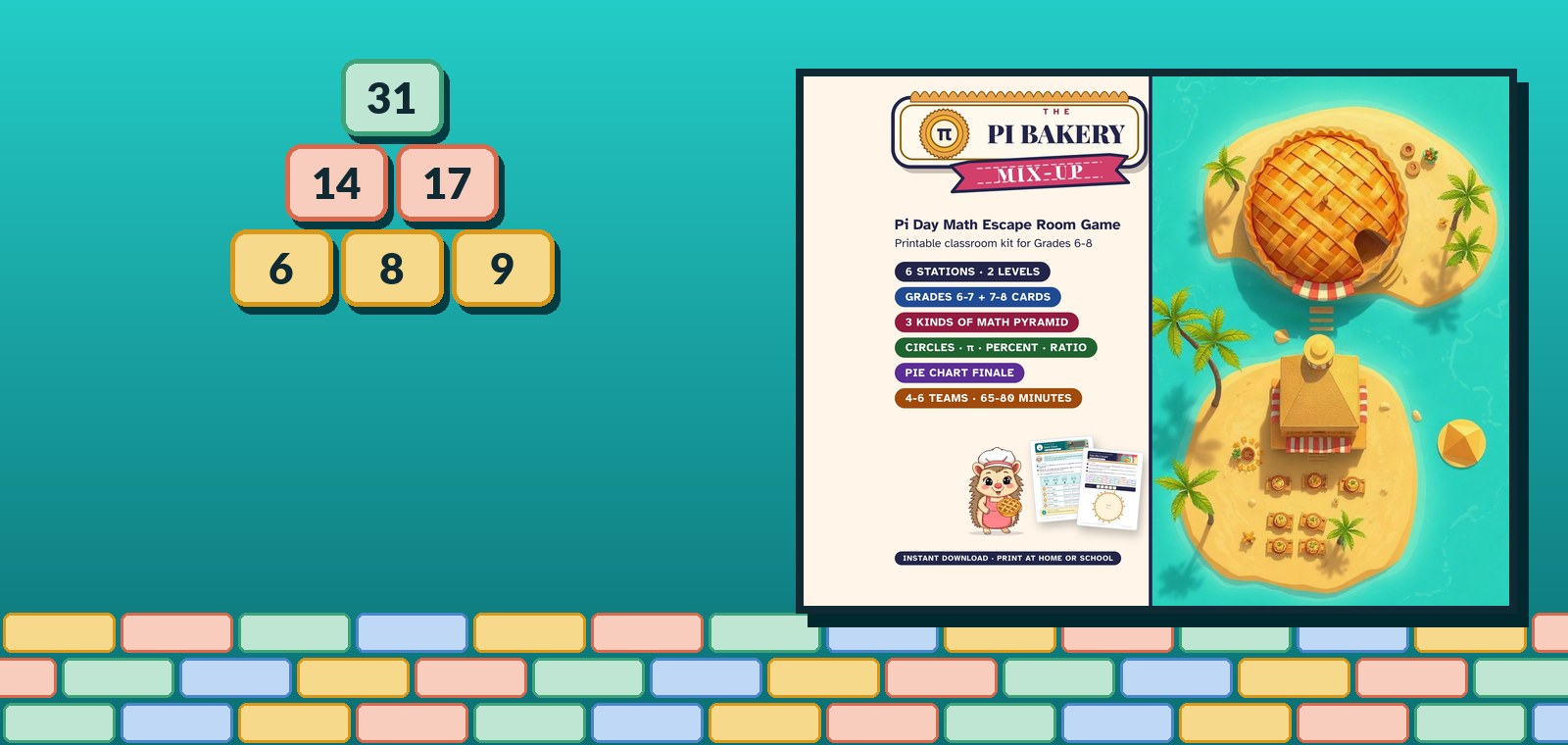
The Pi Bakery Mix-Up: A Pi Day Escape Room Where the Slices Must Add Up to 100
A bakery where every tin has been swapped. A tour of The Pi Bakery Mix-Up, a Pi Day math escape room for Grades 6 to 8, with its video.
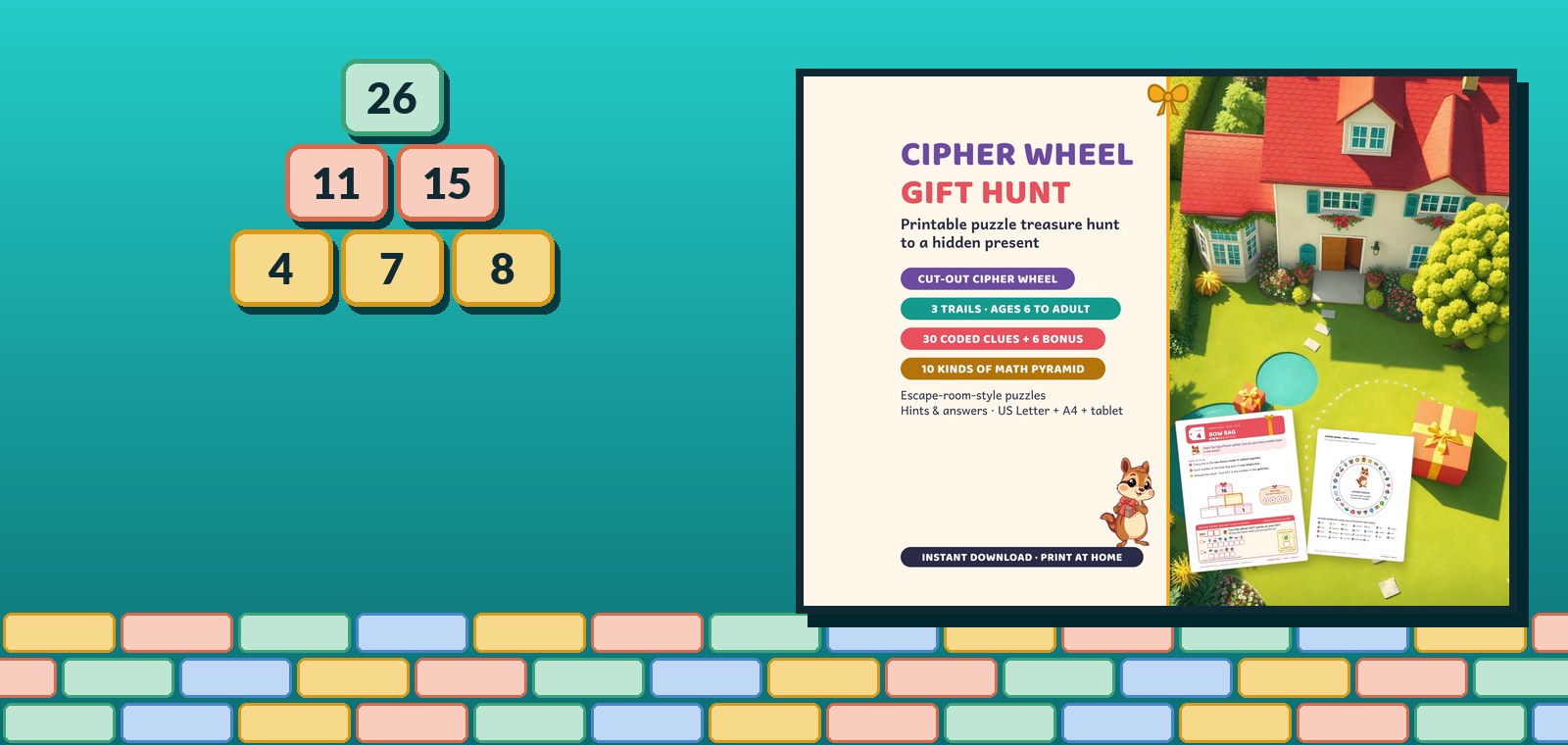
Cipher Wheel Gift Hunt: How a Present Becomes a Puzzle Trail
Solve a puzzle, set a cut-out wheel, decode where the next clue hides. Here is how the Cipher Wheel Gift Hunt works, with its 15-second video.
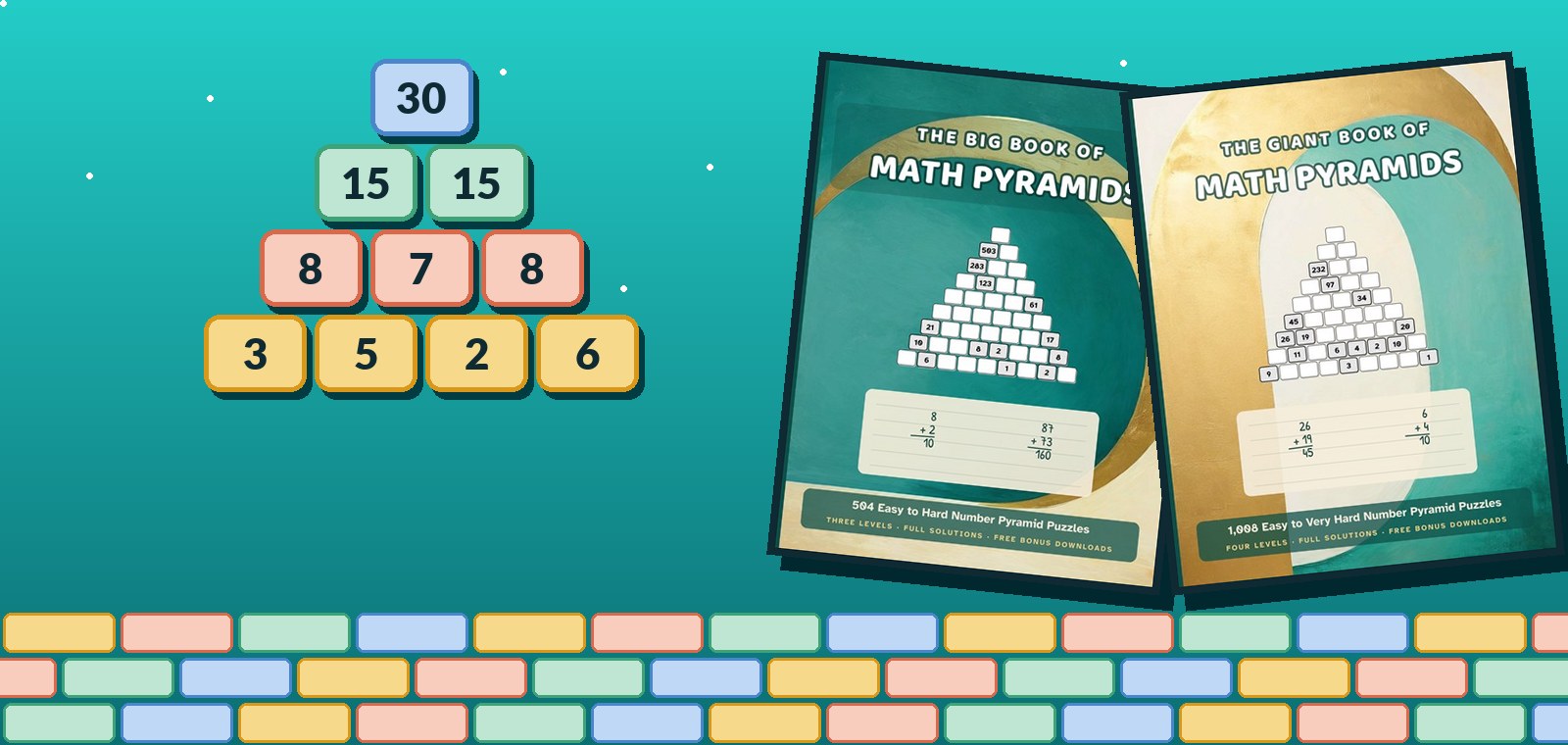
The Top-Brick Shortcut: Why 1, 3, 3, 1 Makes Pyramids Easy
Skip the middle rows. In a four-row pyramid the top is 1, 3, 3 and 1 times the bottom bricks. Why it works, and how to use it.
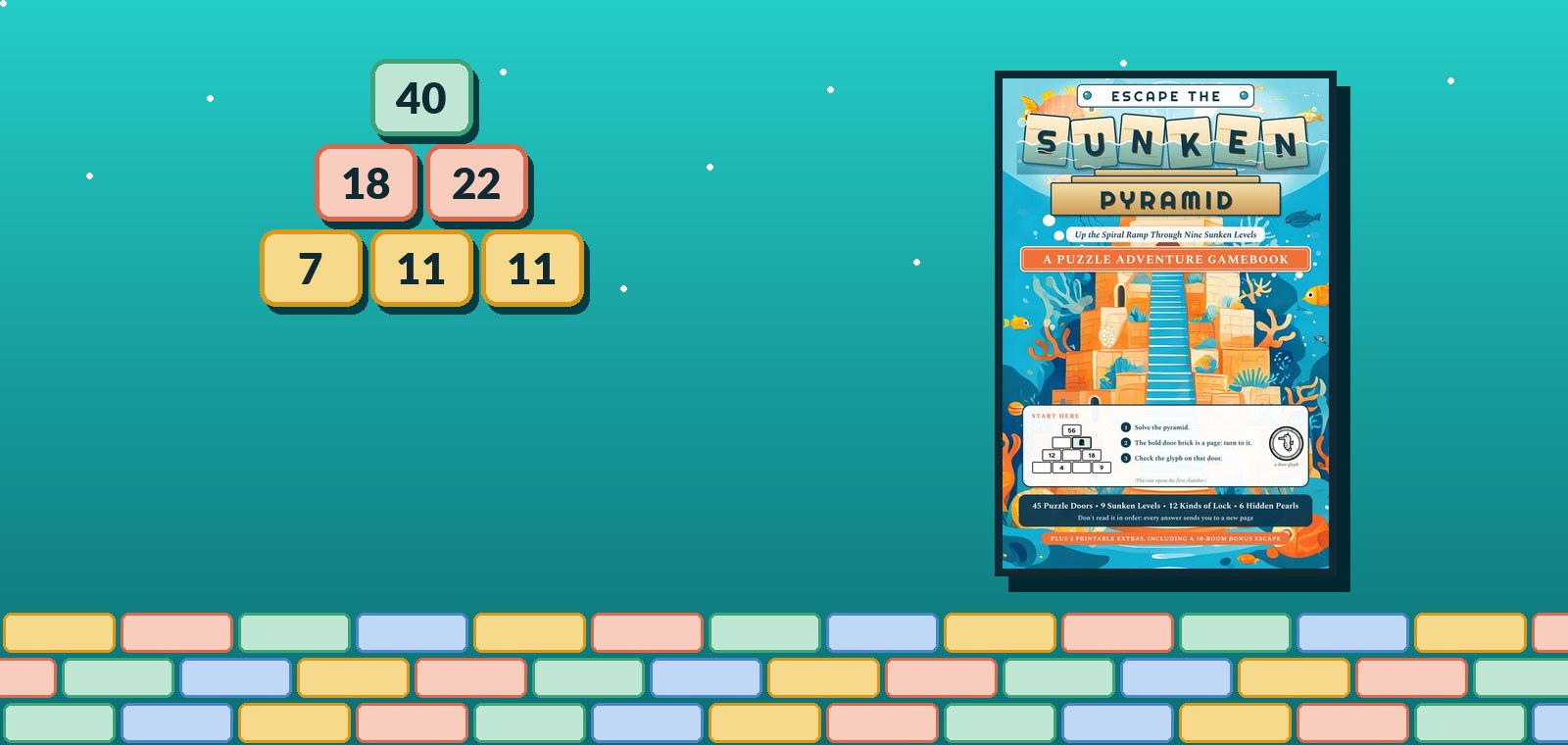
Sonar Echoes: The Buoy Lock That Gives You the Gap
In Escape the Sunken Pyramid some bricks carry a sonar buoy that shows the gap between two bricks. How to use a gap and a sum together.
Creouts Publishing
Puzzle books, printable games and, soon, games you can play here.
As an Amazon Associate we earn from qualifying purchases.
Amazon and Etsy are trademarks of their owners. Creouts is not affiliated with Etsy.