
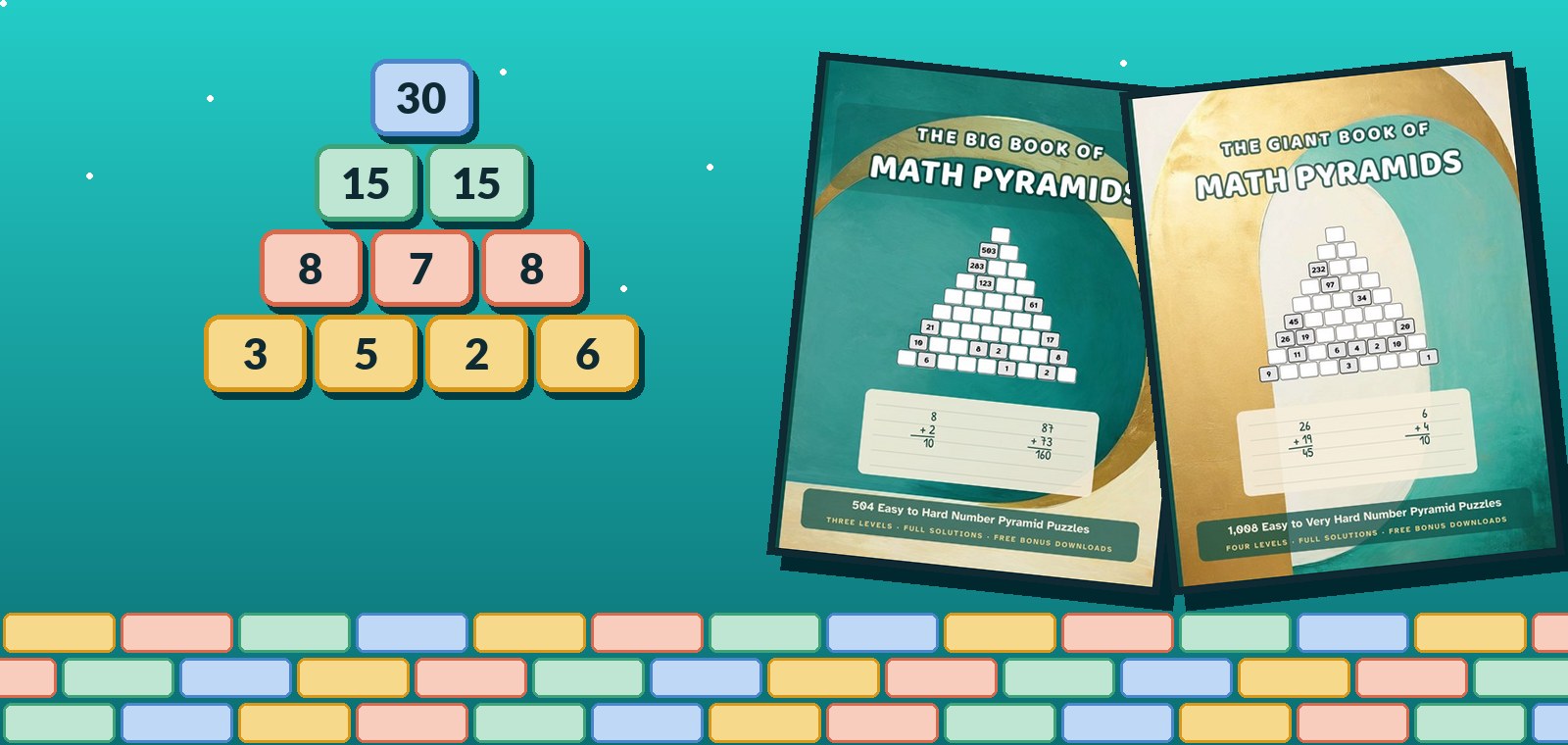
Climb a four-row number pyramid the usual way and you add three rows of bricks to reach the top. There is a quicker road. If you know the bottom row, you can jump straight to the top. The trick is a pattern: 1, 3, 3, 1.
The slow way first
Here is a pyramid with bottom row 3, 5, 2, 6. We climb it brick by brick.
The bottom row
Only the bottom row is known: 3, 5, 2 and 6.
Third row
3 + 5 = 8, 5 + 2 = 7 and 2 + 6 = 8.
Second row
8 + 7 = 15 and 7 + 8 = 15.
The top
15 + 15 = 30. Three rows of adding for one number.
The shortcut
Each bottom brick reaches the top by a number of different roads. The outside bricks have one road each. The two in the middle each have three. The picture shows how many times each bottom brick is counted.
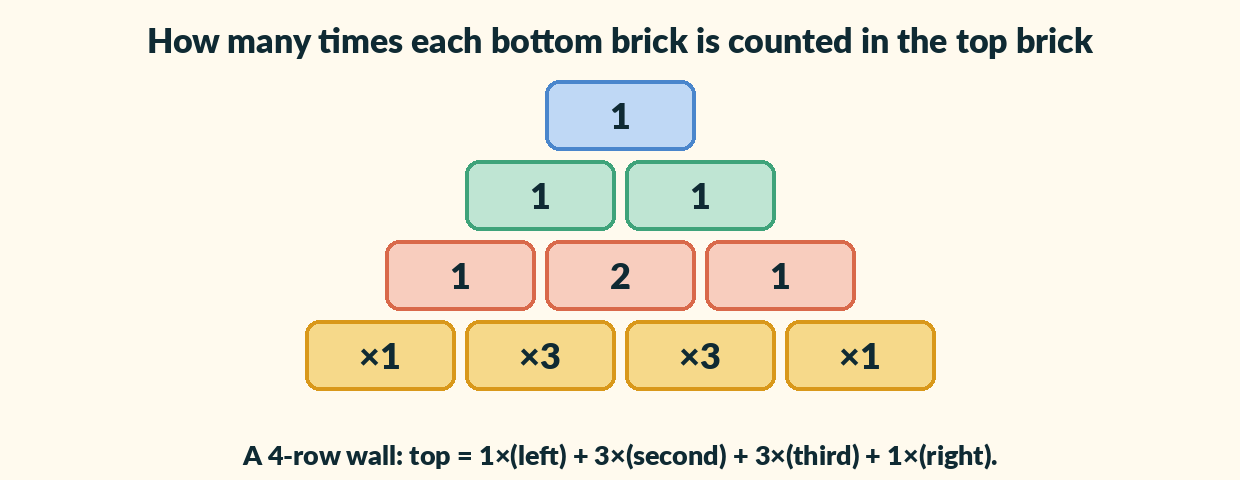
So the top of a four-row pyramid is the first bottom brick, plus three times the second, plus three times the third, plus the fourth. Check with ours:
- 3 × 1 = 3
- 5 × 3 = 15
- 2 × 3 = 6
- 6 × 1 = 6
- 3 + 15 + 6 + 6 = 30. The same top, in one go.
Why it works
Look at the middle bottom brick, 5. It is added into the left brick of the third row (3 + 5) and into the middle brick of the third row (5 + 2). Each of those goes into the second row, and the 5 inside them gets added again. The middle bricks get counted more often because more roads lead from them to the top. Three roads each, one road each for the sides: 1, 3, 3, 1.
A shortcut that finds missing bricks
The same pattern works backwards. Suppose the top is 30, the bottom row is 3, ?, 2, 6, and the second brick is missing.
- Step 1. The known bricks count: 3 × 1 + 2 × 3 + 6 × 1 = 3 + 6 + 6 = 15.
- Step 2. The top is 30, so the missing brick counted three times must make up 30 − 15 = 15.
- Step 3. 15 ÷ 3 = 5. The missing brick is 5, exactly the brick we had before.
Check it with the slow way if you like. Same answer, one step.
Taller pyramids
The pattern grows. A five-row pyramid counts its bottom bricks 1, 4, 6, 4, 1. A six-row pyramid uses 1, 5, 10, 10, 5, 1. These are the rows of Pascal's triangle, in which each number is the sum of the two above it, which is the same rule as our pyramids.
Books mentioned
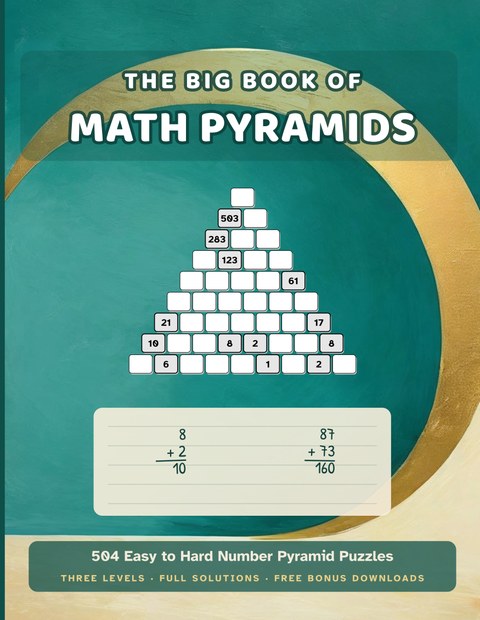
The Big Book of Math Pyramids
504 number pyramid puzzles for adults in three levels, easy to hard, with full solutions. Every puzzle is a pyramid, so this post's idea applies to the whole book.
View on Amazon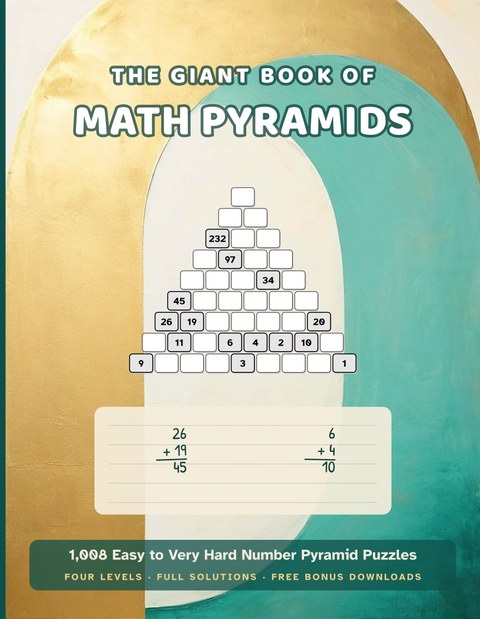
The Giant Book of Math Pyramids
1,008 puzzles in four levels, easy to very hard, with full solutions. Every puzzle is a number pyramid.
View on AmazonAs an Amazon Associate we earn from qualifying purchases. Cover images are the ones we have on file; the book you receive may show a slightly different cover.
More field notes
Sonar Echoes: The Buoy Lock That Gives You the Gap
In Escape the Sunken Pyramid some bricks carry a sonar buoy that shows the gap between two bricks. How to use a gap and a sum together.
Anaconda Bend: Build a Paper Snake 4 Metres Long, Then Measure With Her
A giant anaconda sleeps across the river, and the only way home is a lock opened by measuring. A tour of the Anaconda Bend kit for ages 7 to 11, with its video.
Ink-Blot Pyramids: Find the Digit Under the Ink
Every brick is printed, but ink has covered some of the digits. A worked sample, a 20-second video and a pyramid to try.
How a Puzzle Adventure Gamebook Works (and Why You Don't Read It in Order)
Solve the puzzle, read the door brick, turn to that page. Here is the whole game in three moves, with a worked example.
Tool Doors: How the Inventory Works in Escape the Giant's Castle
Six castle mice lend you numbered tools, and some doors open only when you add a tool's number. Learn the new rule with a drawn, step-by-step example.
Better Ways to Learn Addition and Subtraction
Flashcards have their place, but understanding comes first. Five friendly strategies, drawn step by step, plus how puzzles make the practice stick.
How to Solve a Number Pyramid, Step by Step
Two moves are all you need: add up and subtract down. Follow one real puzzle from the first brick to the top, with every step drawn.