
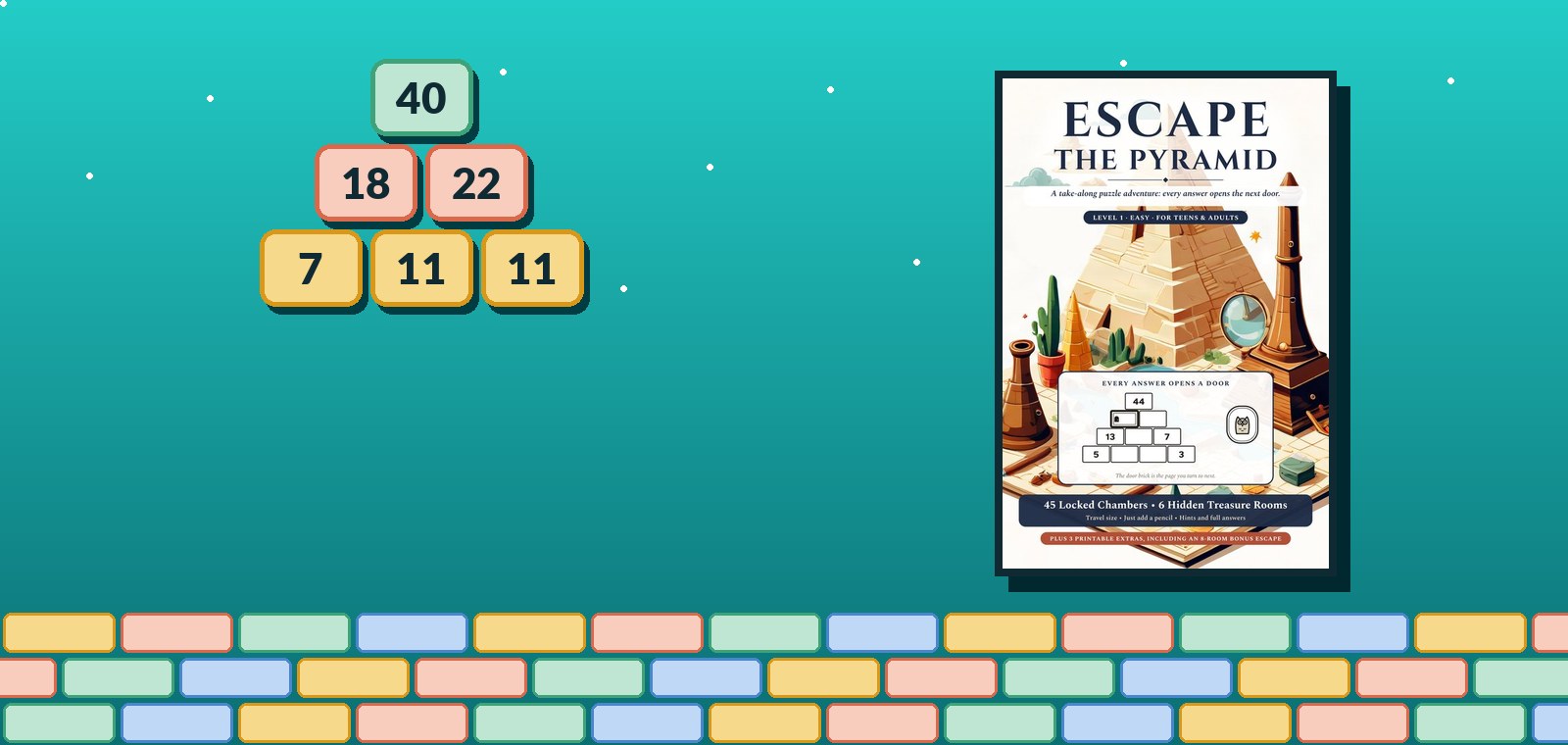
People like to say that puzzles make you smarter. The honest version is more interesting: some kinds of practice have good evidence behind them for some people, and some claims are bigger than the studies. Here is what the research shows at each stage of life, and what it does not.
Kids: puzzles and number games build early skills
In a study of 53 children followed from about two to four years old, those who played with puzzles had better spatial skills at four and a half, and the more they played, the better they did (Levine and colleagues, 2012). Spatial skill matters because it is linked to later maths learning.
Number board games help too. Preschoolers who played a number-line board game for a few short sessions improved their number knowledge (Siegler and Ramani, 2008). The lesson for school-age children is the same: practice inside a game has a good chance of being practised.
Teens: practise by recalling, not just rereading
The best-known result for students is the testing effect: in experiments by Roediger and Karpicke (2006), students who spent study time trying to recall material remembered more a week later than students who spent it rereading. Puzzles are a form of recall practice. You have to pull the facts out and use them, which is what a locked door asks of you.
Puzzles with an answer you can check also teach something quieter: that a wrong answer is information, and that you can try again.
Adults: a link, not a proof
In an online study of 19,078 people aged 50 to 93, those who did number puzzles more often scored better on all 14 cognitive tests, such as attention, reasoning and memory (Brooker and colleagues, 2019). This is a snapshot, so it cannot show that puzzles caused the better scores. People who are sharper may simply choose more puzzles. It is a good reason to enjoy them, not a promise.
Seniors: structured reasoning practice has the best evidence
The strongest evidence comes from a large trial. In ACTIVE, 2,832 older adults (average age 73.6) did ten sessions of training in memory, reasoning or speed, and were followed for ten years. Ten years later, each group reported less difficulty with everyday tasks than people who had no training, and the reasoning and speed groups still showed gains in what they had practised. Memory training did not keep its effect on memory (Rebok and colleagues, 2014).
The gains stayed with the skill that was practised. Reasoning practice improved reasoning. It did not turn into a general promise about the brain.
What puzzles cannot do
- They cannot prevent dementia or replace exercise, sleep, social contact and medical advice.
- Getting better at one kind of puzzle does not reliably make you better at everything.
- They work best when you enjoy them, so pick puzzles at a level that is hard but doable.
Where to start
For teens and adults, Escape the Pyramid, Level 1 is a puzzle adventure gamebook, so do not read it in order. Each chamber is a number-pyramid puzzle, and the answer tells you which page to turn to. It is the easy level, with hints and full answers in the back.
For classrooms and homes with younger learners, the Math Escape Room Bundle packs five printable rooms for Grades 1 to 7. Teams solve the puzzles together, which is practice in explaining as well as in arithmetic. It is a digital download you print yourself.
Books mentioned
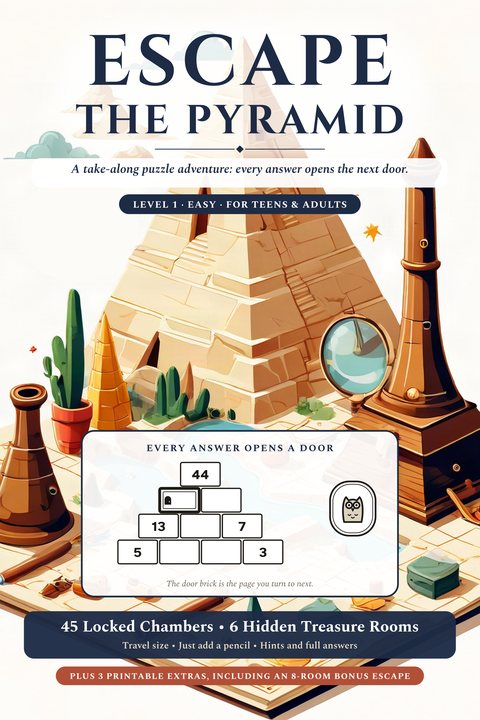
Escape the Pyramid, Level 1 (Easy)
A puzzle adventure gamebook with 45 locked chambers and 6 treasure rooms. A friendly start for teens and adults, with hints and full answers in the back.
View on AmazonGames mentioned
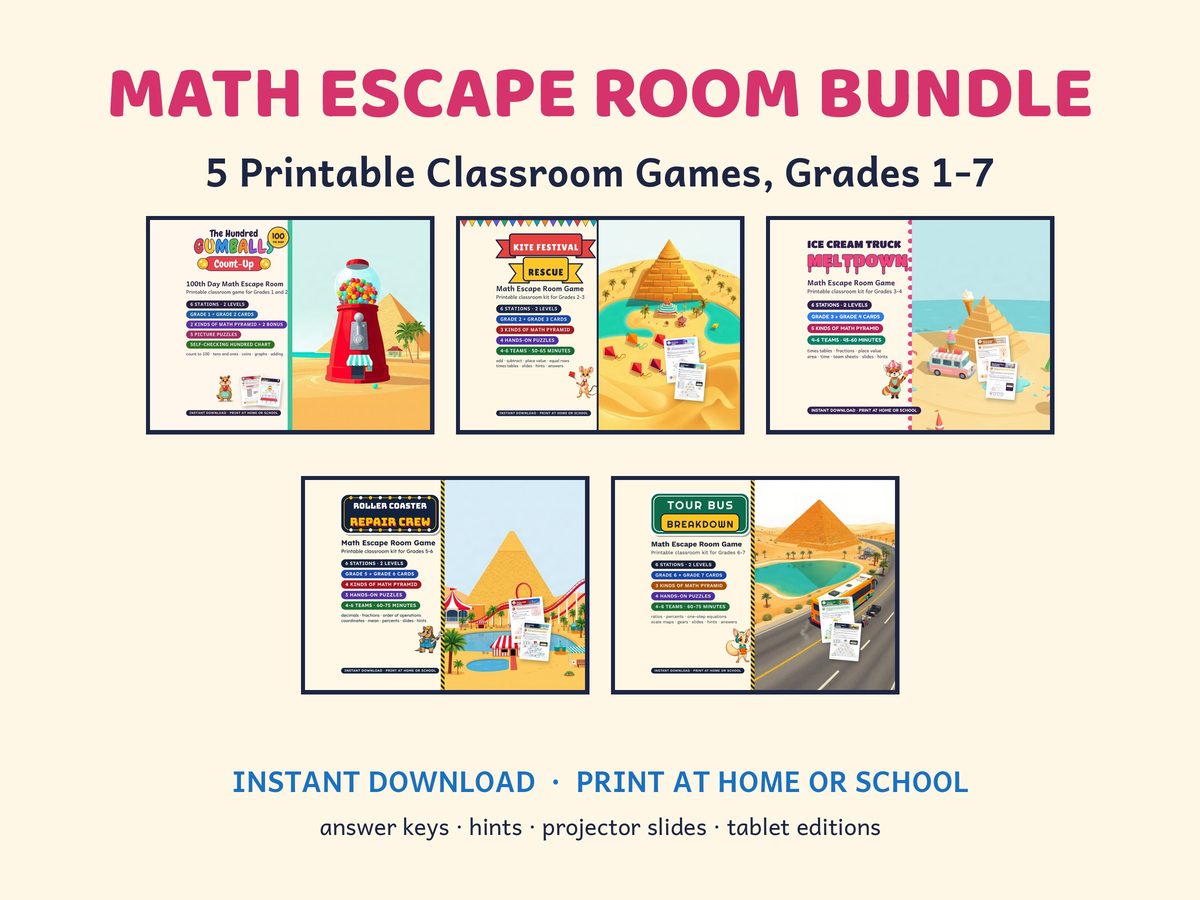
Math Escape Room Bundle, Grades 1 to 7
Five printable classroom math escape rooms in one download, from Grade 1 to Grade 7. Cheaper than buying them one by one.
See it on EtsyAs an Amazon Associate we earn from qualifying purchases. Cover images are the ones we have on file; the book you receive may show a slightly different cover.
Designed by Creouts Publishing using original prompts and AI (Claude by Anthropic). Illustrations made with AI image tools. Digital download: nothing is shipped.
More field notes
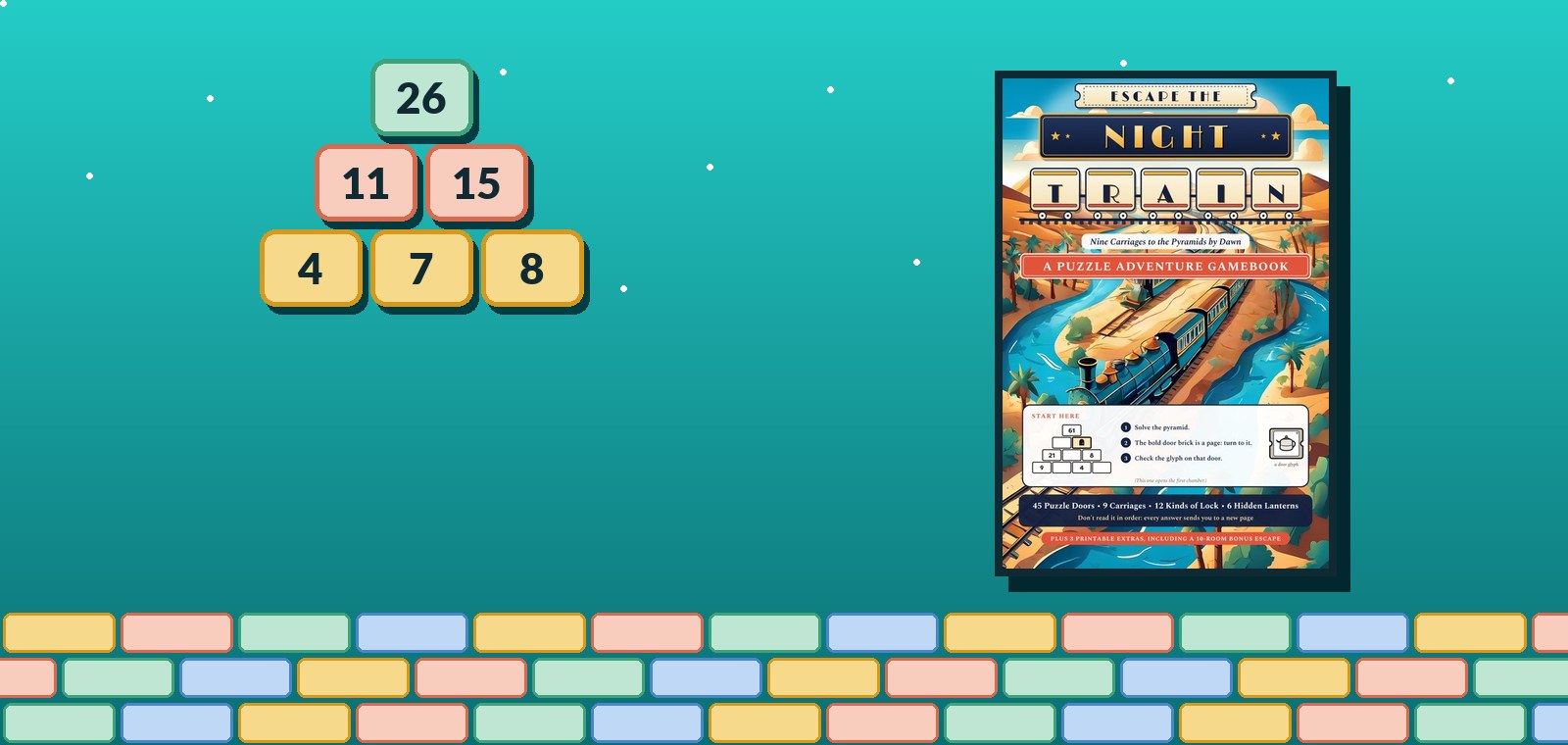
Carriage Lamps: The Lock That Tells You a Whole Row
A lamp at the end of a row shows the total of every brick in it. One quick subtraction fills in a hidden brick, and a neat check keeps you honest.
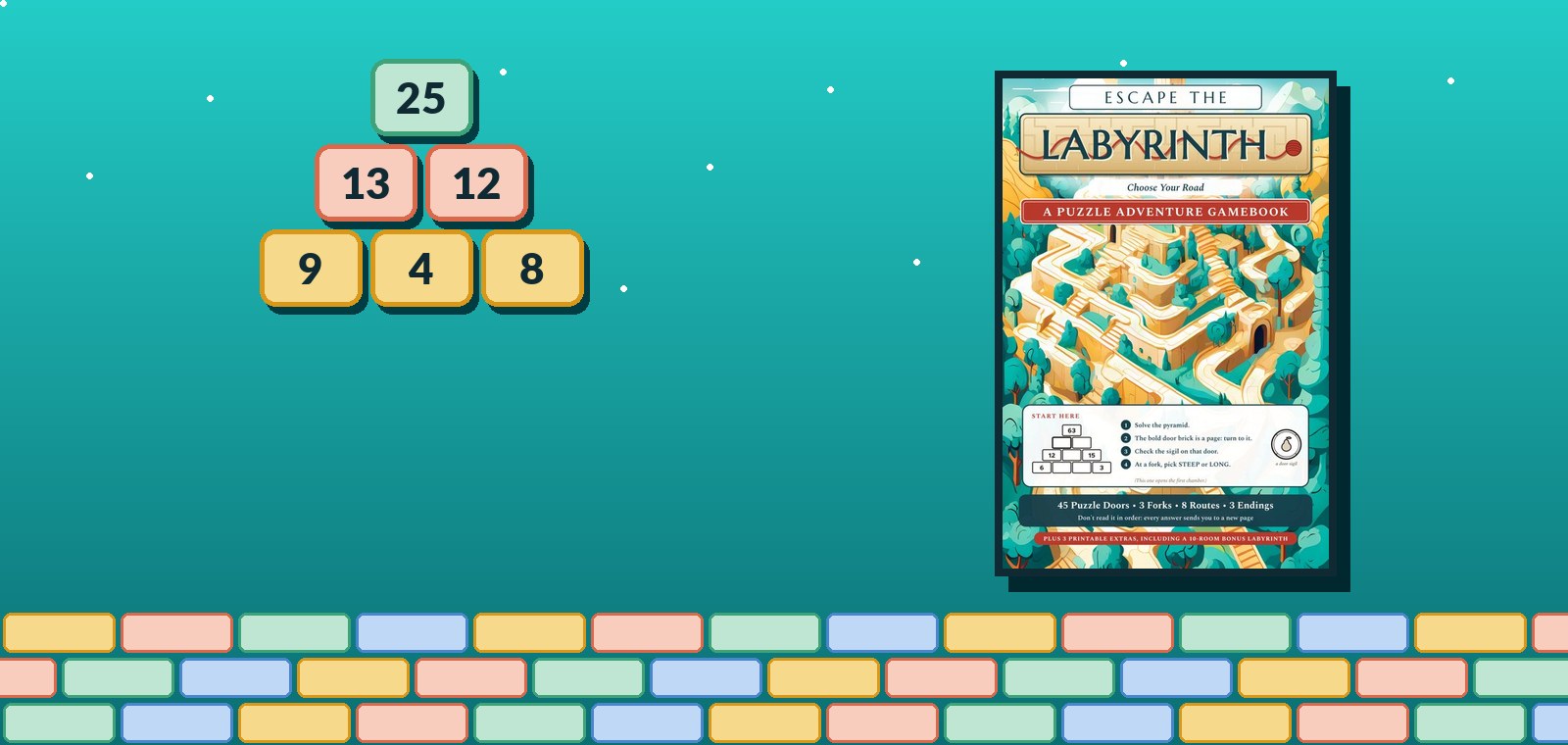
Escape the Labyrinth: The Story and a Look Inside
Escape the Labyrinth: the story, how a chamber plays and a look at a real page.
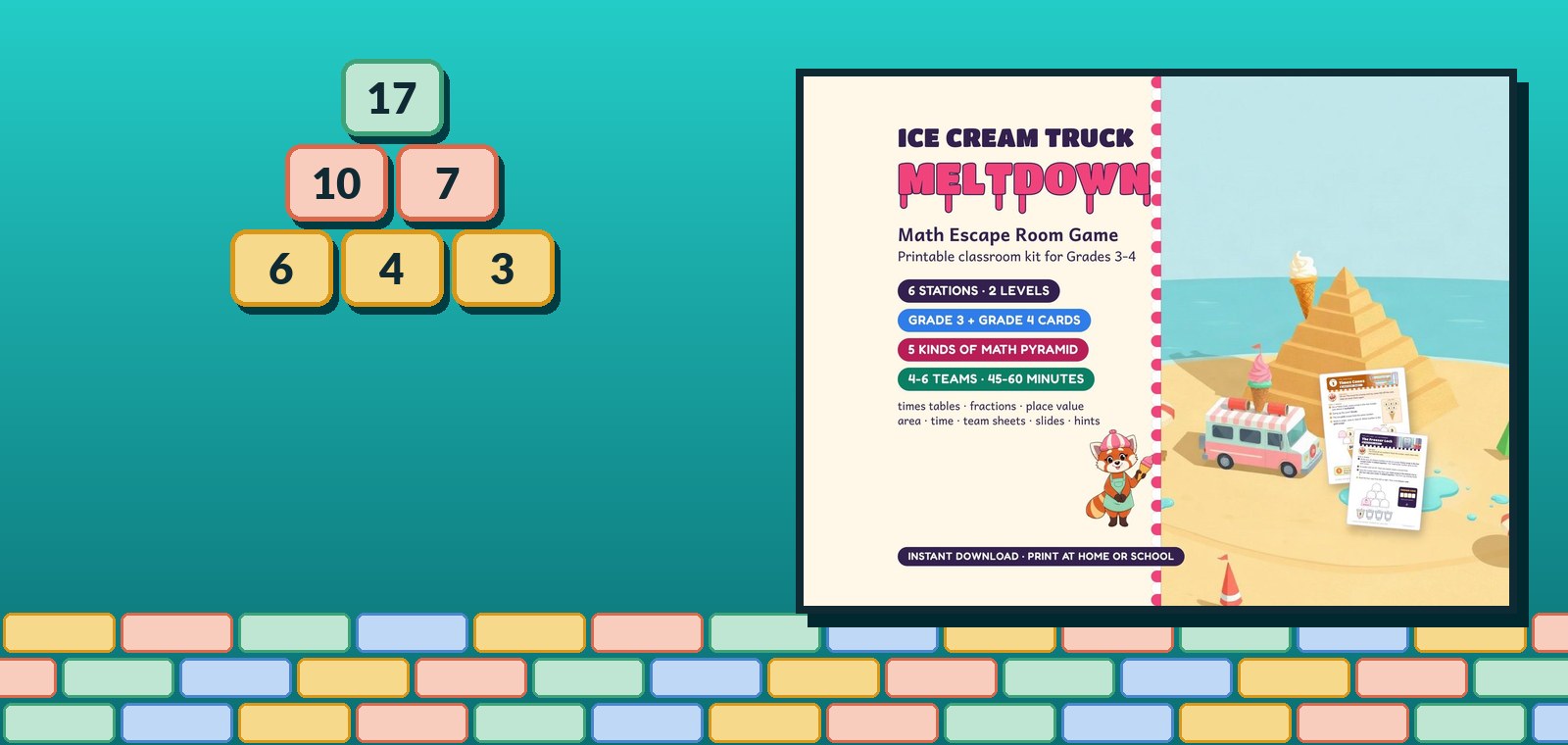
Ice Cream Truck Meltdown: What It Can Do for Players
Ice Cream Truck Meltdown (Grades 3 and 4): what is in it, what players can get out of it and how to run it.
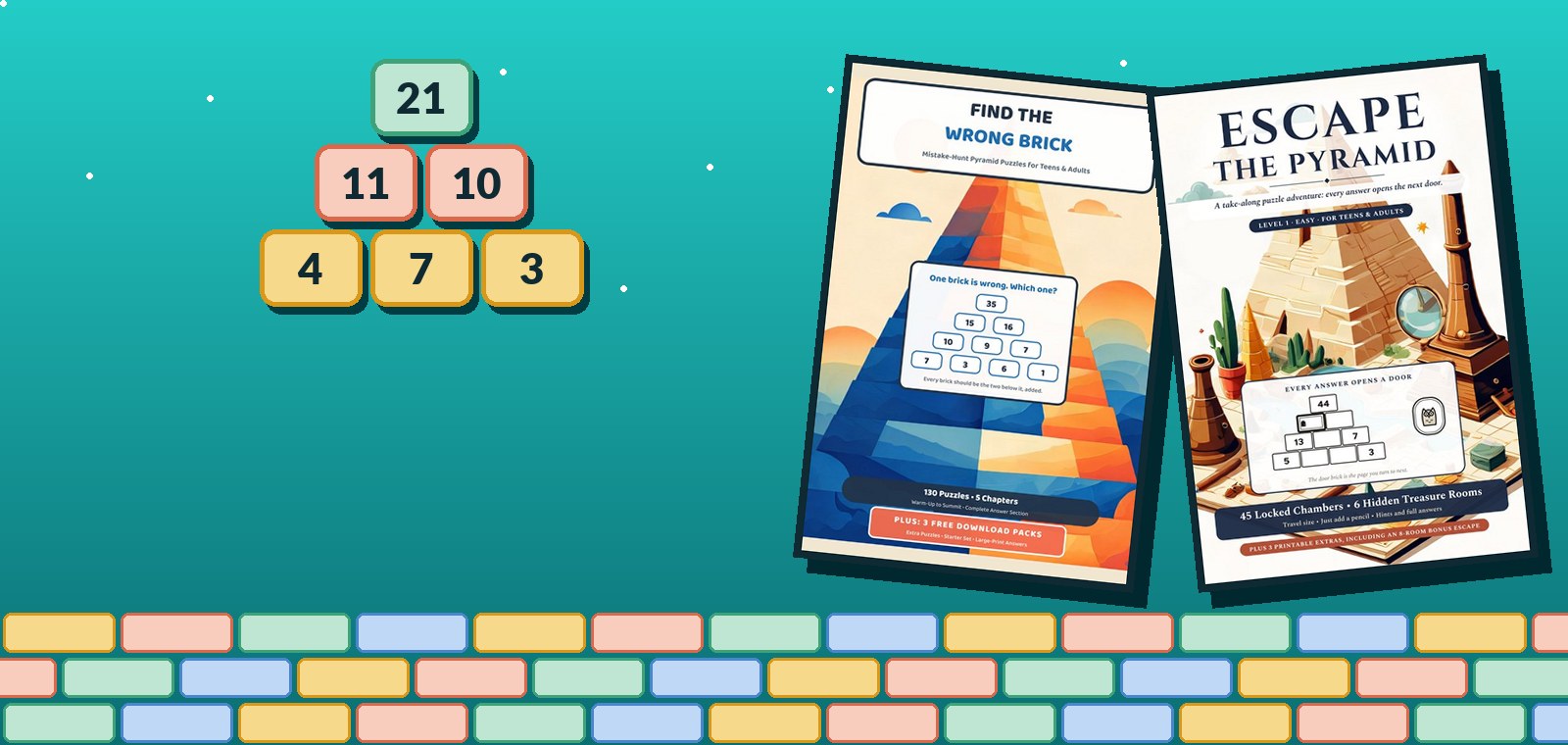
The Odd-Even Check: Spot a Mistake in Five Seconds
Odd plus odd is even. Three small facts let you test a brick without adding it up, and catch many mistakes at a glance.
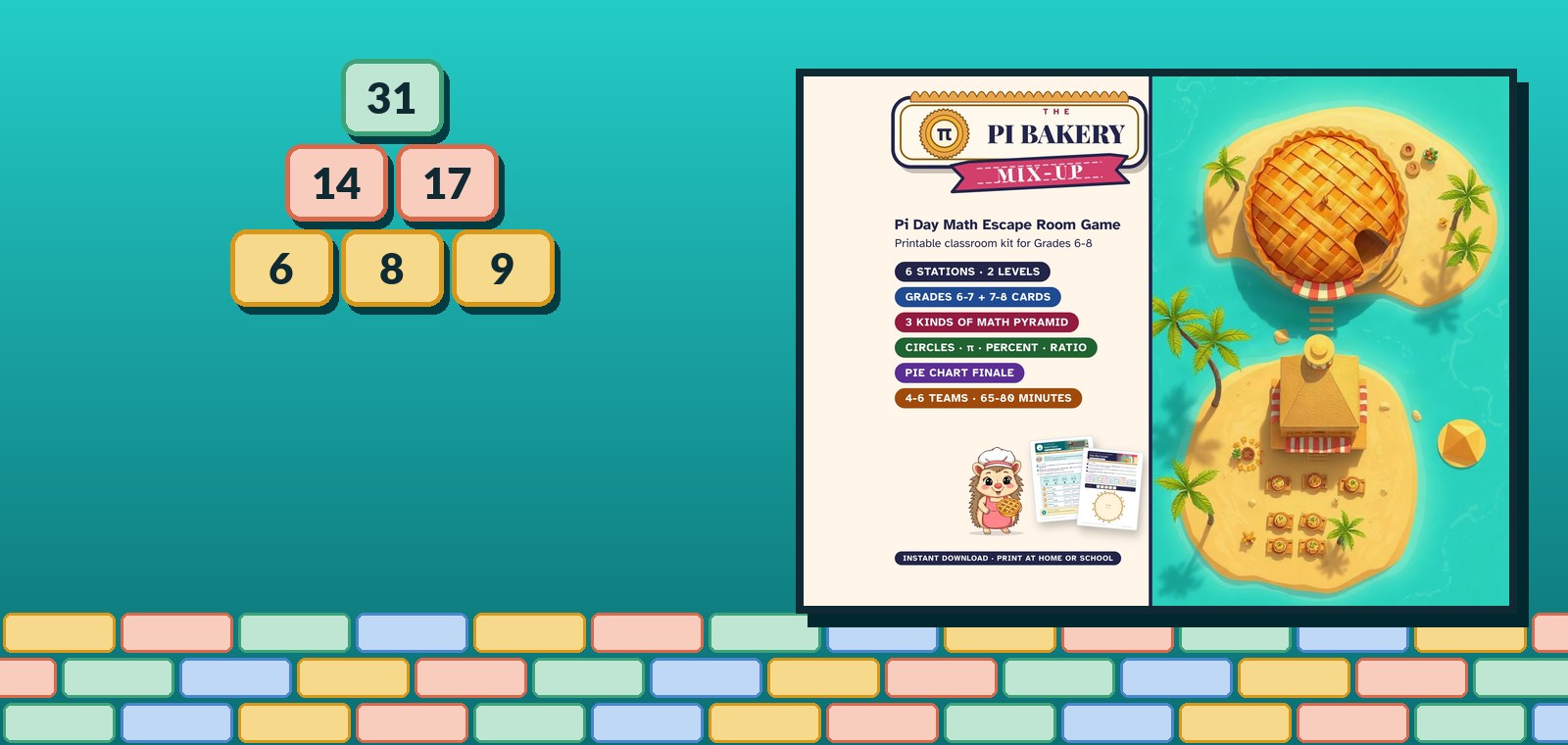
The Pi Bakery Mix-Up: A Pi Day Escape Room Where the Slices Must Add Up to 100
A bakery where every tin has been swapped. A tour of The Pi Bakery Mix-Up, a Pi Day math escape room for Grades 6 to 8, with its video.
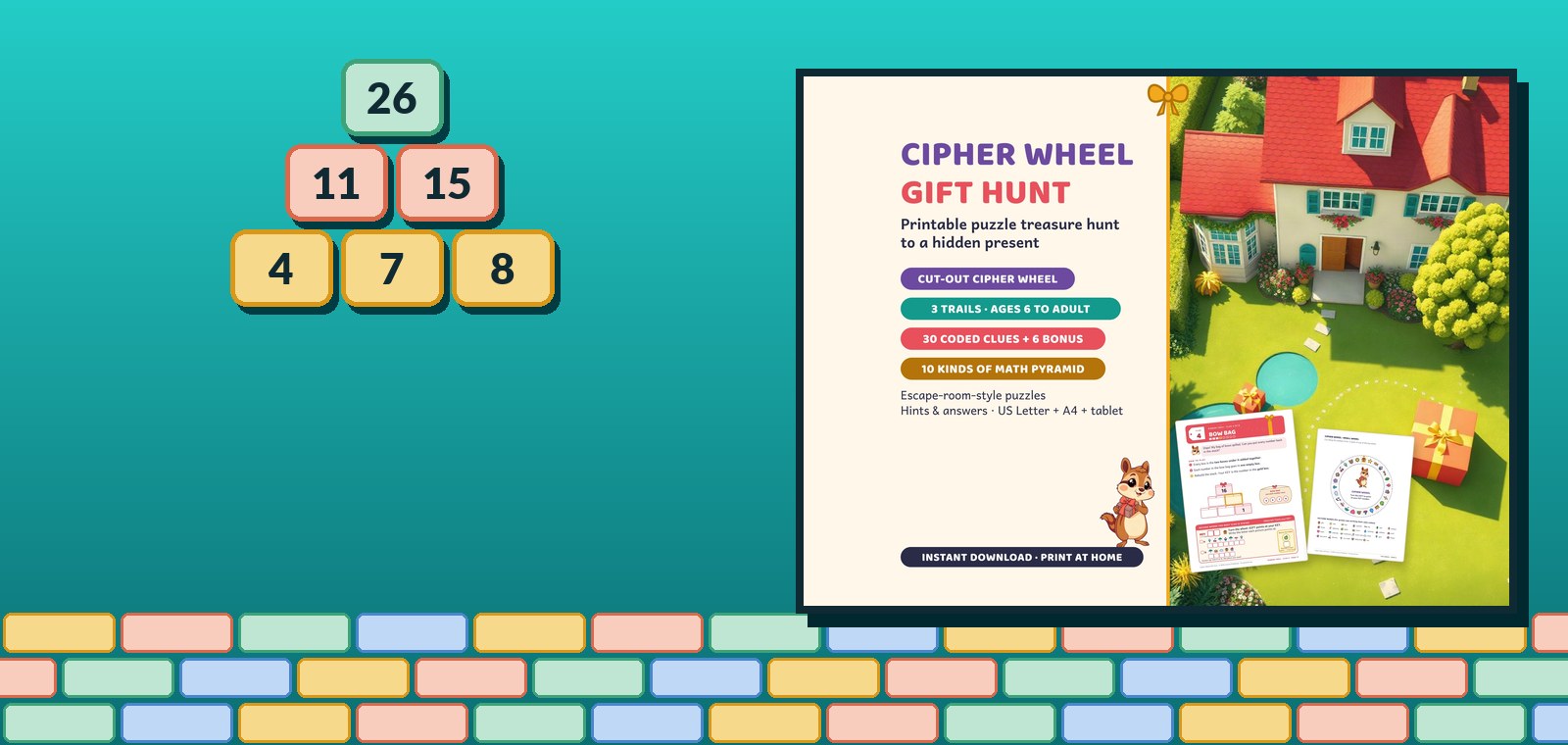
Cipher Wheel Gift Hunt: How a Present Becomes a Puzzle Trail
Solve a puzzle, set a cut-out wheel, decode where the next clue hides. Here is how the Cipher Wheel Gift Hunt works, with its 15-second video.
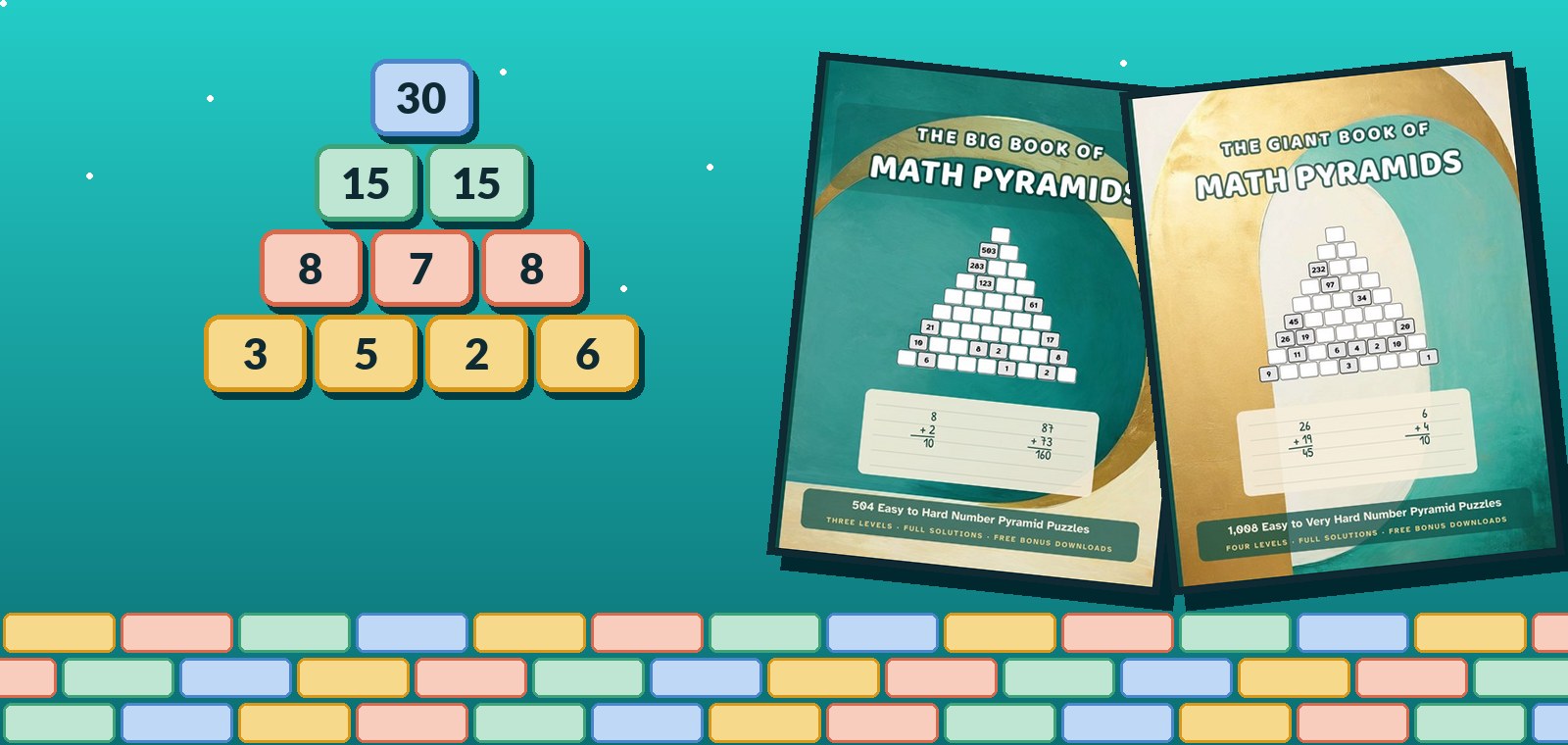
The Top-Brick Shortcut: Why 1, 3, 3, 1 Makes Pyramids Easy
Skip the middle rows. In a four-row pyramid the top is 1, 3, 3 and 1 times the bottom bricks. Why it works, and how to use it.
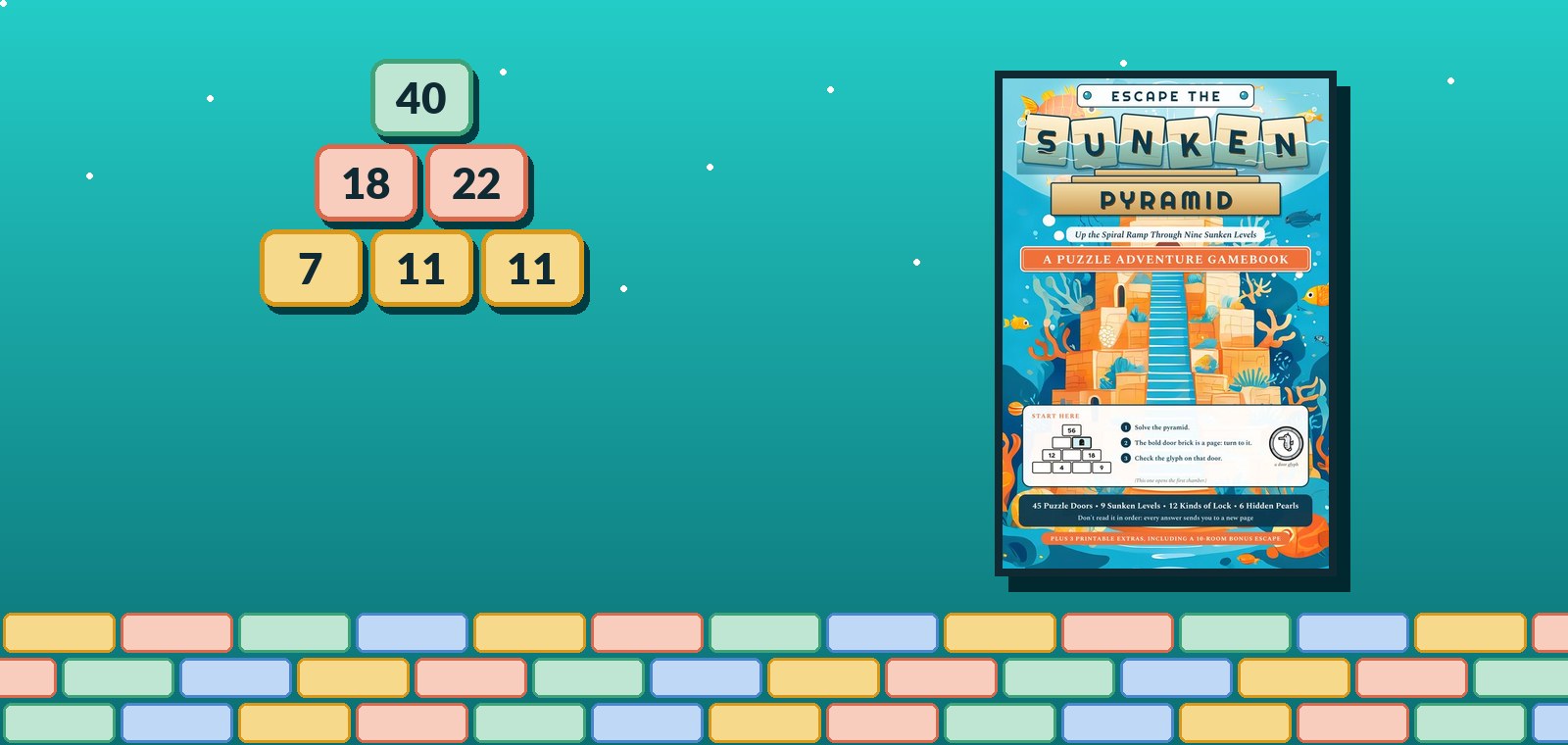
Sonar Echoes: The Buoy Lock That Gives You the Gap
In Escape the Sunken Pyramid some bricks carry a sonar buoy that shows the gap between two bricks. How to use a gap and a sum together.
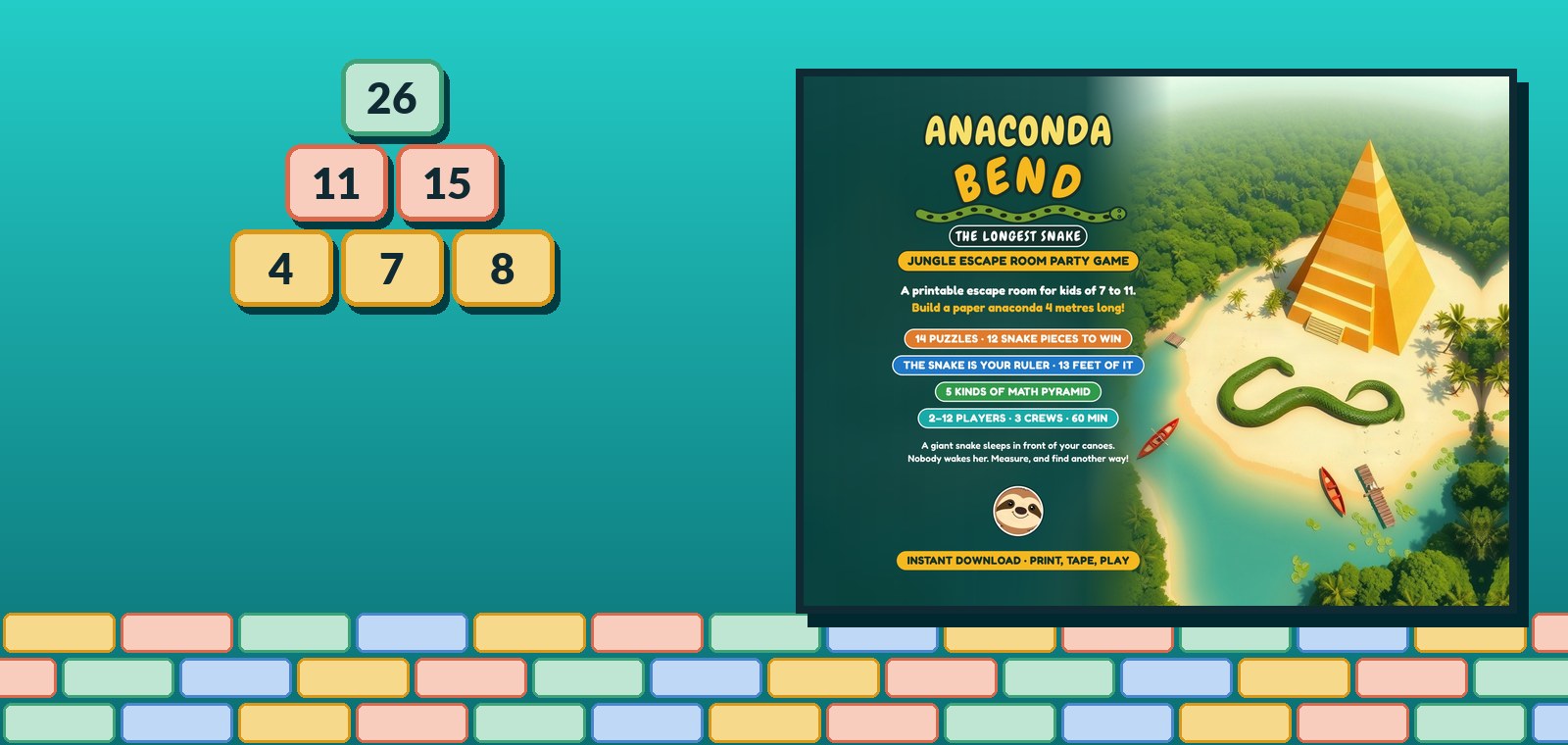
Anaconda Bend: Build a Paper Snake 4 Metres Long, Then Measure With Her
A giant anaconda sleeps across the river, and the only way home is a lock opened by measuring. A tour of the Anaconda Bend kit for ages 7 to 11, with its video.
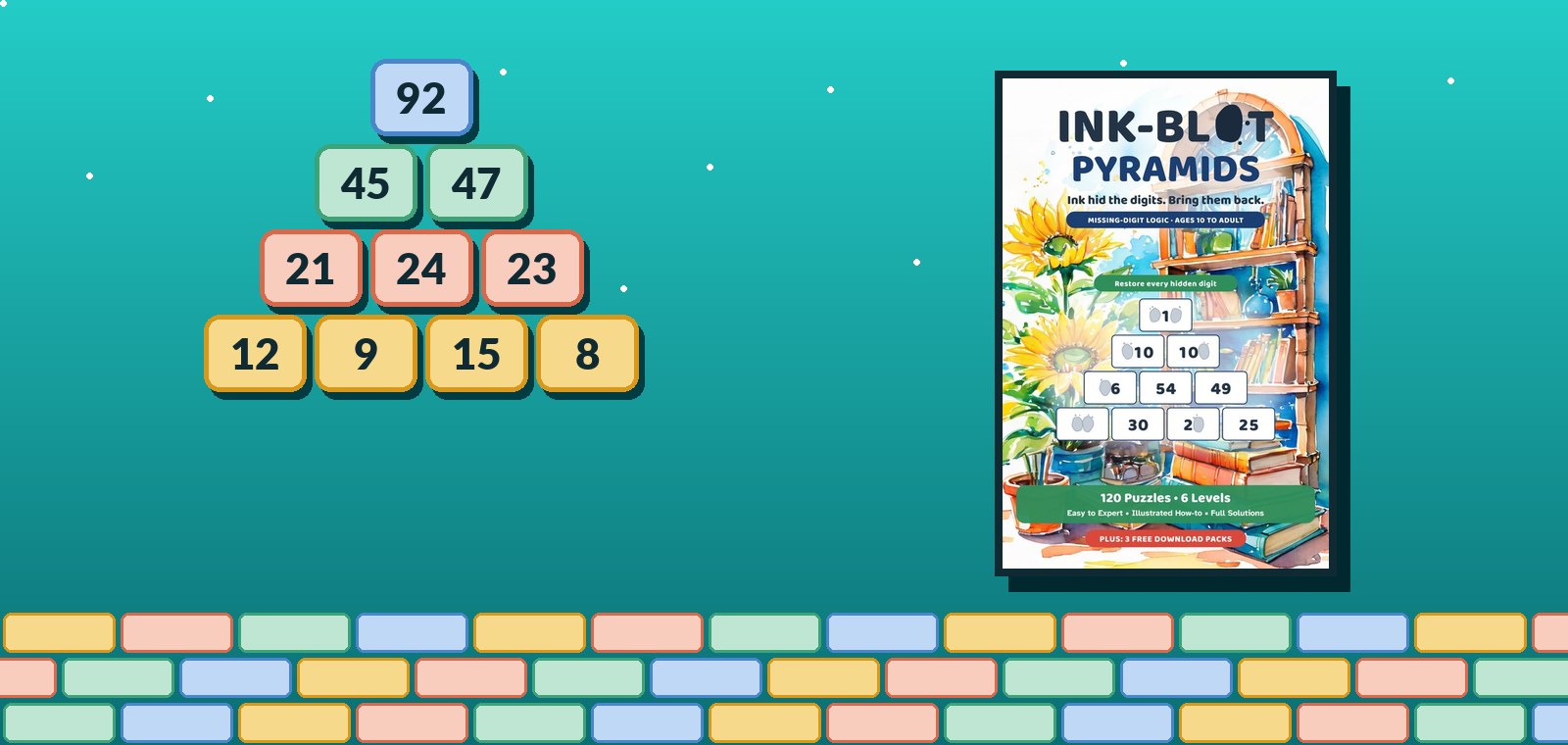
Ink-Blot Pyramids: Find the Digit Under the Ink
Every brick is printed, but ink has covered some of the digits. A worked sample, a 20-second video and a pyramid to try yourself, with the one rule you need to read the hidden digits.
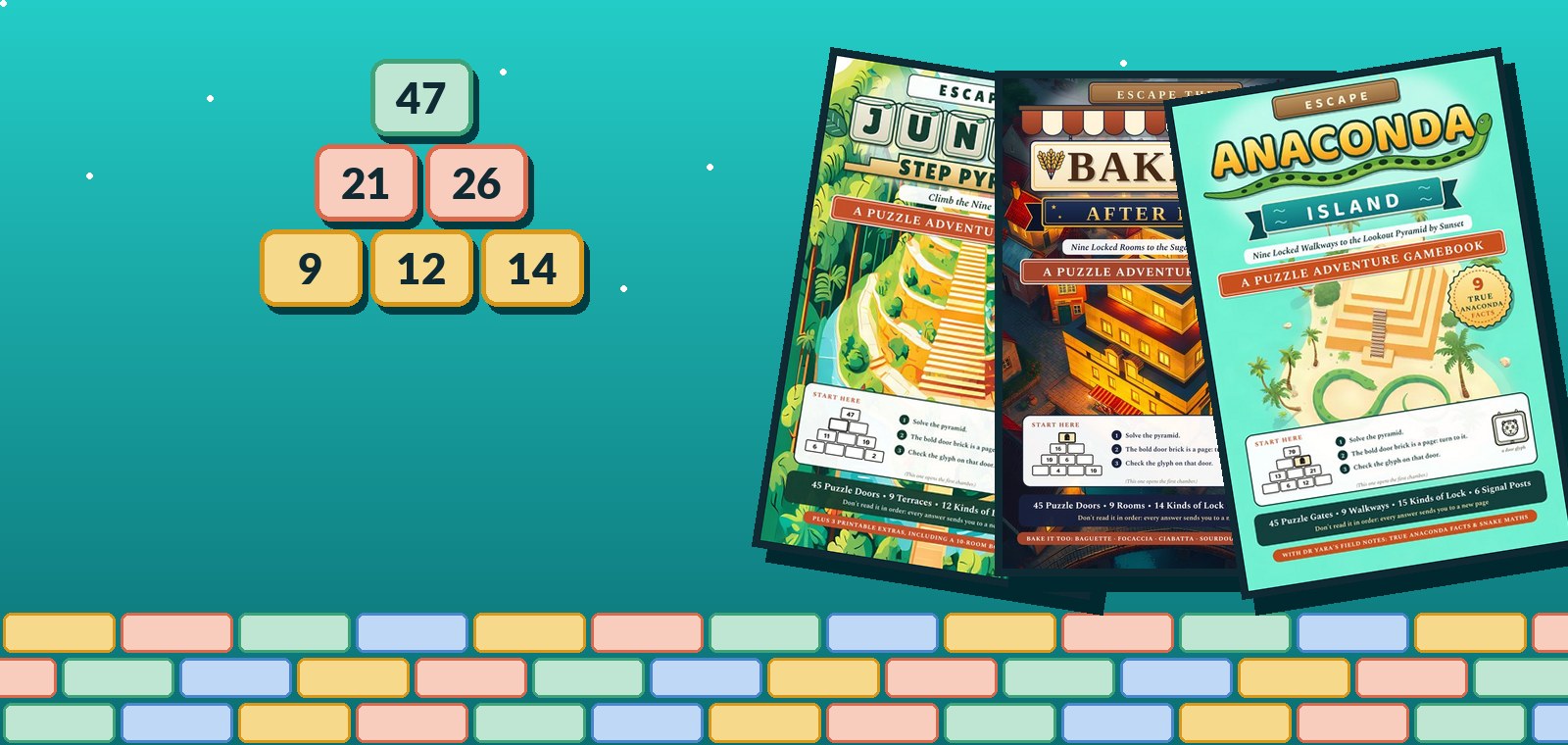
How a Puzzle Adventure Gamebook Works (and Why You Don't Read It in Order)
Solve the puzzle, read the door brick, turn to that page. Here is the whole game of a puzzle adventure gamebook in three moves, with a worked example.
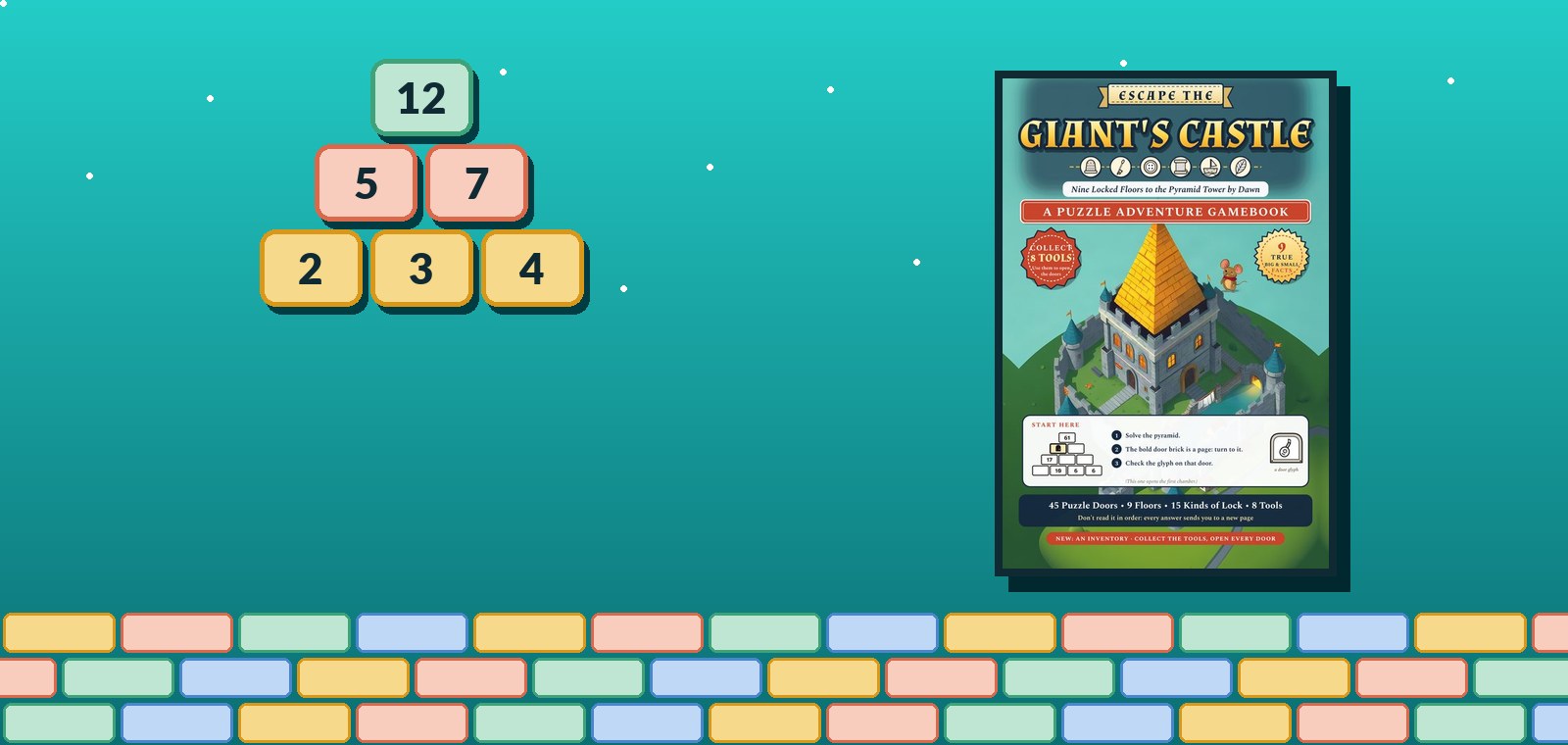
Tool Doors: How the Inventory Works in Escape the Giant's Castle
Six castle mice lend you numbered tools, and som