
Sometimes a brick is missing and there is no way to add up to it. Both bricks next to it are unknown, or they only touch it from above. Then you do what mathematicians do. You give the missing number a name, usually x, and keep going. That is algebra, and it is gentler than it sounds.
The puzzle
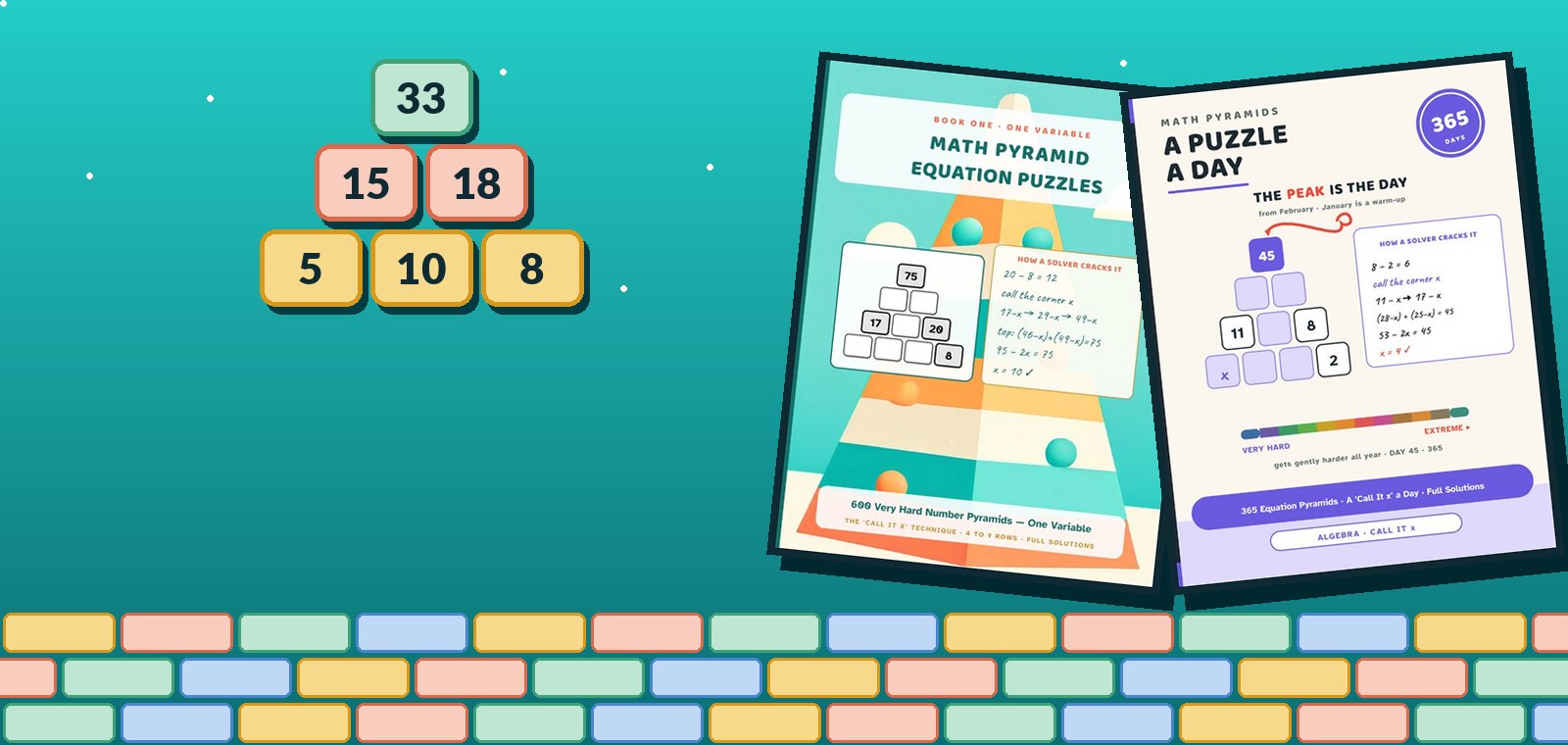
A three-row pyramid. The top is 33. The bottom row is 5, a missing brick and 8. Find the missing brick.
What we know
Top 33, bottom left 5, bottom right 8. The middle of the bottom row is missing. Call it x.
Write the middle row using x
The left middle brick is 5 + x. The right middle brick is x + 8. We don't know their values yet, but we know how they are made.
Write the top using x
The top is the two middle bricks added: (5 + x) + (x + 8) = 13 + 2x. And the top is 33. So 13 + 2x = 33.
Solve for x
Take 13 away from both sides: 2x = 20. Halve both sides: x = 10.
Check by climbing
5 + 10 = 15 and 10 + 8 = 18. Then 15 + 18 = 33, the top we were given. It works.
The four steps, any time
- Name it. Call the missing brick x.
- Build upwards. Write each brick above as a sum, with x in it.
- Match the top. The top is a known number, so you get an equation.
- Undo. Do the opposite of each step on both sides until x stands alone. Then climb the pyramid to check.
Why this is worth learning
The same four steps solve equations in school: name the unknown, write what you know, undo it step by step. A pyramid is a friendly place to practise because you can check the answer yourself by climbing, so you never have to ask whether you are right.
Books mentioned
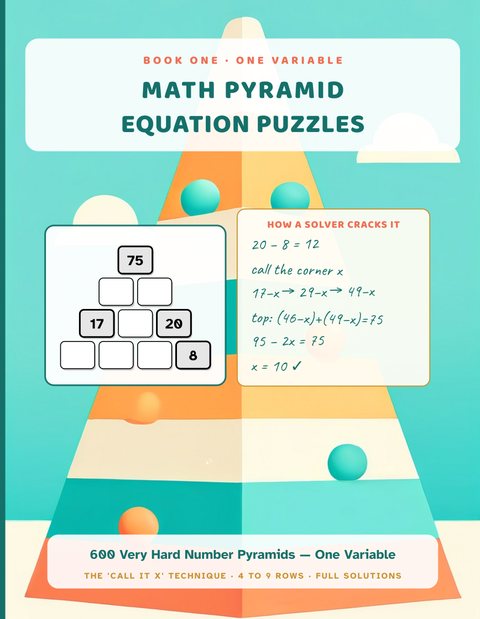
Math Pyramid Equation Puzzles: One Variable
600 very hard number pyramid puzzles with one variable, 4 to 9 rows, with full solutions. The puzzle in this post is a gentle first step; the book climbs far higher.
View on Amazon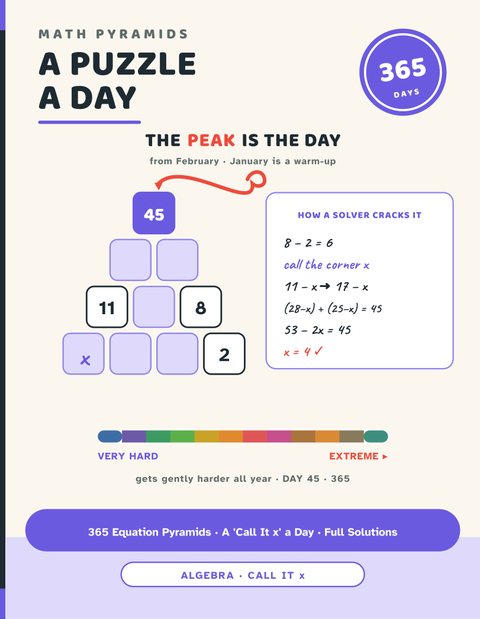
A Puzzle a Day: 365 Equation Pyramids
A 'Call It x' puzzle a day for a year, with full solutions. The idea in this post is exactly what the book trains.
View on AmazonAs an Amazon Associate we earn from qualifying purchases. Cover images are the ones we have on file; the book you receive may show a slightly different cover.
More field notes
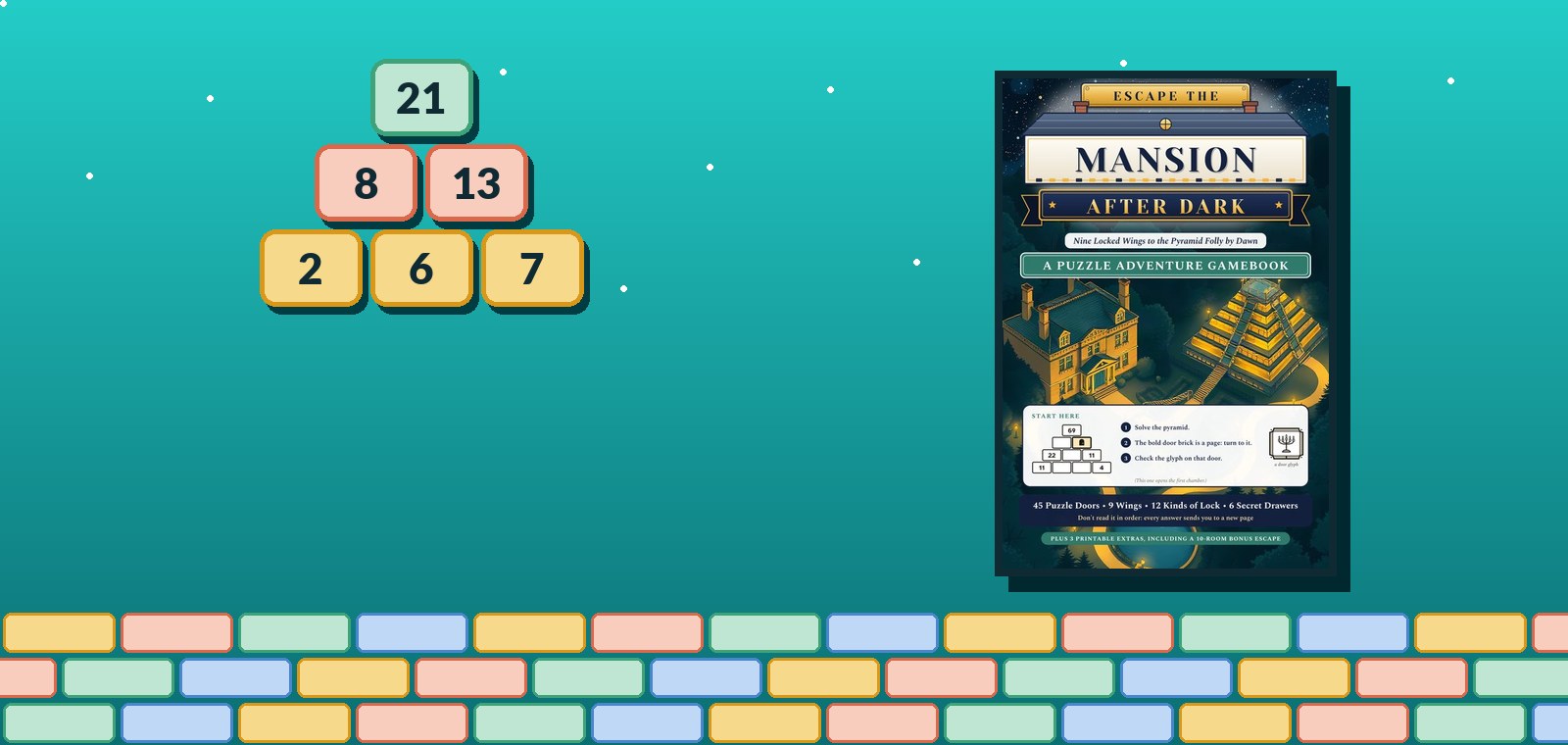
Portrait Pairs: When a Gilt Frame Multiplies Two Bricks
A frame holds two bricks and its plaque shows their product. Try each pair of factors and let the pyramid decide. A lock from Escape the Mansion After Dark.
Negative Numbers in a Pyramid: Moving Left on the Number Line
Adding a negative number is just a step to the left. A number line, a pyramid and a few easy habits make negatives feel ordinary.
Number Bank Pyramids: Place Every Number Once
An empty pyramid and a bank of numbers. Each number is used exactly once. A worked sample, a 20-second video and a pyramid to try yourself, with the one rule you need to read the hidden digits.
Pascal's Triangle: Patterns Hiding in a Number Pyramid
One simple rule builds a triangle full of surprises: doubling rows, counting and triangular numbers, Fibonacci numbers, a fractal and route counting. Each pattern is drawn step by step.
Escape the Museum After Dark: The Story and a Look Inside
Escape the Museum After Dark: the story, how a chamber plays and a look at a real page.
Frost Village Puzzle Hunt: What It Can Do for Players
Frost Village Puzzle Hunt (Ages 7 to 12): what is in it, what players can get out of it and how to run it.
Fossil Camp: Nine Sites, Nine Bone Cards, One Cracking Egg
A dinosaur egg is about to hatch and the nest is behind the Bone Gate. A tour of the Fossil Camp kit for ages 6 to 9, with its video.
Escape the Dwarf Halls: The Story and a Look Inside
Escape the Dwarf Halls: the story, how a chamber plays and a look at a real page.
Escape the Bakery After Dark: The Story and a Look Inside
Escape the Bakery After Dark: the story, how a chamber plays and a look at a real page.
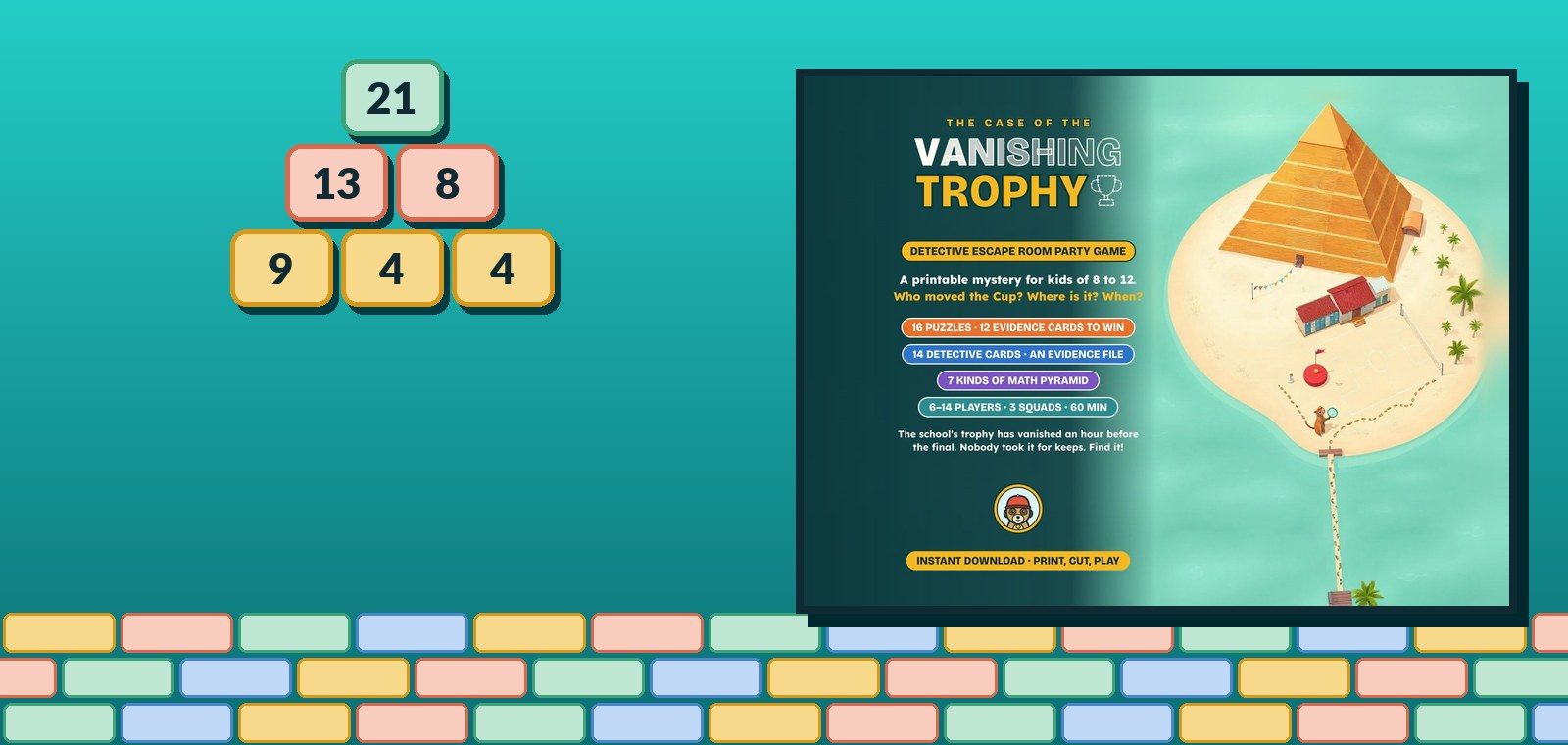
The Case of the Vanishing Trophy: What It Can Do for Players
The Case of the Vanishing Trophy (Ages 8 to 12): what is in it, what players can get out of it and how to run it.
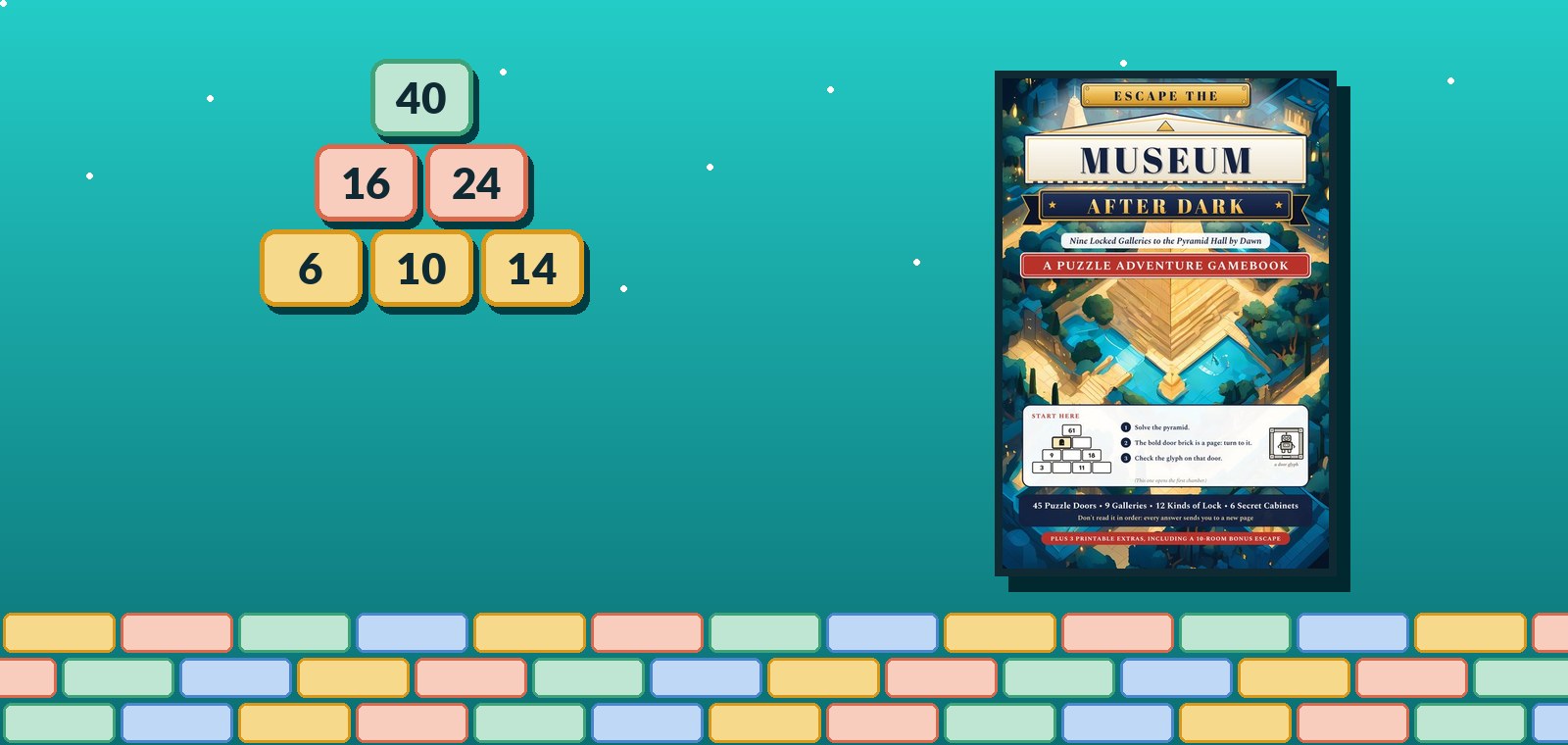
Timeline Rows: Equal Steps Like the Years on a Museum Wall
A timeline row goes up in equal steps, and every row above it is a timeline too, with a step twice as big. A lock from Escape the Museum After Dark.
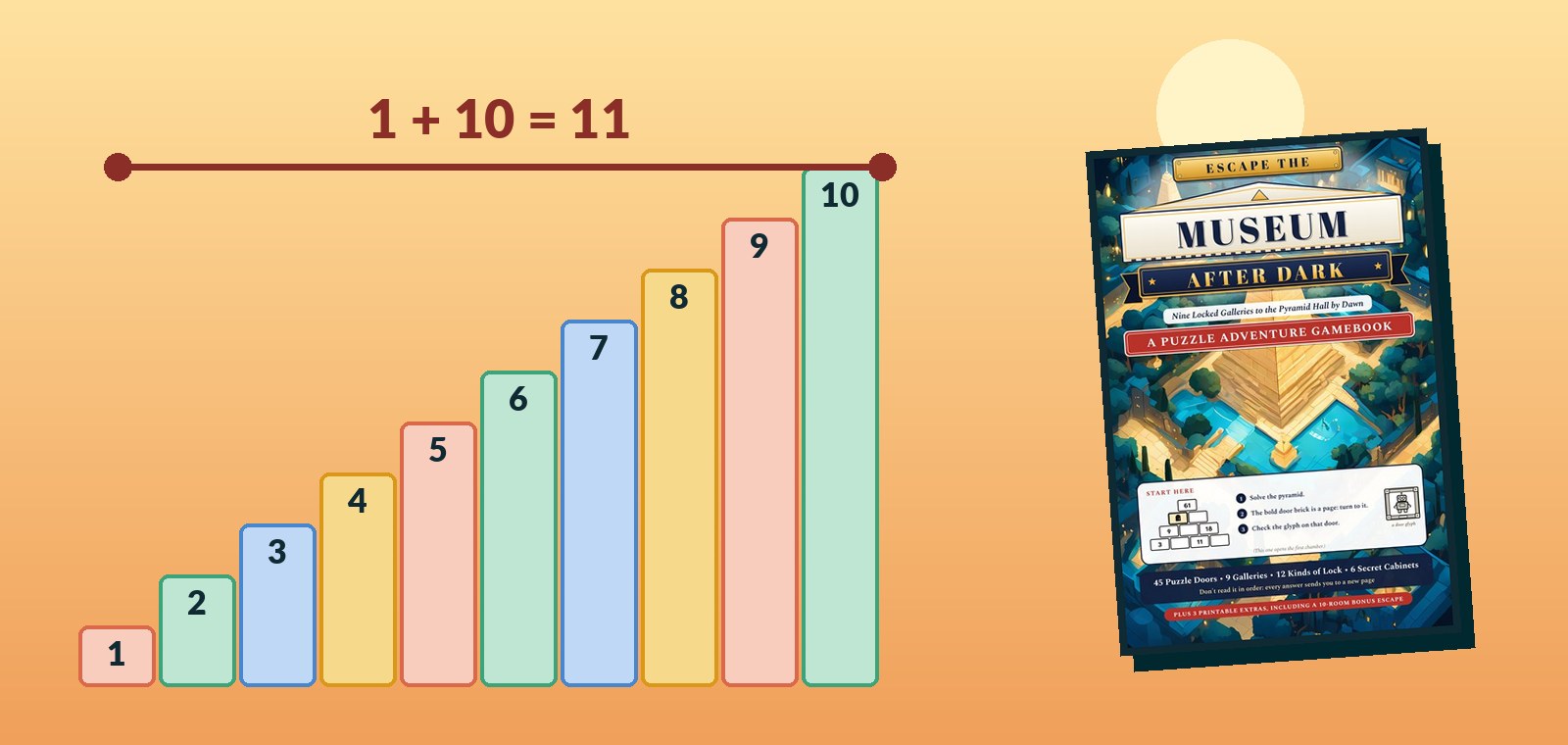
Gauss's Trick: Add 1 to 100 in Ten Seconds
The famous 1 + 2 + 3 + ... + 100 shortcut, why it works (with drawings), what we really know about the story, and the pyramid of bricks hiding inside it.
Creouts Publishing
Puzzle books, printable games and, soon, games you can play here.
As an Amazon Associate we earn from qualifying purchases.
Amazon and Etsy are trademarks of their owners. Creouts is not affiliated with Etsy.