
Build a number pyramid where every brick is the sum of the two bricks above it, with 1s down both edges. That is Pascal's triangle. It looks plain, yet it hides a surprising number of patterns. Here are five, each one drawn so you can check it yourself.
Where it comes from
It is named after Blaise Pascal, who wrote a treatise on it in the 1650s, but it is much older. Commentators on the Sanskrit work Chandas Shastra drew it around the 10th century (Halayudha, around the year 1000), the Persian poet and mathematician Omar Khayyam is linked with it (in Iran it is called the Khayyam triangle), and in China it is called Yang Hui's triangle after a 13th-century mathematician (historical note). Many people found it; Pascal's name stuck in the West.
The rule
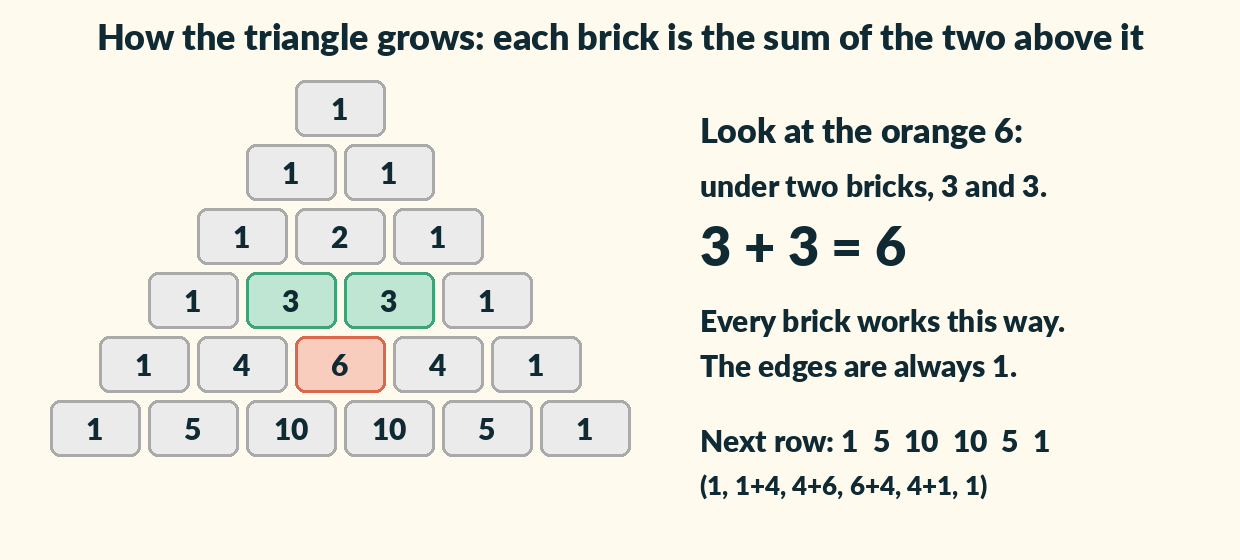
If you have met the first four rows before, it was probably in our post The Top-Brick Shortcut, where 1, 3, 3, 1 tells you how many times each bottom brick counts. This post looks at the whole triangle.
Pattern 1: each row adds up to a power of 2
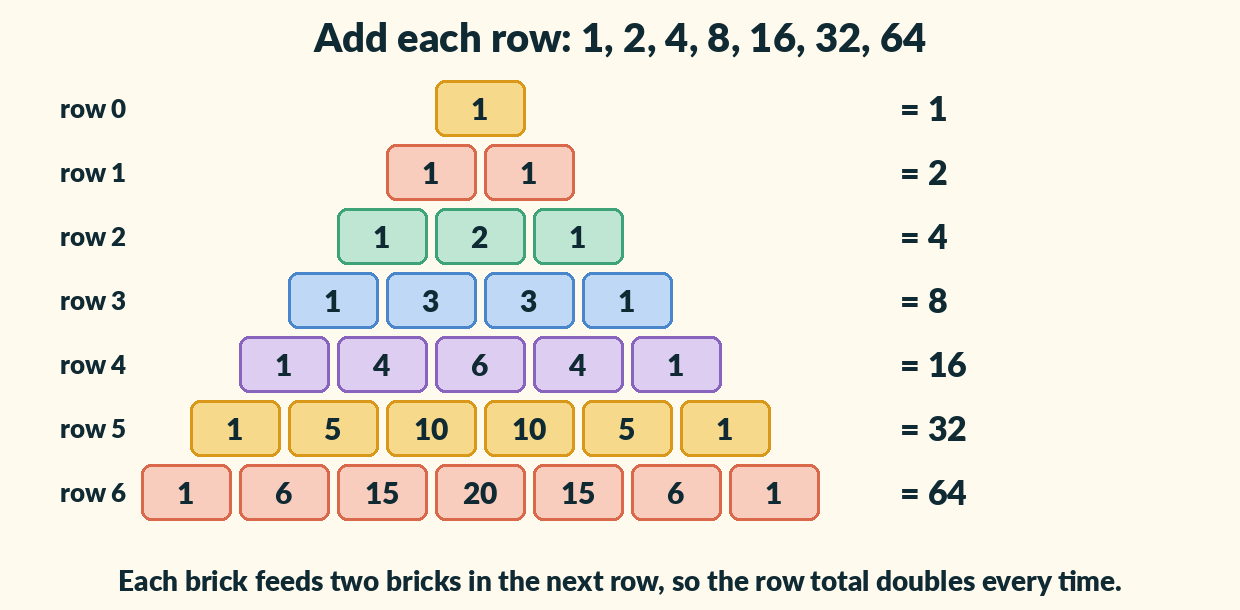
Add row 4: 1 + 4 + 6 + 4 + 1 = 16. The totals go 1, 2, 4, 8, 16, 32, 64. The reason: every brick is passed down into two bricks of the next row, so the next row's total is exactly double.
Pattern 2: counting numbers and triangular numbers
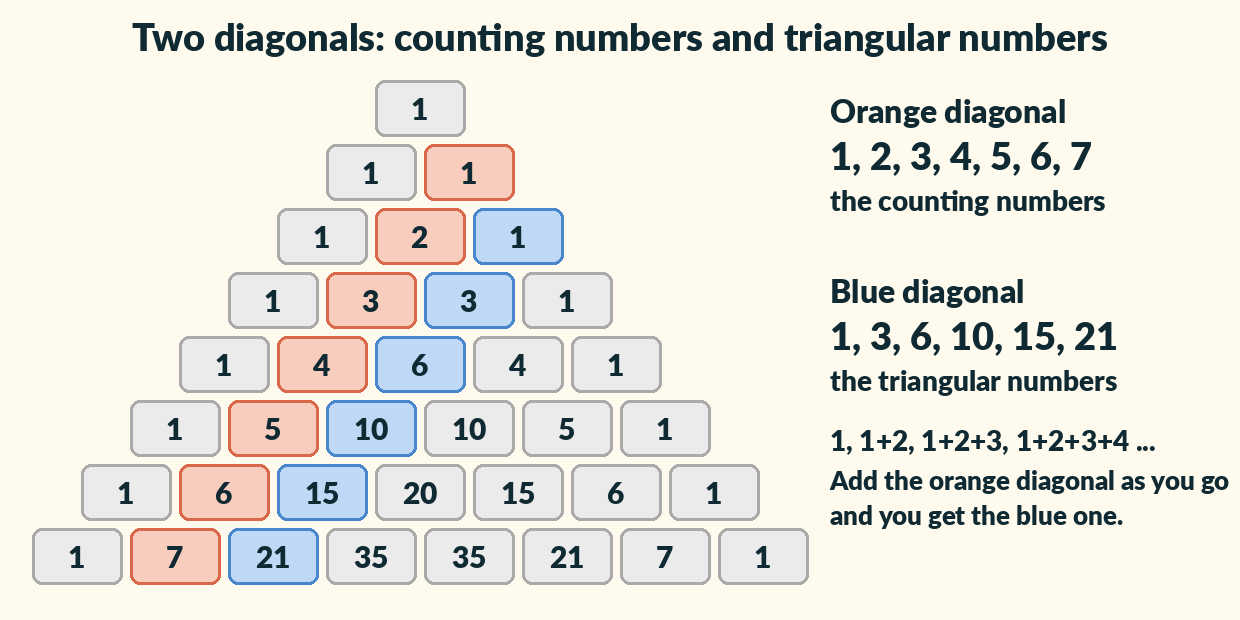
Walk down the second diagonal and you meet 1, 2, 3, 4, 5, 6, 7. The next diagonal gives 1, 3, 6, 10, 15, 21, the triangular numbers: 1, then 1 + 2, then 1 + 2 + 3, and so on. They are the number of dots in a triangle of dots, and the triangle builds them for you, because each blue brick is the blue brick above it plus the orange brick next to that.
Pattern 3: slanted diagonals give Fibonacci numbers
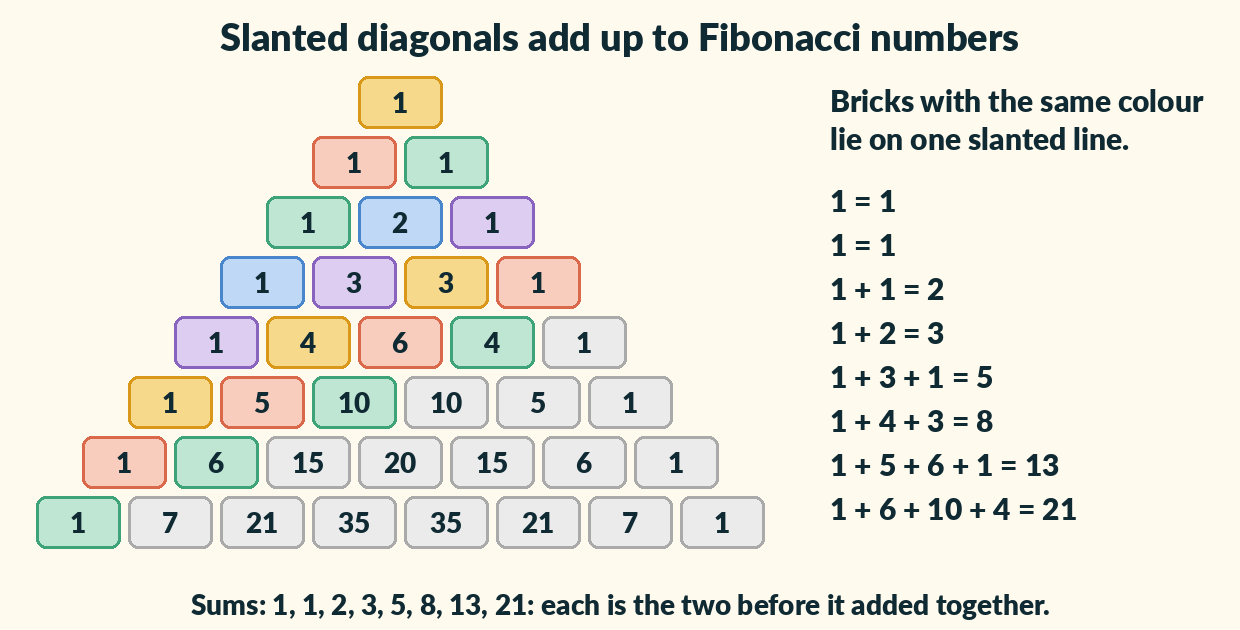
Now cut the triangle on a shallow slant. Take 1 + 5 + 6 + 1 = 13, or 1 + 6 + 10 + 4 = 21. The slanted sums run 1, 1, 2, 3, 5, 8, 13, 21: the Fibonacci numbers, where each number is the two before it added together.
Pattern 4: colour the odd numbers
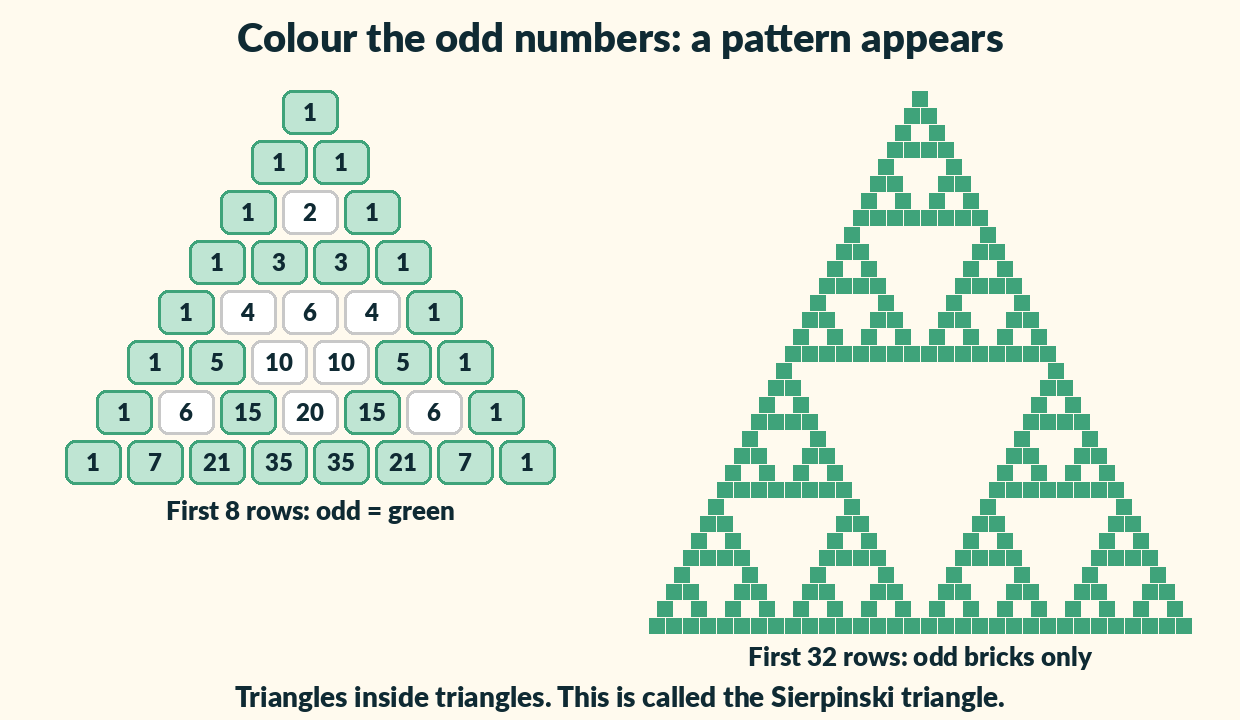
Shade every odd brick and leave the even ones empty. Triangles appear, with smaller triangles of empty bricks inside bigger ones. Carry on for more rows and you approach a famous shape, the Sierpinski triangle (Chalkdust article). You only ever need to know whether a sum of two numbers is odd or even to draw it.
Pattern 5: it counts routes
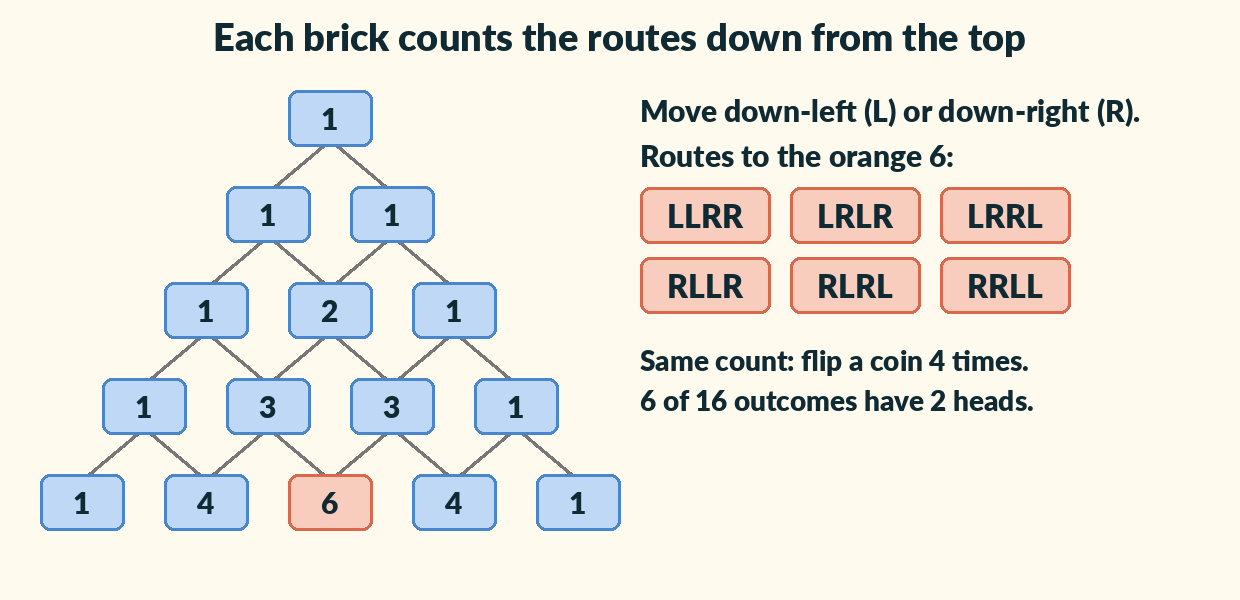
Start at the top and, at each step, go down-left or down-right. The number in a brick is how many different routes reach it. Four steps ending in the orange 6 can be written with two Ls and two Rs in six different orders. Flipping a coin four times works the same way: 6 of the 16 possible results have exactly two heads. That is why this triangle turns up in chances and choices.
Try it yourself
- Write out 10 rows. Check each row total is a power of 2.
- Find the Fibonacci sums on the slanted lines.
- Shade the odd numbers with a pencil and see the triangles appear.
- Pick any brick and count its routes from the top by hand.
Where a puzzle adventure fits
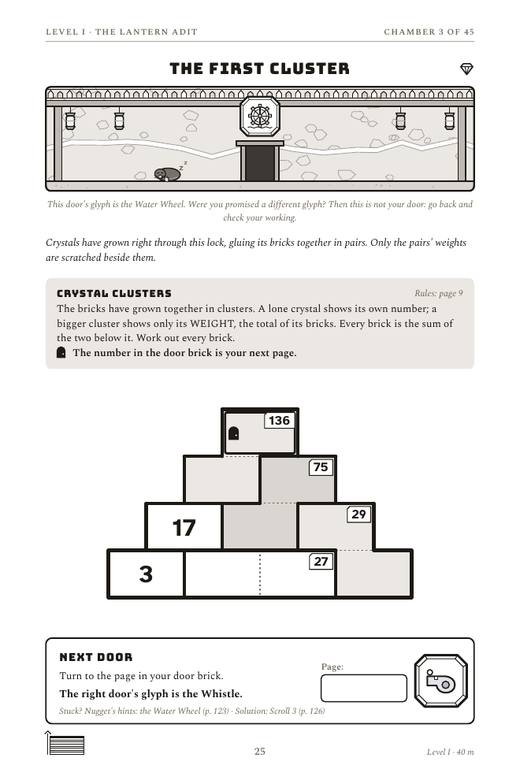
Number pyramids with sums are one of the puzzle kinds in Escape the Pyramid, a puzzle adventure gamebook, so you do not read it in order. Pascal's triangle itself is not in the book: it is the same add-the-two-bricks idea, grown into a pattern. Level 1 (Easy) and Level 3 (Hard) each have 45 locked chambers and 6 treasure rooms, with hints and full answers in the back.
Books mentioned
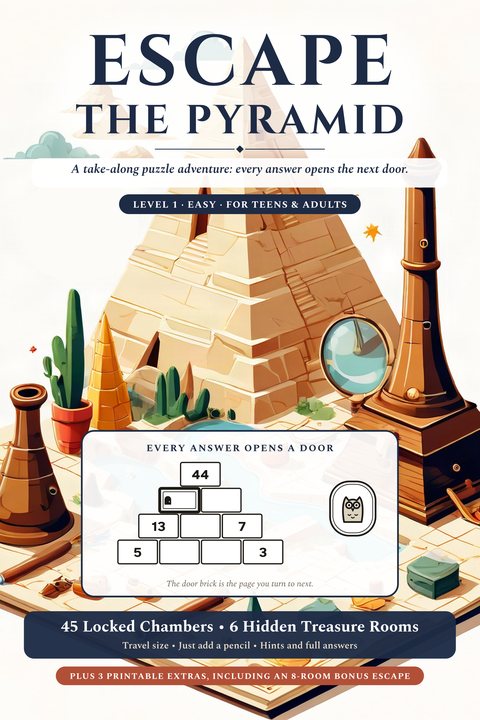
Escape the Pyramid, Level 1 (Easy)
A puzzle adventure gamebook with 45 locked chambers and 6 treasure rooms, hints and full answers in the back.
View on Amazon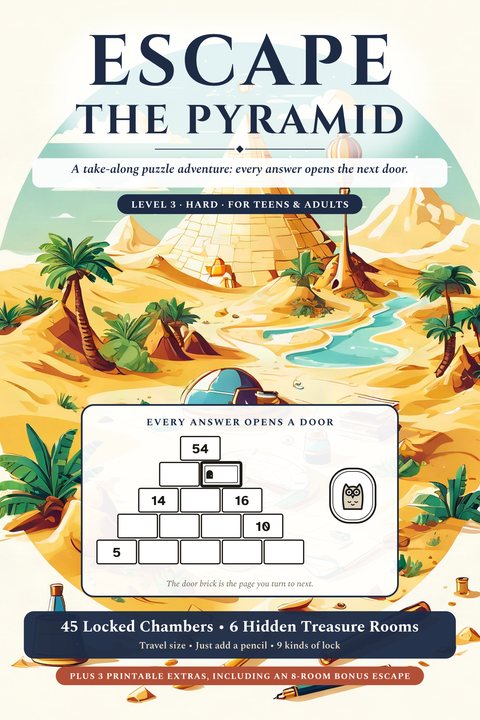
Escape the Pyramid, Level 3 (Hard)
A puzzle adventure gamebook of 45 harder chambers and 6 treasure rooms, with hints and full answers in the back.
View on Amazon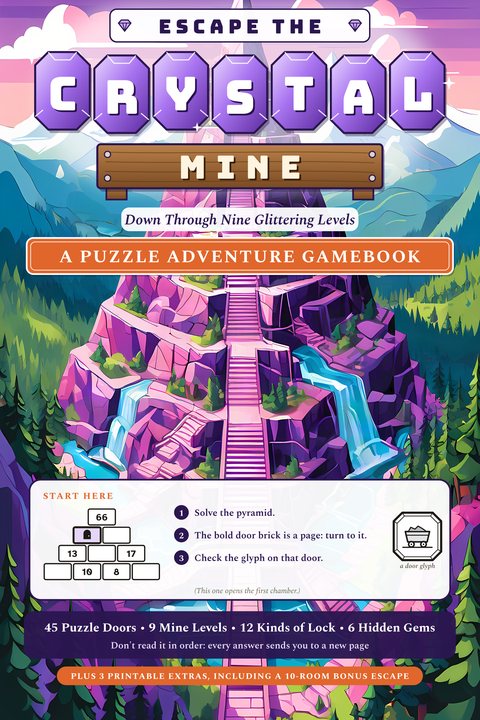
Escape the Crystal Mine
Go down nine glittering levels through 45 locked chambers. A puzzle adventure gamebook.
View on AmazonAs an Amazon Associate we earn from qualifying purchases. Cover images are the ones we have on file; the book you receive may show a slightly different cover.
More field notes
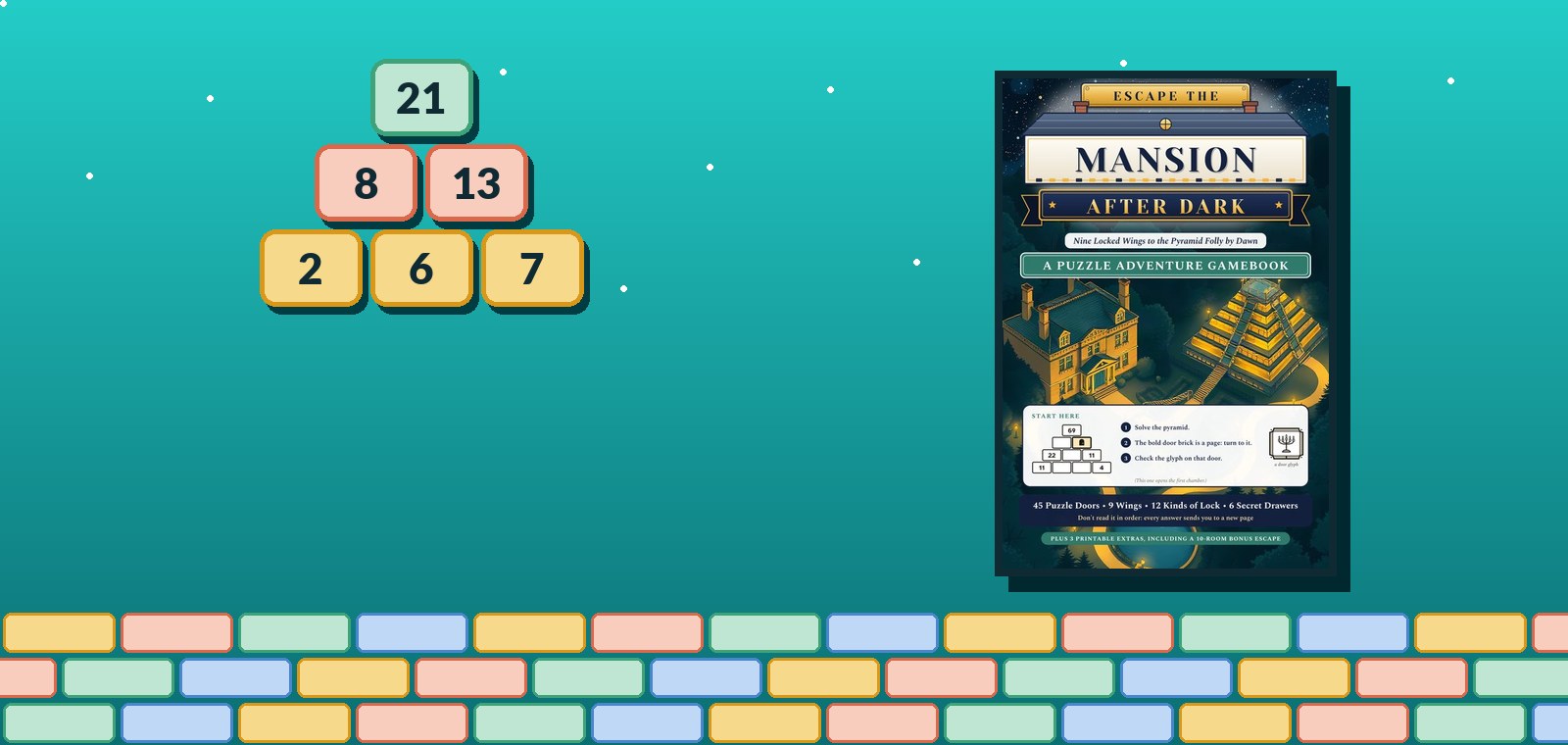
Portrait Pairs: When a Gilt Frame Multiplies Two Bricks
A frame holds two bricks and its plaque shows their product. Try each pair of factors and let the pyramid decide. A lock from Escape the Mansion After Dark.
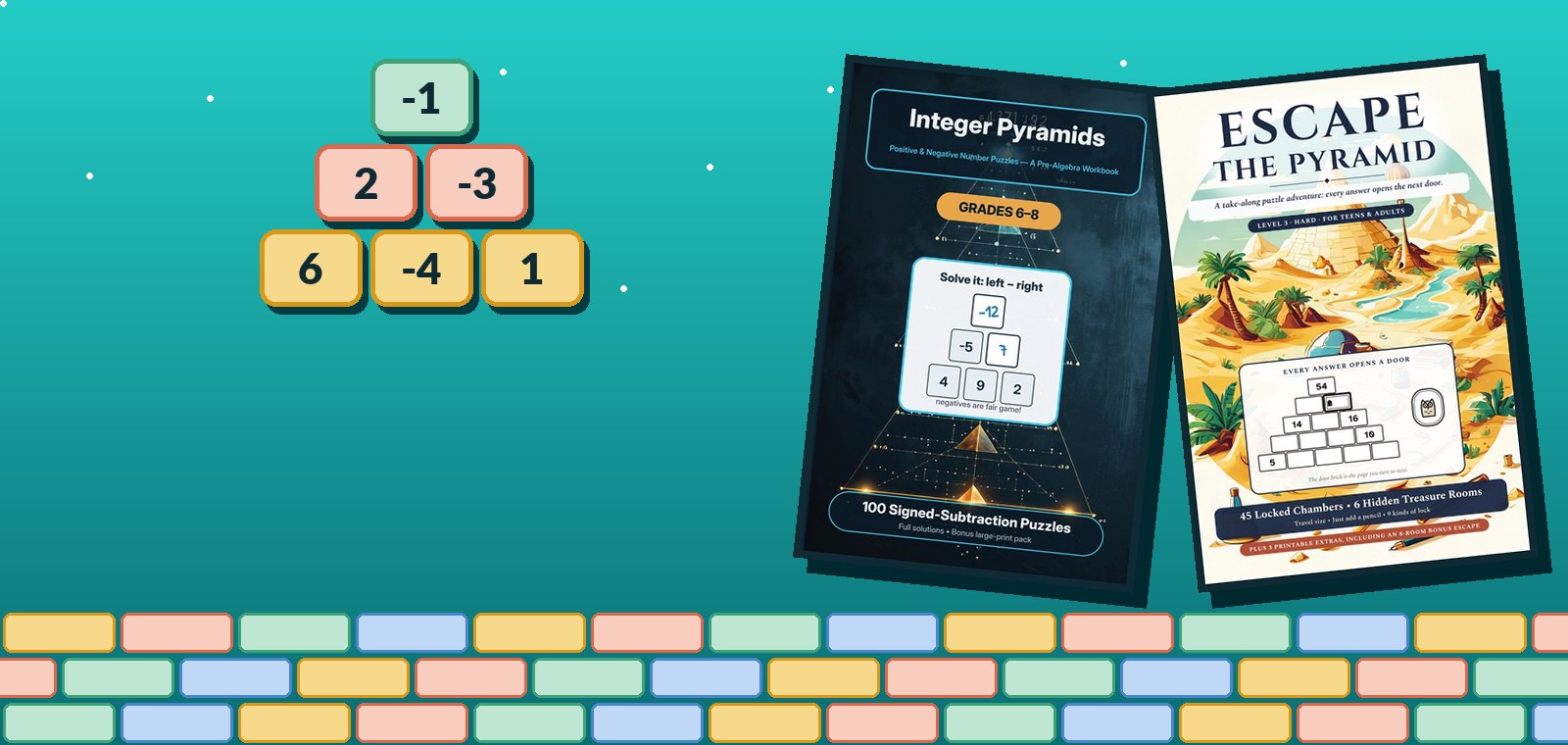
Negative Numbers in a Pyramid: Moving Left on the Number Line
Adding a negative number is just a step to the left. A number line, a pyramid and a few easy habits make negatives feel ordinary.
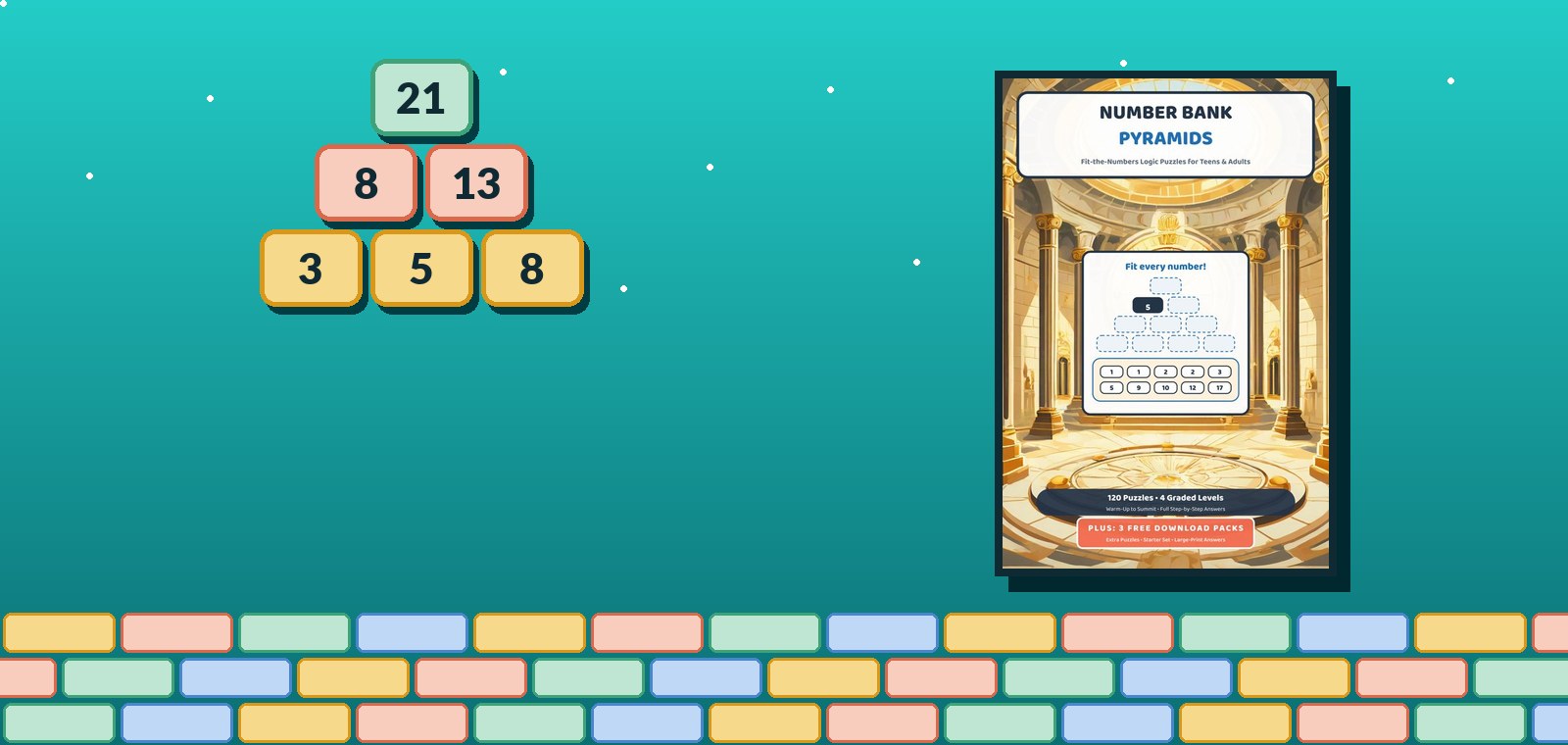
Number Bank Pyramids: Place Every Number Once
An empty pyramid and a bank of numbers. Each number is used exactly once. A worked sample, a 20-second video and a pyramid to try yourself, with the one rule you need to read the hidden digits.
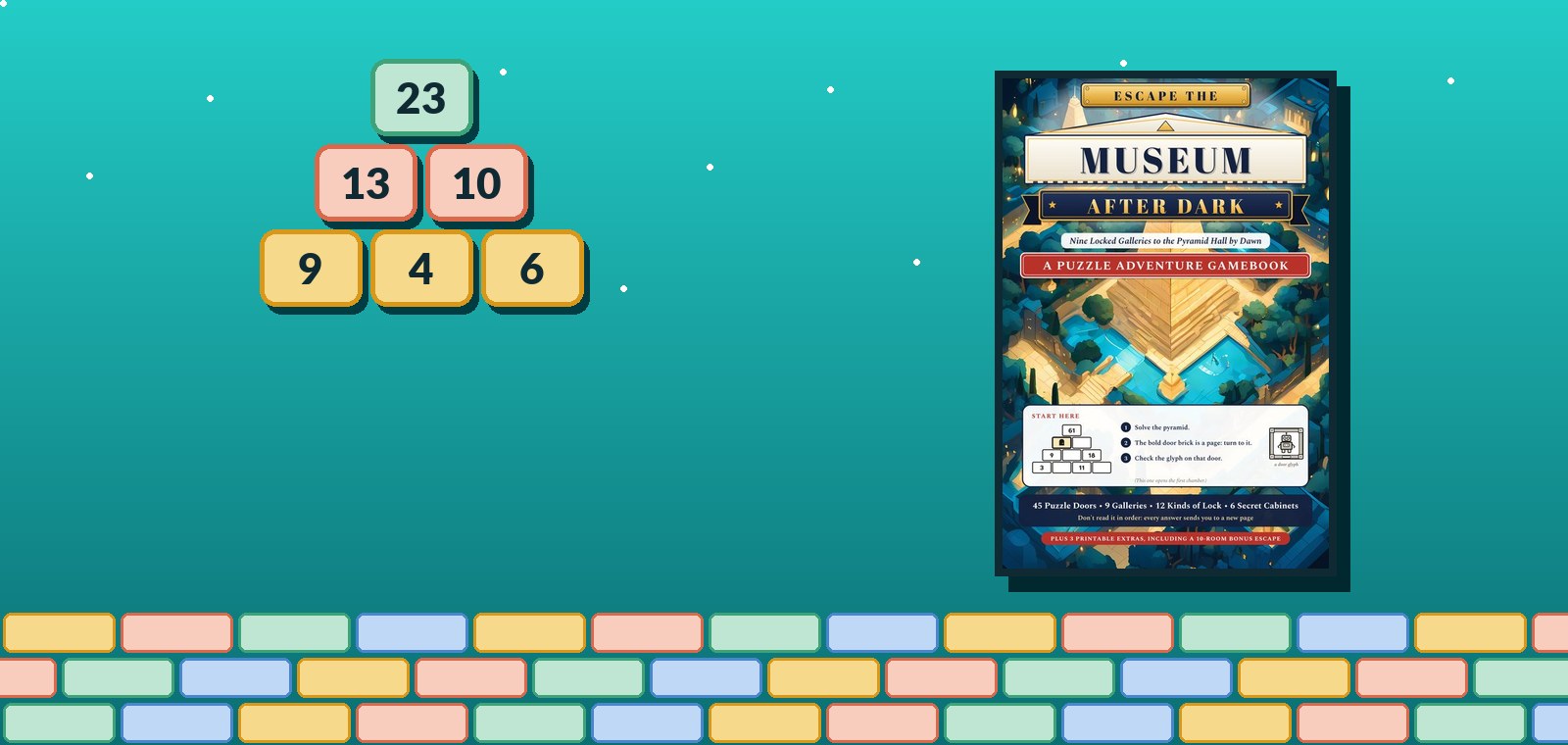
Escape the Museum After Dark: The Story and a Look Inside
Escape the Museum After Dark: the story, how a chamber plays and a look at a real page.
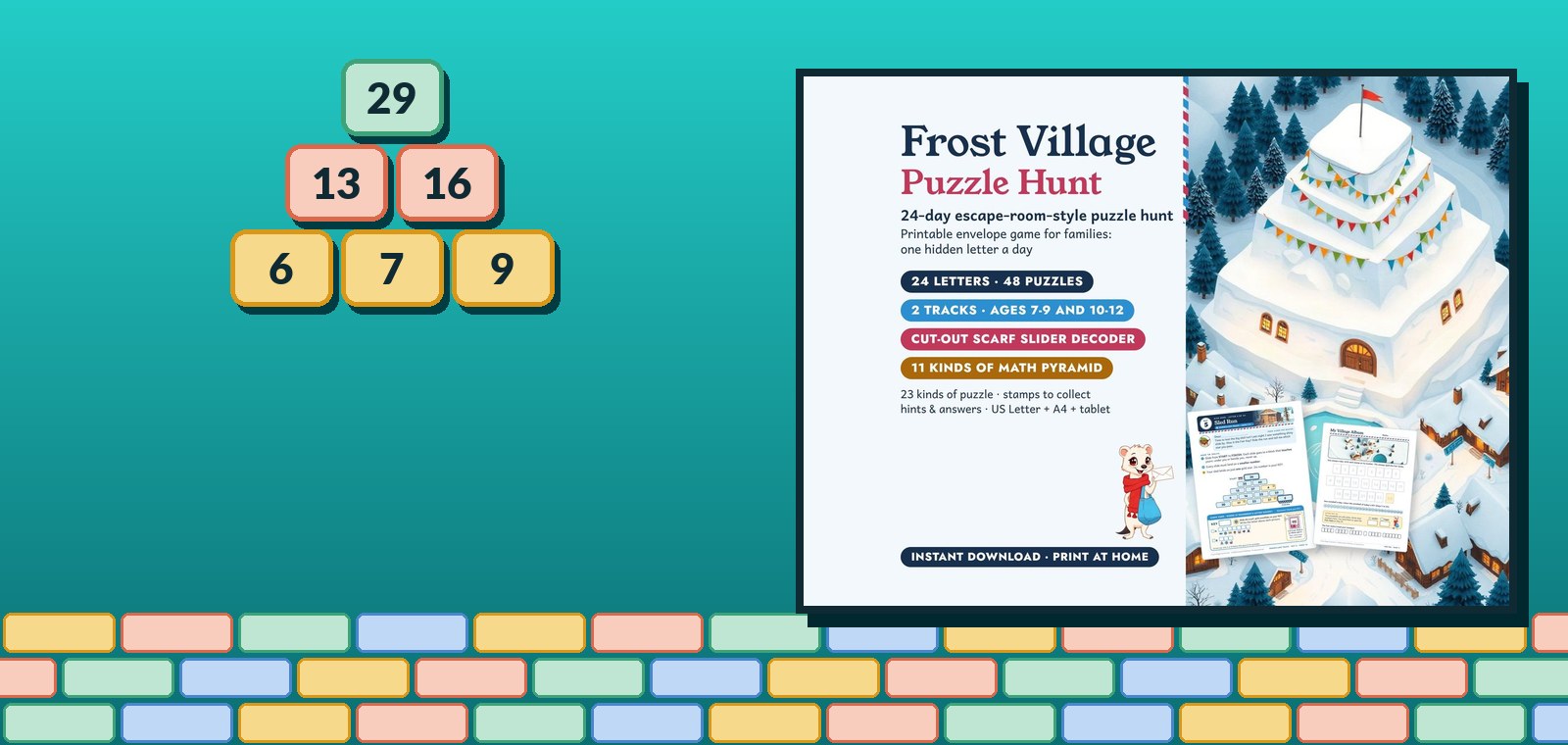
Frost Village Puzzle Hunt: What It Can Do for Players
Frost Village Puzzle Hunt (Ages 7 to 12): what is in it, what players can get out of it and how to run it.
Fossil Camp: Nine Sites, Nine Bone Cards, One Cracking Egg
A dinosaur egg is about to hatch and the nest is behind the Bone Gate. A tour of the Fossil Camp kit for ages 6 to 9, with its video.
Escape the Dwarf Halls: The Story and a Look Inside
Escape the Dwarf Halls: the story, how a chamber plays and a look at a real page.
Call It x: Your First Algebra Is Hiding in a Pyramid
When a brick is missing and the sums don't reach it, name it x. A gentle four-step method, drawn out.
Escape the Bakery After Dark: The Story and a Look Inside
Escape the Bakery After Dark: the story, how a chamber plays and a look at a real page.
The Case of the Vanishing Trophy: What It Can Do for Players
The Case of the Vanishing Trophy (Ages 8 to 12): what is in it, what players can get out of it and how to run it.
Timeline Rows: Equal Steps Like the Years on a Museum Wall
A timeline row goes up in equal steps, and every row above it is a timeline too, with a step twice as big. A lock from Escape the Museum After Dark.
Gauss's Trick: Add 1 to 100 in Ten Seconds
The famous 1 + 2 + 3 + ... + 100 shortcut, why it works (with drawings), what we really know about the story, and the pyramid of bricks hiding inside it.
Creouts Publishing
Puzzle books, printable games and, soon, games you can play here.
As an Amazon Associate we earn from qualifying purchases.
Amazon and Etsy are trademarks of their owners. Creouts is not affiliated with Etsy.