
Everyone knows the advice: "sleep on it." Is there any evidence behind it? There is one well-known experiment, and it is a puzzle story. Here is what it did, what it found, and how far the result goes.
The task with a secret shortcut
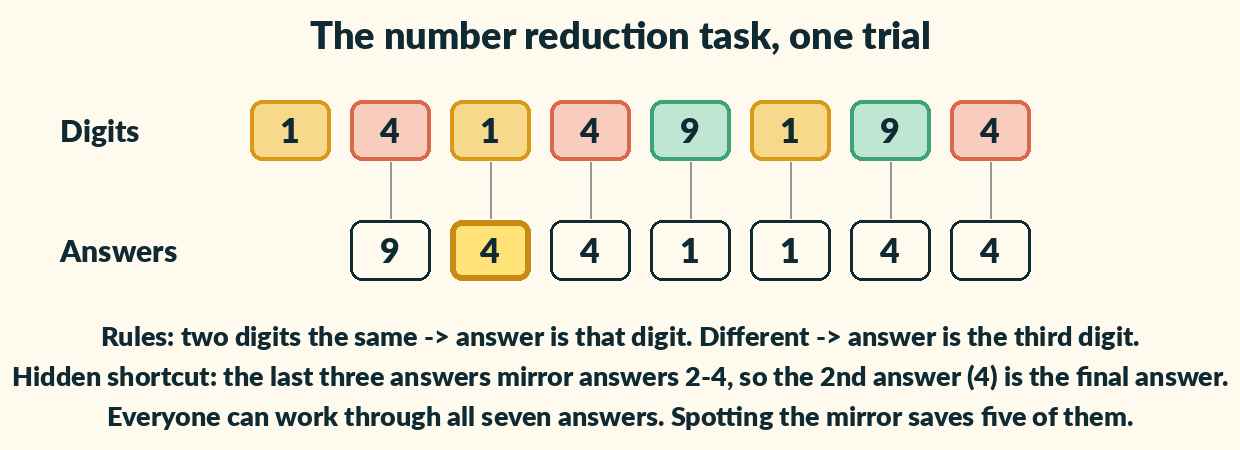
In 2004 Ullrich Wagner, Steffen Gais, Hilde Haider, Rolf Verleger and Jan Born published "Sleep inspires insight" in the journal Nature. People practised a number reduction task. Each trial shows a string of eight digits made of 1s, 4s and 9s. You work left to right with two rules (as described in Stickgold and Walker, 2004):
- If two digits are the same, the answer is that digit.
- If they are different, the answer is the third digit.
- Use each answer together with the next digit, and carry on to the end. The last answer is the solution.
Hidden in the task is a shortcut that the people were never told about. The last three answers always mirror the earlier ones, so the second answer is already the final answer. Someone who notices can stop early. Here is one trial, computed with the rules above:
What the study found
After training, some people slept for a night before trying again, and others stayed awake for the same time. The abstract reports that more than twice as many people gained insight into the hidden rule after sleep as after wakefulness, whatever the time of day. In the summary by Stickgold and Walker, 59% of the people who slept discovered the shortcut the next morning, while no more than 25% did in any of four comparison groups who did not sleep.
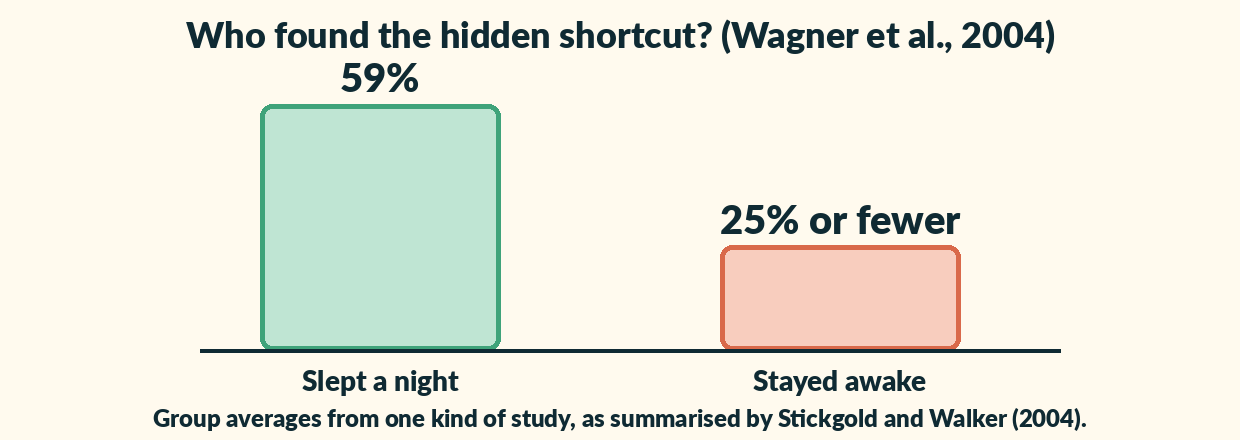
Two details are worth noticing. The people were not told a shortcut existed, and training came first: the sleep effect was seen after they had practised the task.
The same idea on a number pyramid
In a sum pyramid, each brick is the total of the two bricks under it. The long way fills every brick. But some pyramids hide a pattern. Take the bottom row 3, 5, 7, 9, 11, which goes up by 2 each time. Filling every brick gives a top of 112. Because the row is evenly spaced, the top is always 16 times the middle brick: 16 x 7 = 112. We checked it by computing the whole pyramid first.
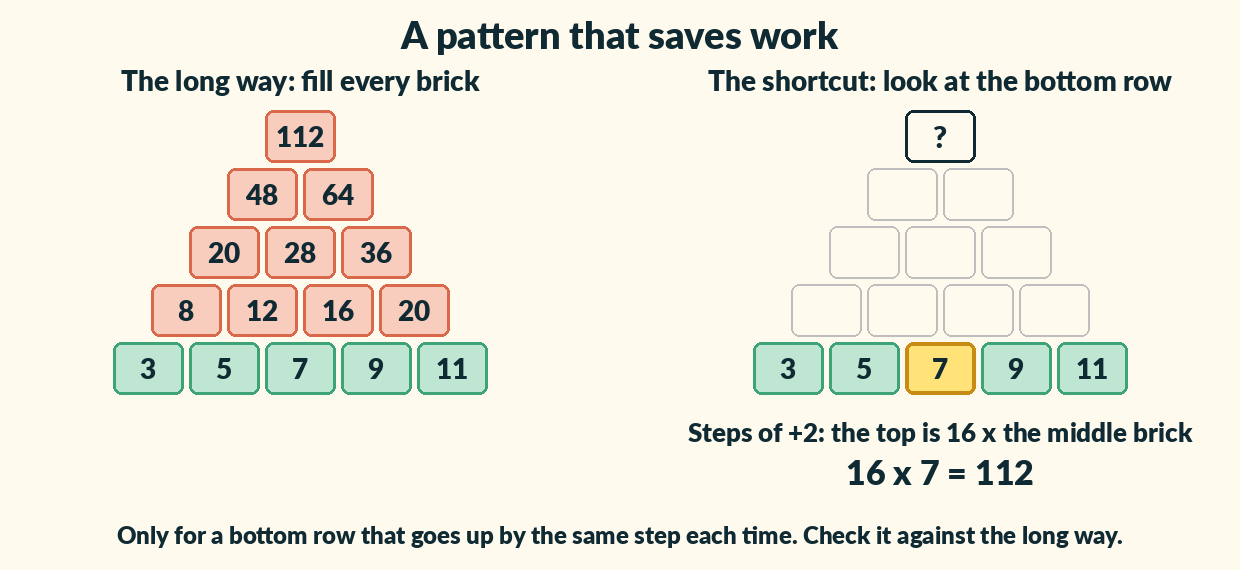
The shortcut only works for evenly spaced bottom rows, so always test a pattern you think you see against the long way once. A pattern you have noticed but not checked is only a guess.
Modest tips
- Do the work first. In the study, insight followed practice. Give the puzzle a real try before you leave it.
- Stop when you are stuck. Going round in circles tires you out. Write down where you got to.
- Come back the next day. Look at your notes with fresh eyes, and ask whether the numbers repeat or mirror each other.
- Check the pattern. Try it on one more example before you trust it.
- Do not stay up late over a puzzle. Leaving it until tomorrow is fine.
Where a puzzle adventure fits
Escape the Pyramid, Level 1 and Escape the Labyrinth are puzzle adventure gamebooks, so you do not read them in order: each chamber's answer is the page you turn to next. Both have 45 locked chambers. The Pyramid book also has 6 treasure rooms, and hints and full answers sit in the back. Number-pyramid locks are the core, and spotting a pattern in the bottom row is the sort of move they reward. They are puzzle books, not a course and not a sleep programme. They simply make it easy to leave a lock, go to another chamber, and return later.
Books mentioned
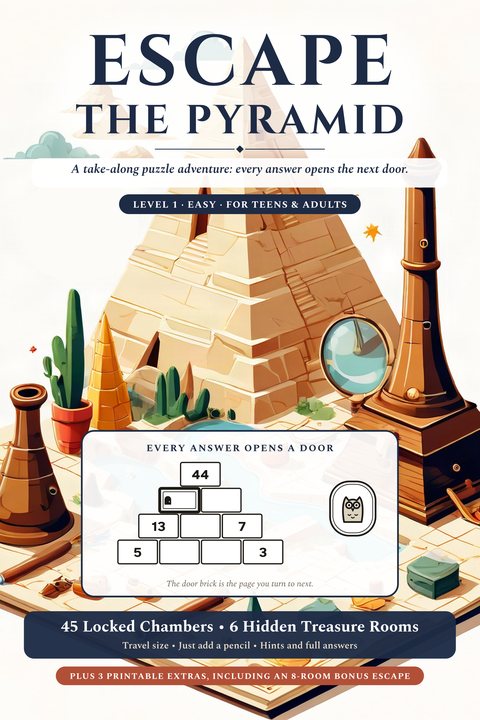
Escape the Pyramid, Level 1 (Easy)
A puzzle adventure gamebook with 45 locked chambers and 6 treasure rooms, hints and full answers in the back.
View on Amazon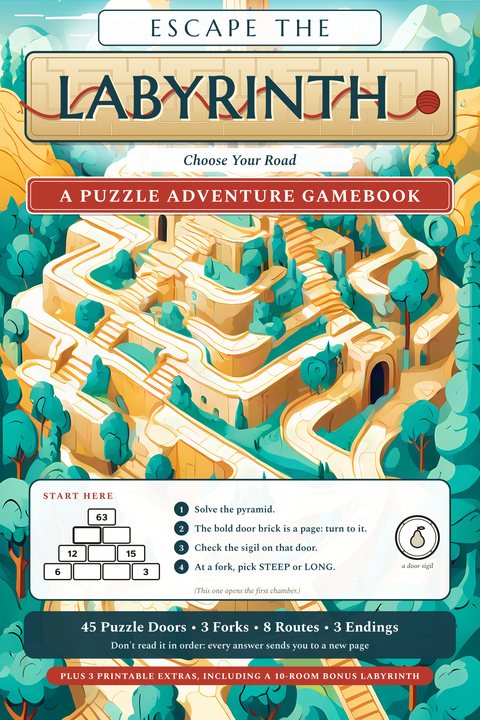
Escape the Labyrinth
A puzzle adventure gamebook with 45 locked chambers. You choose your road, and the puzzle kind changes from door to door.
View on Amazon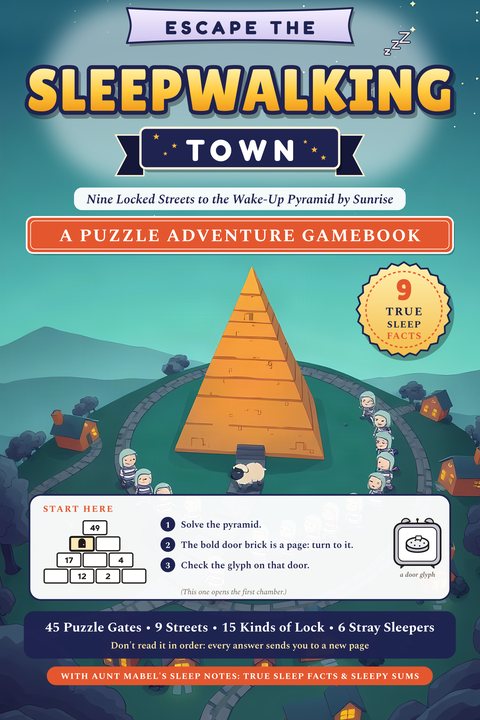
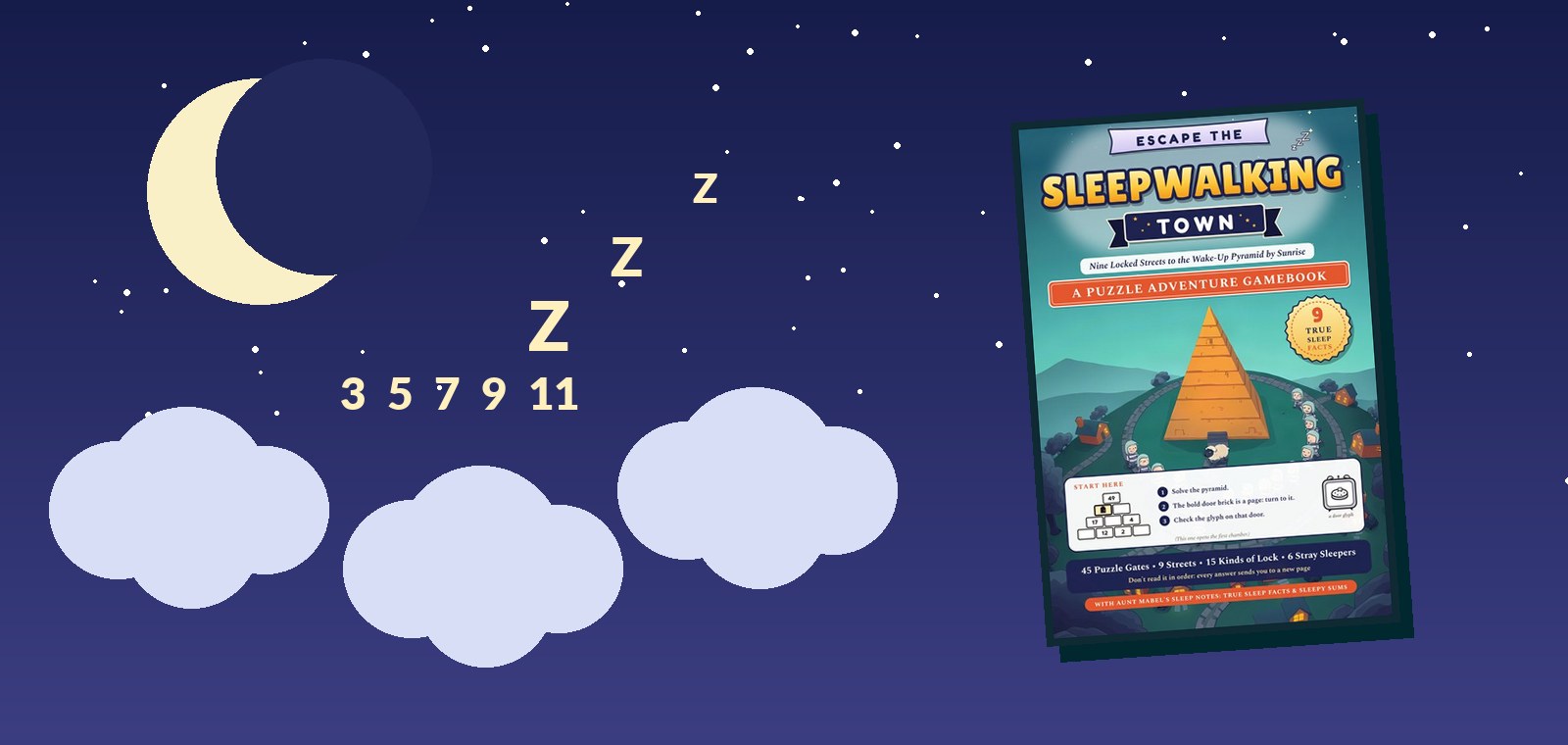
Escape the Sleepwalking Town
A comic puzzle adventure gamebook: climb nine locked streets to the Wake-Up Pyramid, with true sleep facts.
View on AmazonAs an Amazon Associate we earn from qualifying purchases. Cover images are the ones we have on file; the book you receive may show a slightly different cover.
More field notes
Ice Shards: Rebuild a Shattered Pyramid From Its Pieces
The pyramid has shattered. Fit each shard back into the gaps, the way up it lies, until every brick is the sum of the two below it.
Symbol Pyramids: What Is a Star Worth?
The bottom row is pictures. Every picture hides a number, and the same picture is always the same number. A worked sample, a 20-second video and a pyramid to try yourself, with the one rule you need to read the hidden digits.
Seeing Numbers Without Counting: Subitizing and Ten-Frames
What 'subitizing' means, what the researchers say about it, and five ten-minute games with dice, dominoes and ten-frames.
Escape the Sunken Pyramid: The Story and a Look Inside
Escape the Sunken Pyramid: the story, how a chamber plays and a look at a real page.
The Hundred Gumballs Count-Up: What It Can Do for Players
The Hundred Gumballs Count-Up (Grades 1 and 2): what is in it, what players can get out of it and how to run it.
Snow Owl Ice Camp: A Math Game That Opens in Your Browser, Offline
230 number pyramids, twelve huts and twelve lanterns to relight, as an offline browser game plus a printable PDF. How it works, and what it needs.
Kitchen Chemistry: A Free Periodic Table and Safe Experiments to Try at Home
A free color periodic table, 12 element spotlights and 12 kitchen experiments with safety notes. We walk through the red cabbage color test step by step.
Escape the Mansion After Dark: The Story and a Look Inside
Escape the Mansion After Dark: the story, how a chamber plays and a look at a real page.
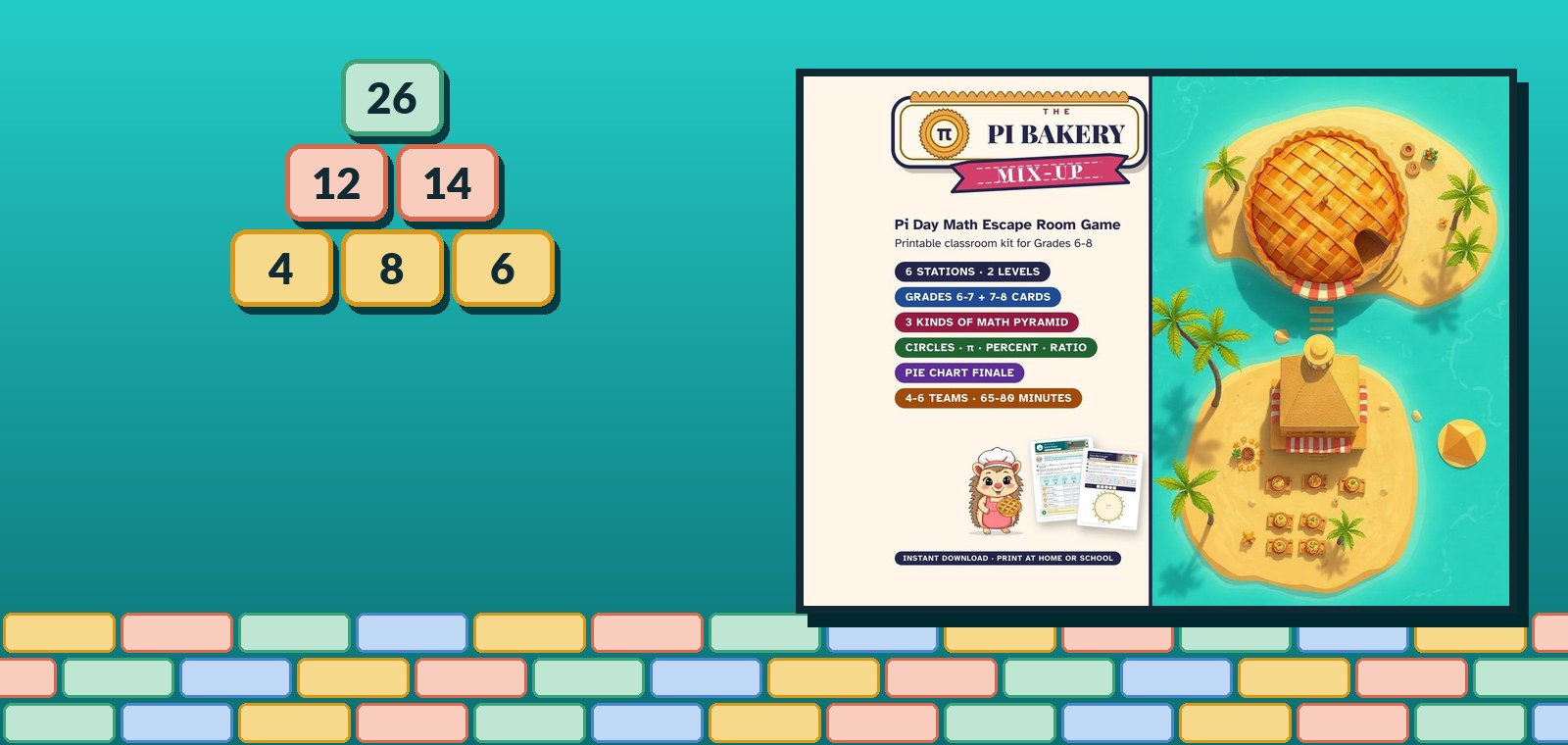
The Pi Bakery Mix-Up: What It Can Do for Players
The Pi Bakery Mix-Up (Grades 6 to 8): what is in it, what players can get out of it and how to run it.
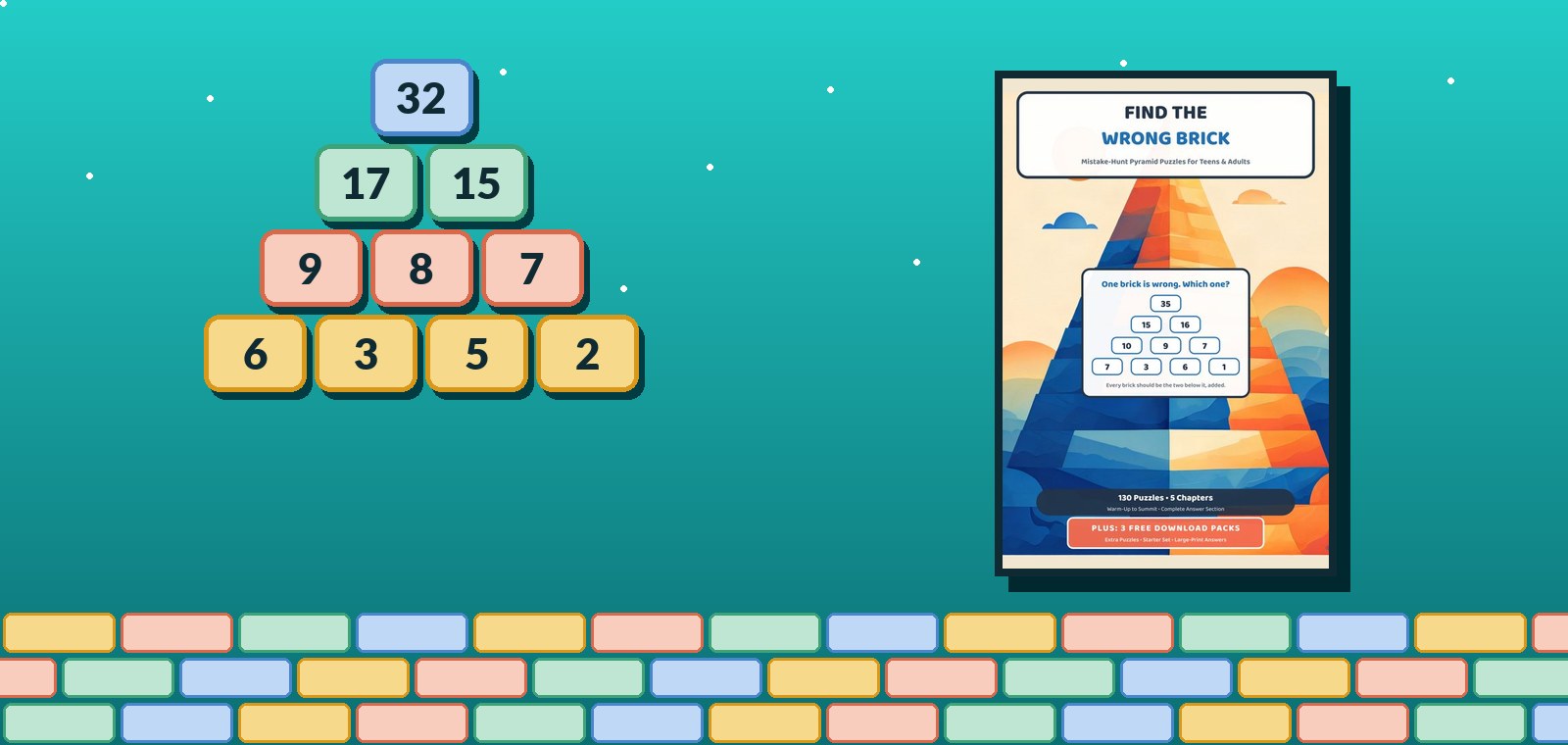
Find the Wrong Brick: Proofread a Math Pyramid
The whole pyramid is printed. One brick is wrong. You proofread it. A worked sample, a 20-second video and a pyramid to try yourself, with the one rule you need to read the hidden digits.
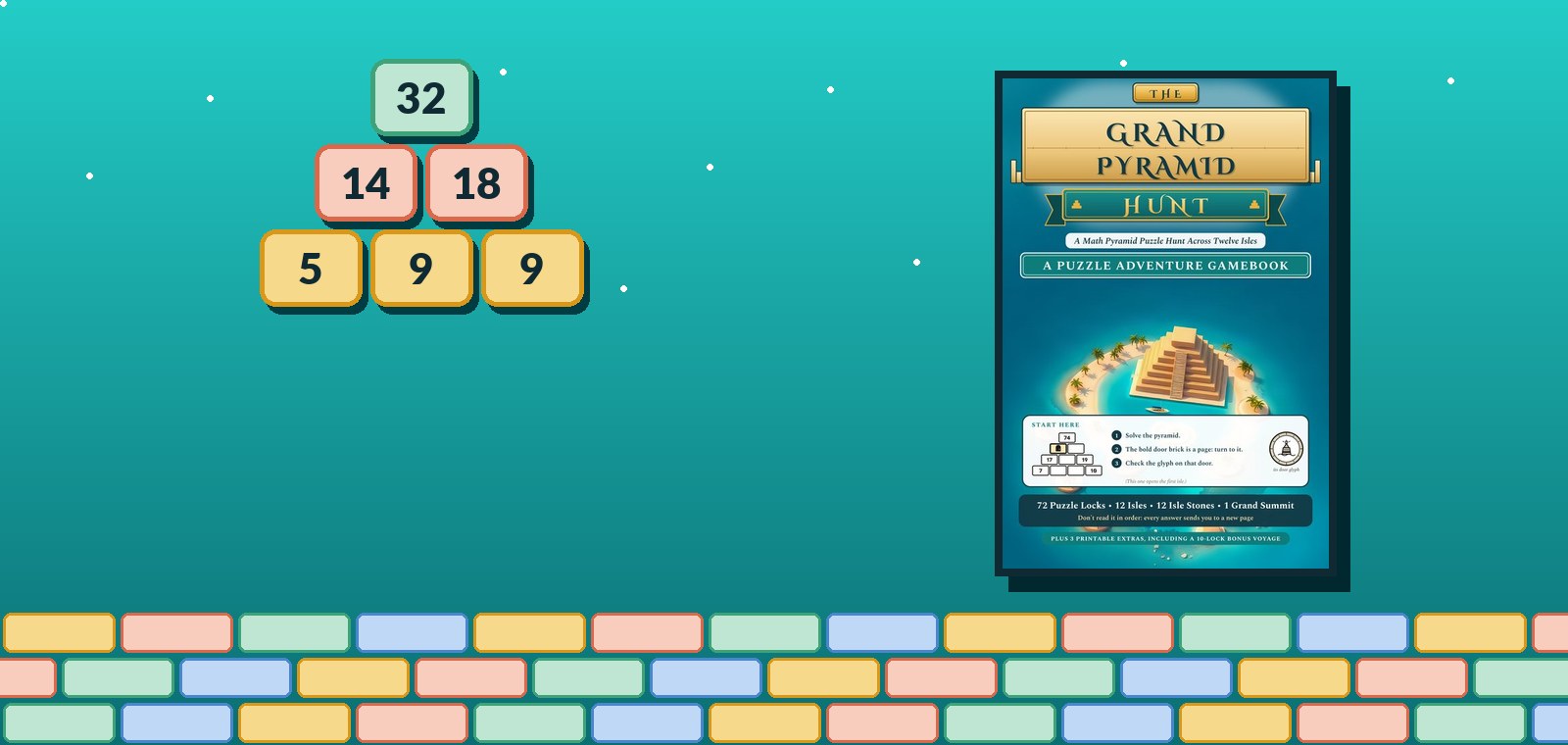
The Grand Pyramid Hunt: The Story and a Look Inside
The Grand Pyramid Hunt: the story, how a chamber plays and a look at a real page.
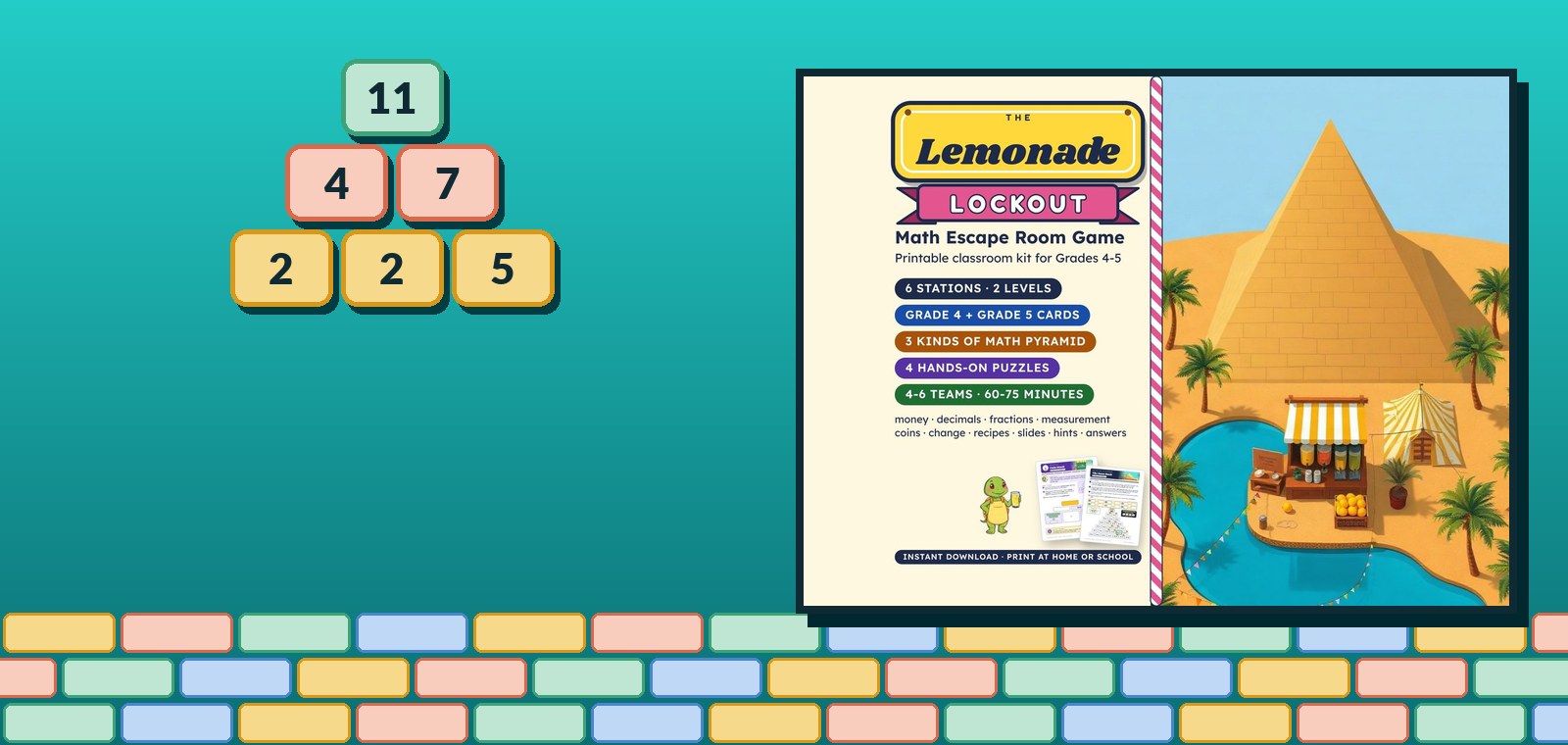
The Lemonade Lockout: What It Can Do for Players
The Lemonade Lockout (Grades 4 and 5): what is in it, what players can get out of it and how to run it.
Creouts Publishing
Puzzle books, printable games and, soon, games you can play here.
As an Amazon Associate we earn from qualifying purchases.
Amazon is a trademark of its owner. Creouts is not affiliated with Amazon.