
You have done a long sum and want to know if it is right. Doing it again the same way tends to repeat the same slip. Casting out nines is a different route to the same answer: it uses tiny numbers, takes about ten seconds, and works for adding, subtracting and multiplying. (For a simpler check that only looks at odd and even, see The Odd-Even Check.)
Step 1: the digit sum
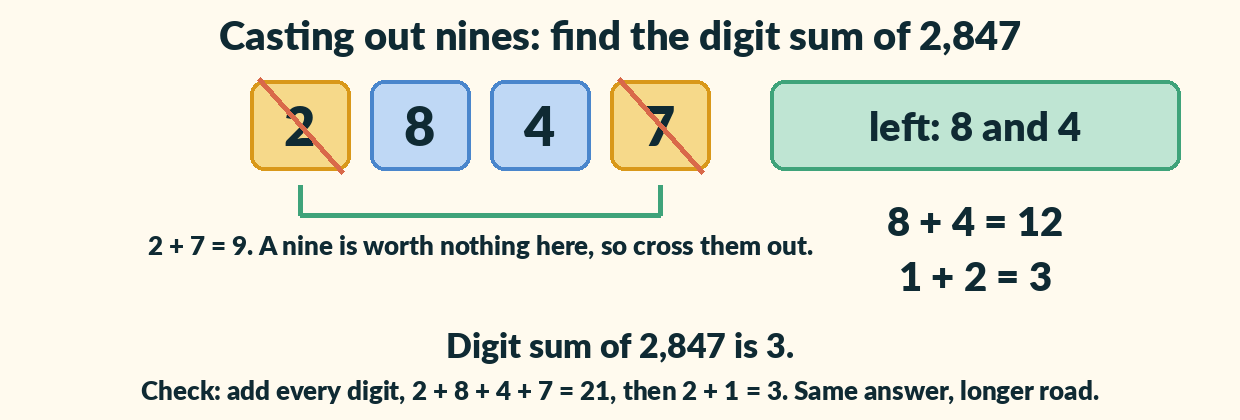
Add the digits of a number. If the answer has two digits, add those too, until one digit is left. A 9 counts as 0, because nines get "cast out". Here is 2,847.
Why it works
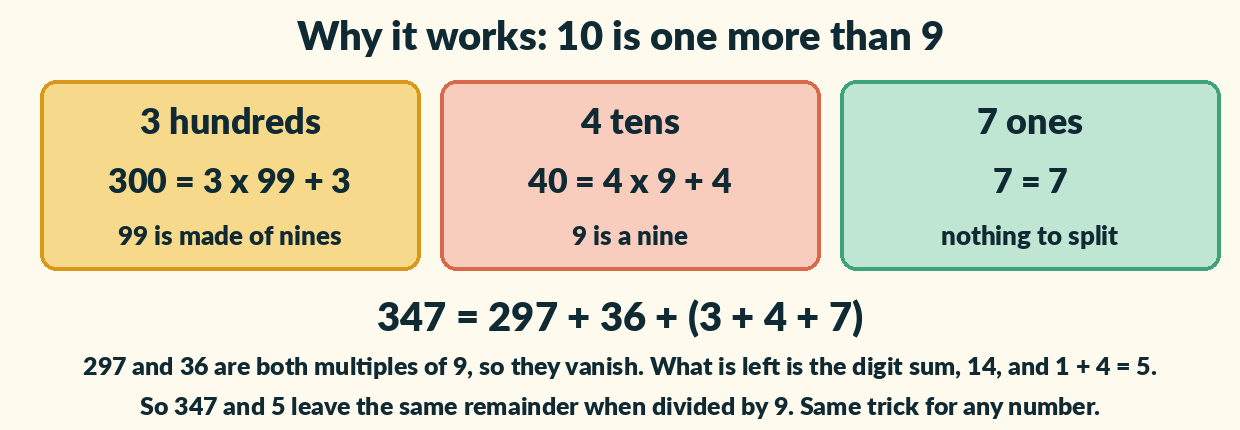
Ten is one more than nine. So a hundred is 99 + 1, a thousand is 999 + 1, and so on: every place value is a pile of nines plus one. Split 347 that way and the piles of nines are all multiples of 9, leaving only the digits to add up.
Because of that, adding, subtracting or multiplying two numbers does the same thing to their digit sums as it does to the numbers themselves, as far as remainders from 9 go. So if you do the sum on the small digit sums, the answer must have the digit sum you get.
Step 2: the check, for + - and x
Draw a cross. Put the digit sums of the two numbers left and right, and do the sum on them at the top. At the bottom, put the digit sum of the answer you wrote. Top and bottom must match.
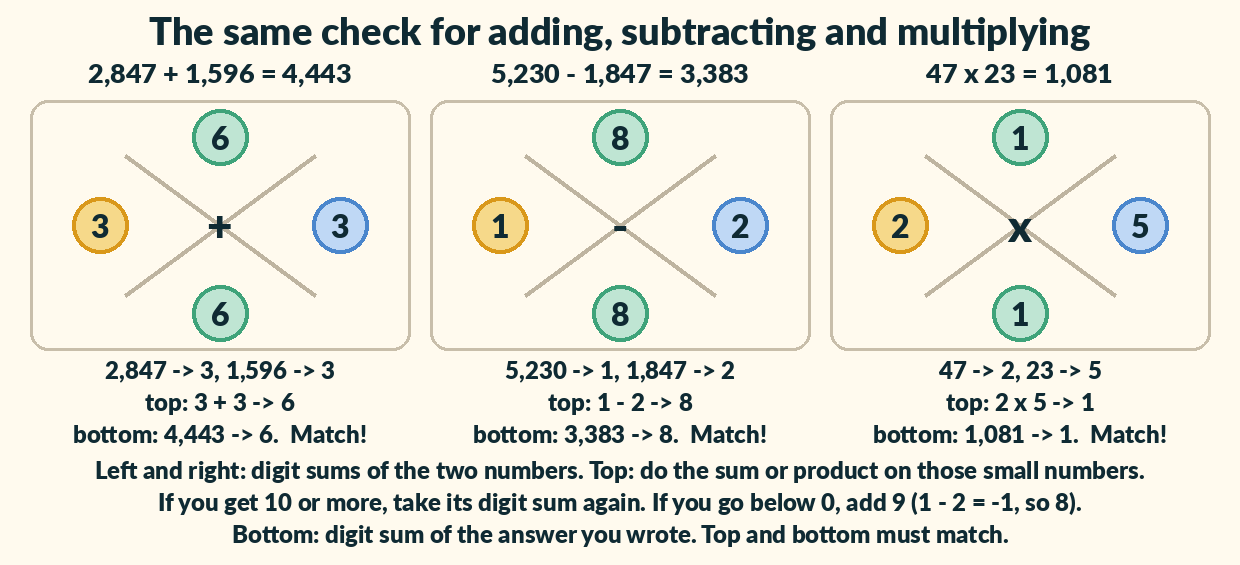
- Adding: 3 + 3 = 6, and 4,443 has digit sum 4 + 4 + 4 + 3 = 15, then 6. Match.
- Subtracting: 1 - 2 = -1. Add 9 to get 8. The answer 3,383 gives 3 + 3 + 8 + 3 = 17, then 8. Match.
- Multiplying: 2 x 5 = 10, then 1 + 0 = 1. The answer 1,081 gives 1 + 0 + 8 + 1 = 10, then 1. Match.
If top and bottom disagree, there is a mistake somewhere. Try 2,847 + 1,596 = 4,433: the bottom becomes 5, the top is still 6. Caught.
Checking a pyramid
A number pyramid is a stack of small additions: each brick is the two bricks below it added together. That is perfect for this check. Put the digit sum beside each brick, then test each brick against the two below it.
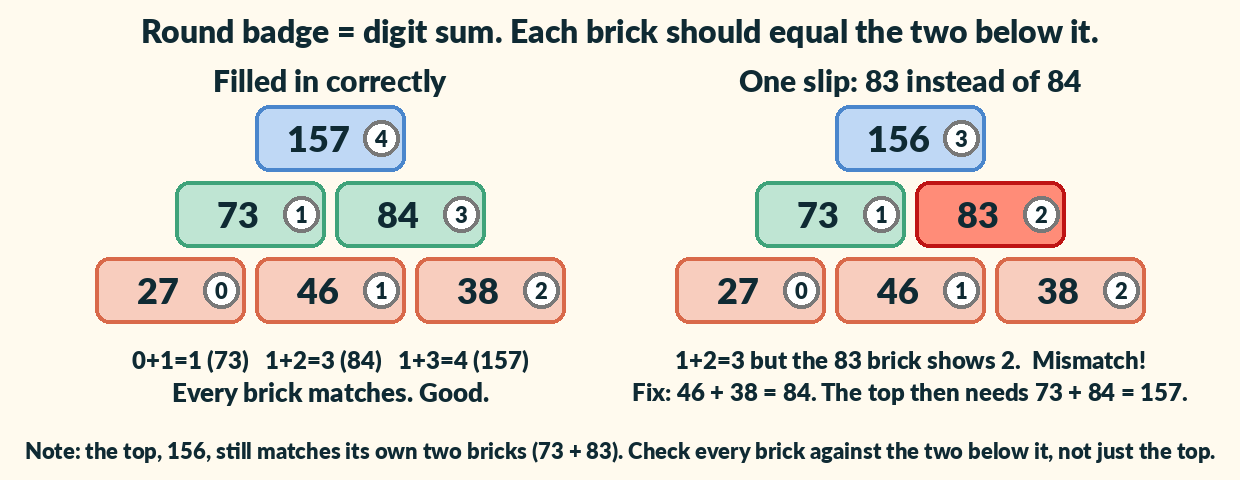
The right-hand pyramid is a useful warning. Its top, 156, is 73 + 83, so it matches the bricks just below it. The mistake sits one level down. Check every brick, not only the top.
What it cannot catch
Casting out nines can only say "probably right" or "definitely wrong". It misses two kinds of slip:
- Swapped digits. 4,443 written as 4,434 has the same digits, so the same digit sum. The check passes a wrong answer.
- Errors that are a multiple of 9. Being out by 9, 18 or 90 changes the number but not its remainder from 9, so the check stays quiet. (Swapping two neighbouring digits changes a number by a multiple of 9, which is why those two cases are really one.)
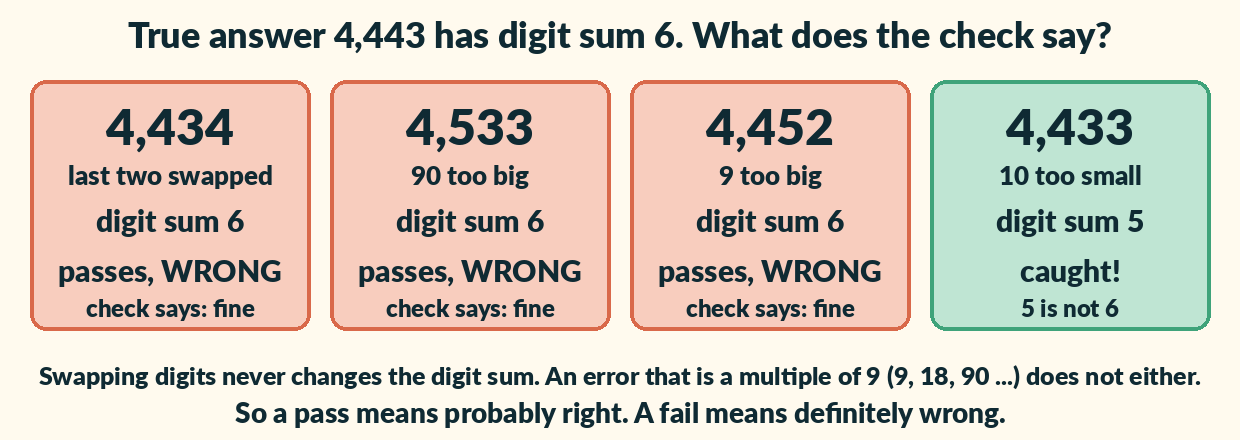
A pass does not prove the sum. A fail does prove a mistake, so use it as a quick filter, then look again at any row that fails.
Where a puzzle adventure fits
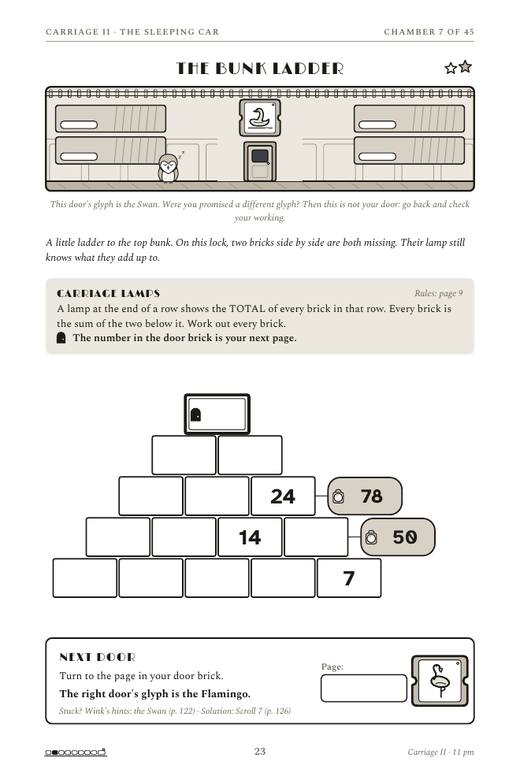
Escape the Pyramid, Level 1 and Escape the Labyrinth are puzzle adventure gamebooks, so you do not read them in order. Number pyramids are one of the lock kinds in each book, so there are plenty of small additions to check, but they are not the whole book, and neither book teaches this trick: it is just a handy way to test your own work before you turn to the page your answer sends you to.
Books mentioned
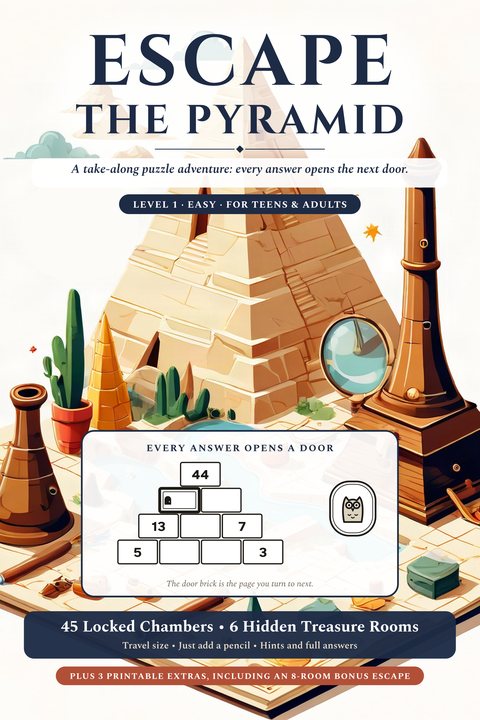
Escape the Pyramid, Level 1 (Easy)
A puzzle adventure gamebook with 45 locked chambers and 6 treasure rooms, hints and full answers in the back.
View on Amazon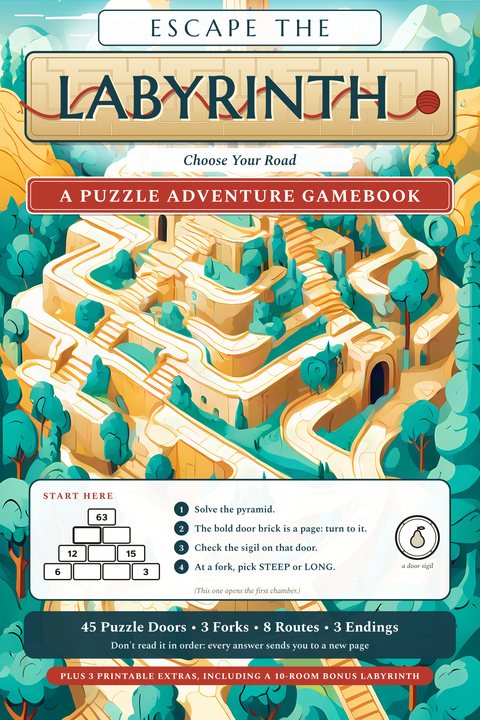
Escape the Labyrinth
A puzzle adventure gamebook with 45 locked chambers. You choose your road, and the puzzle kind changes from door to door.
View on Amazon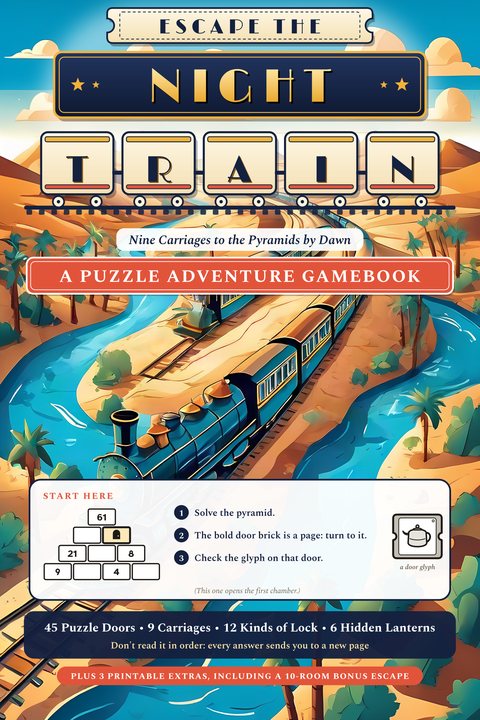
Escape the Night Train
Cross nine locked carriages to the pyramids by dawn. A puzzle adventure gamebook.
View on AmazonAs an Amazon Associate we earn from qualifying purchases. Cover images are the ones we have on file; the book you receive may show a slightly different cover.
More field notes
Puffcloud Expedition: An Escape Room You Play With 52 Cards
The answer is the number of the next card. How a printable escape room card game works, why every answer is checked twice, and how you choose your path.
River Rise: Find the Rise, Then Climb the Pyramid
On a rising river every brick gets a little extra. When the gauge has no number, find the rise first. A lock from Escape Anaconda Island, in a made-up example.
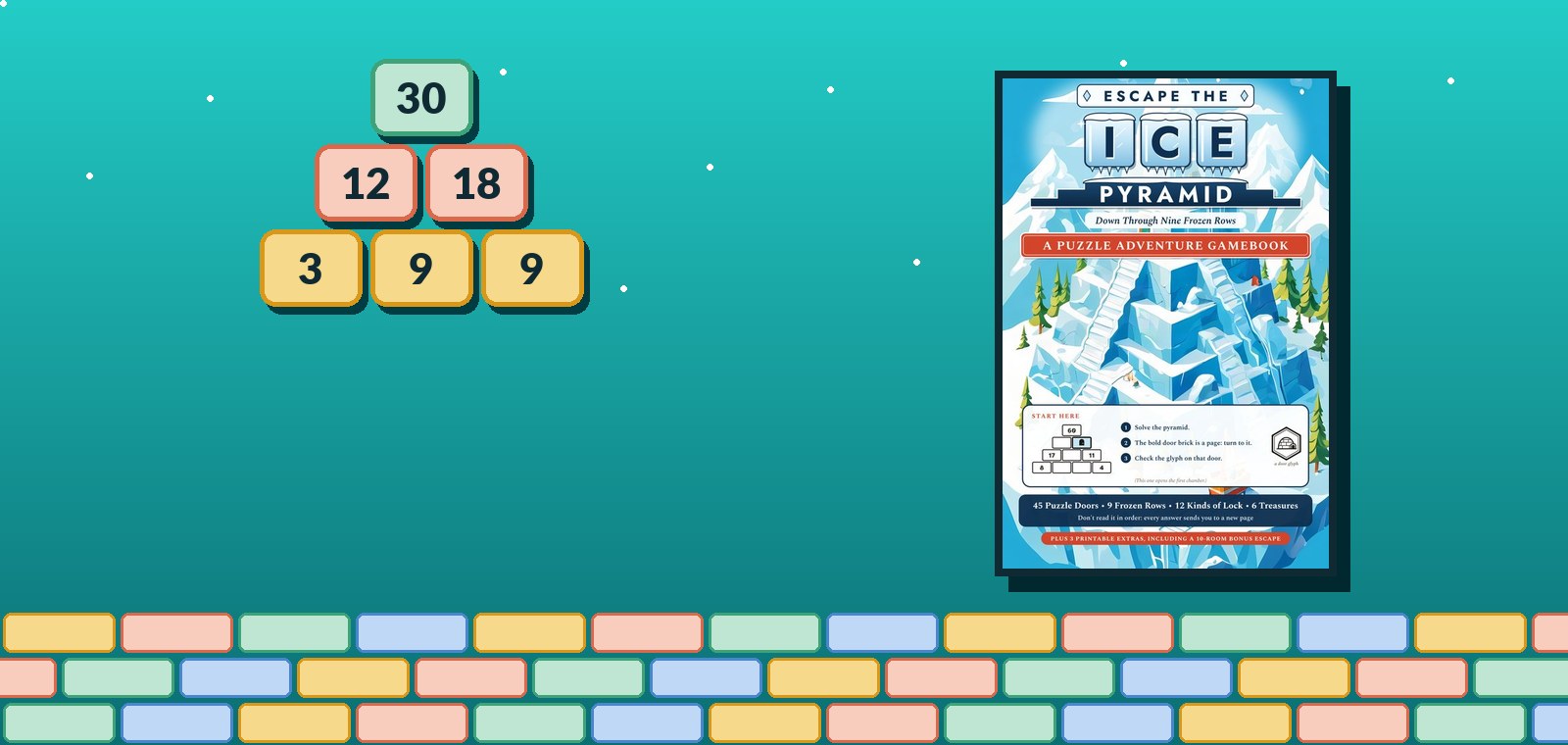
Escape the Ice Pyramid: The Story and a Look Inside
Escape the Ice Pyramid: the story, how a chamber plays and a look at a real page.
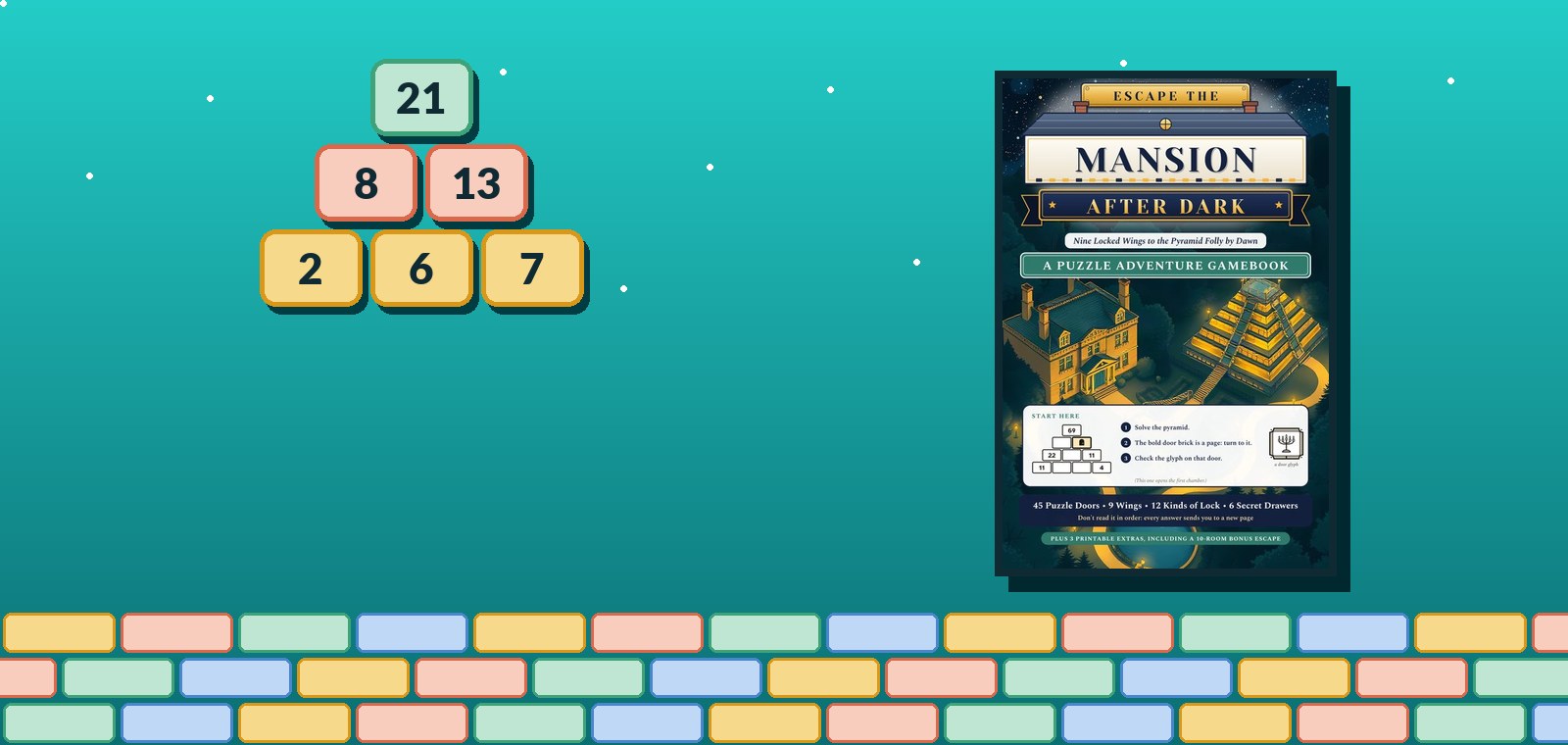
Portrait Pairs: When a Gilt Frame Multiplies Two Bricks
A frame holds two bricks and its plaque shows their product. Try each pair of factors and let the pyramid decide. A lock from Escape the Mansion After Dark.
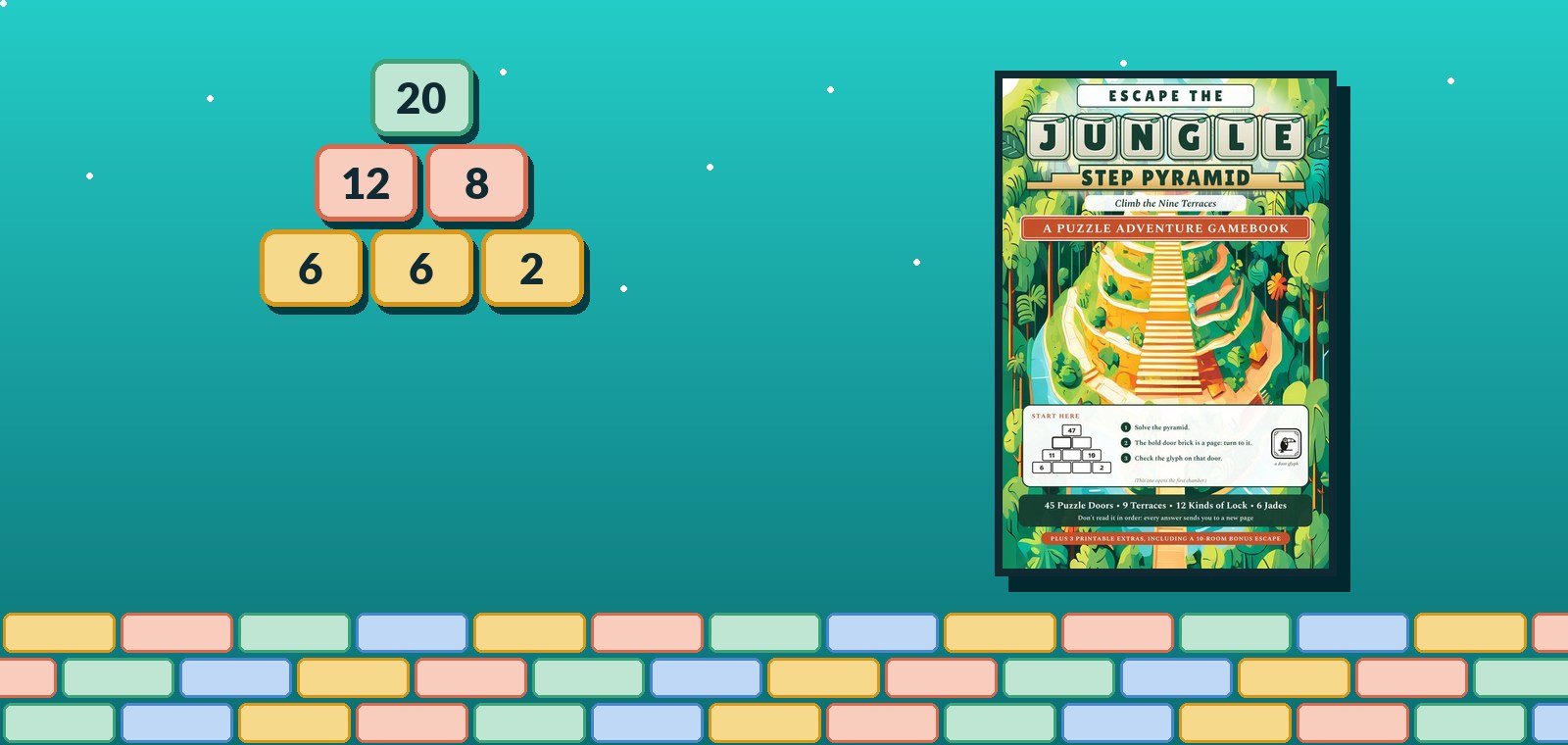
Escape the Jungle Step Pyramid: The Story and a Look Inside
Escape the Jungle Step Pyramid: the story, how a chamber plays and a look at a real page.
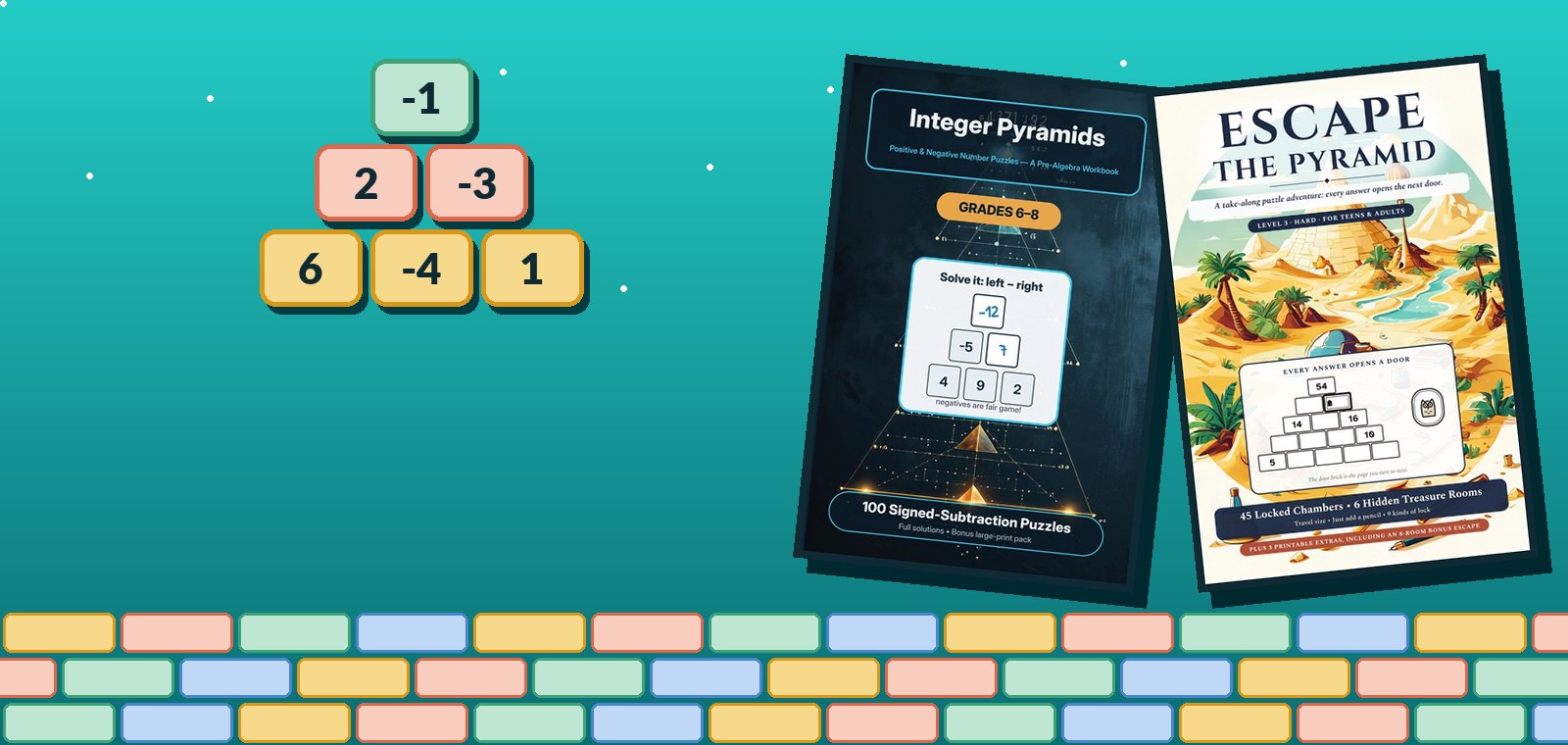
Negative Numbers in a Pyramid: Moving Left on the Number Line
Adding a negative number is just a step to the left. A number line, a pyramid and a few easy habits make negatives feel ordinary.
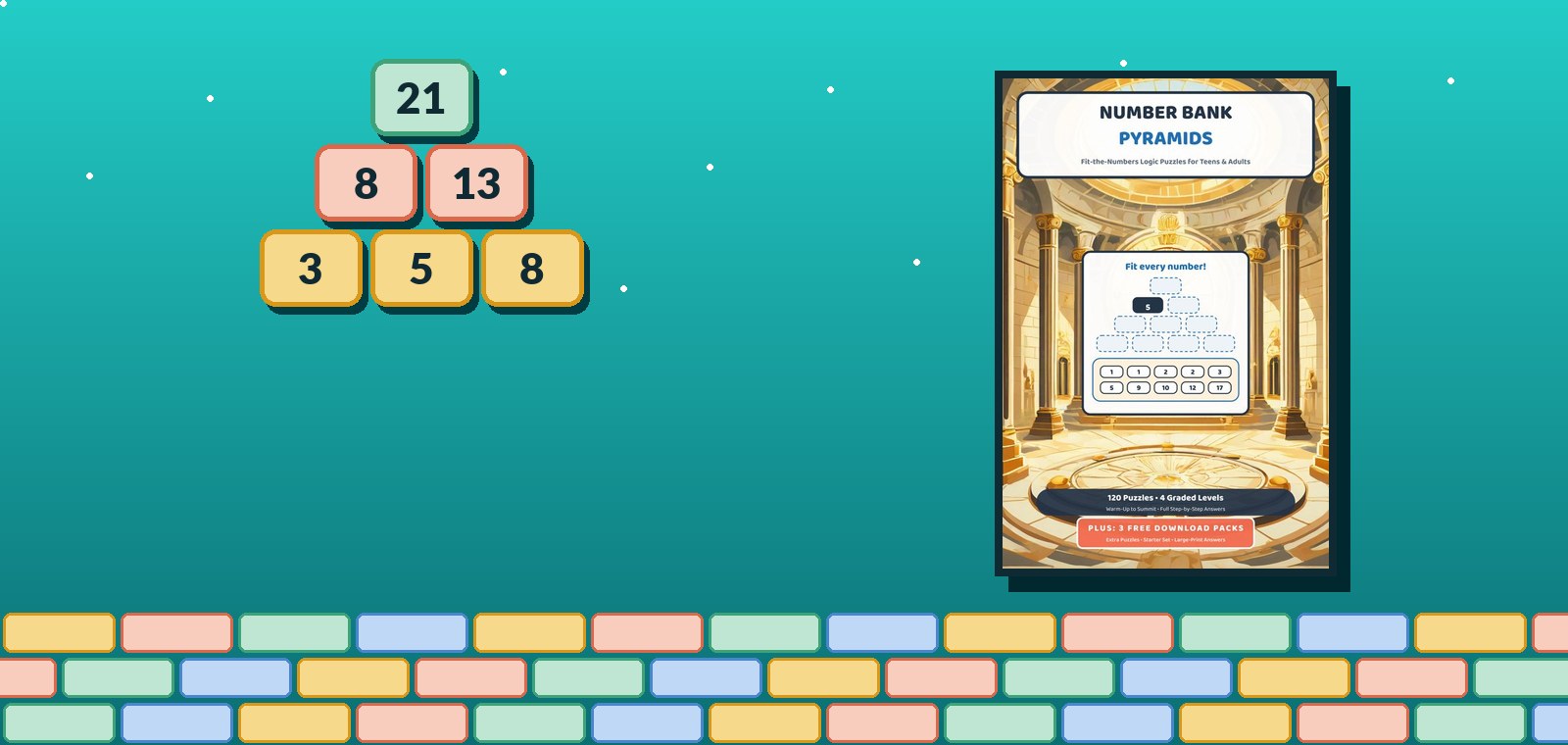
Number Bank Pyramids: Place Every Number Once
An empty pyramid and a bank of numbers. Each number is used exactly once. A worked sample, a 20-second video and a pyramid to try yourself, with the one rule you need to read the hidden digits.
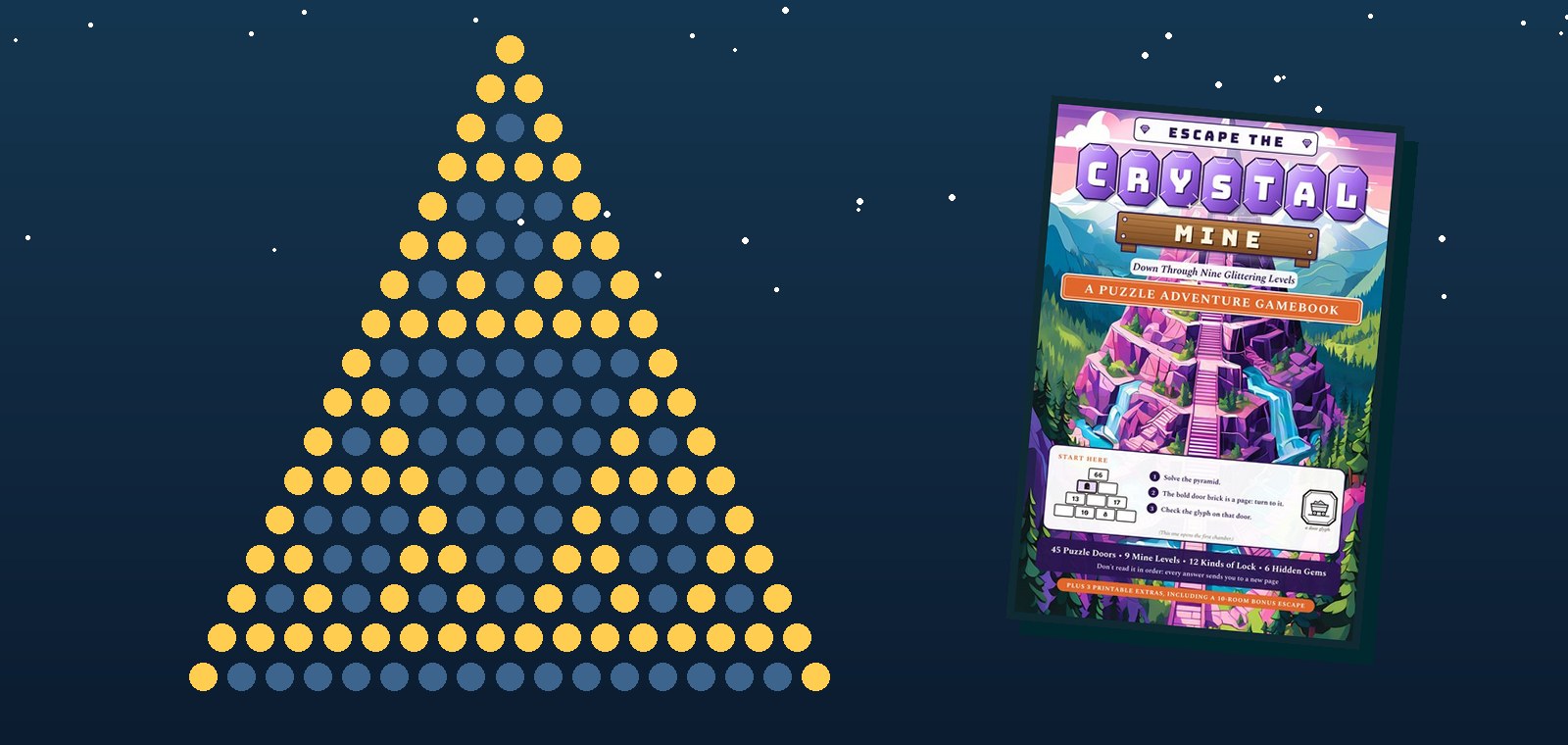
Pascal's Triangle: Patterns Hiding in a Number Pyramid
One simple rule builds a triangle full of surprises: doubling rows, counting and triangular numbers, Fibonacci numbers, a fractal and route counting. Each pattern is drawn step by step.
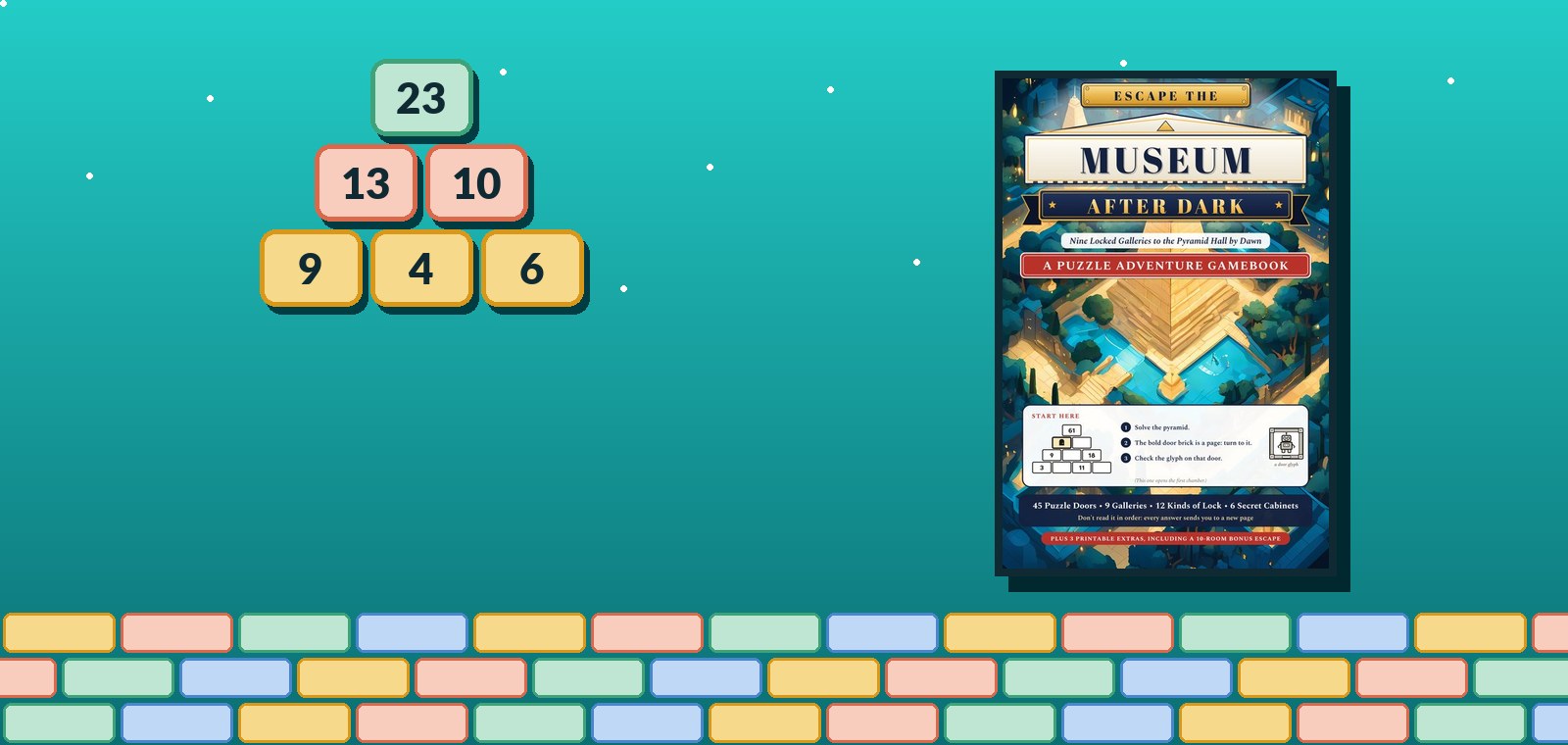
Escape the Museum After Dark: The Story and a Look Inside
Escape the Museum After Dark: the story, how a chamber plays and a look at a real page.
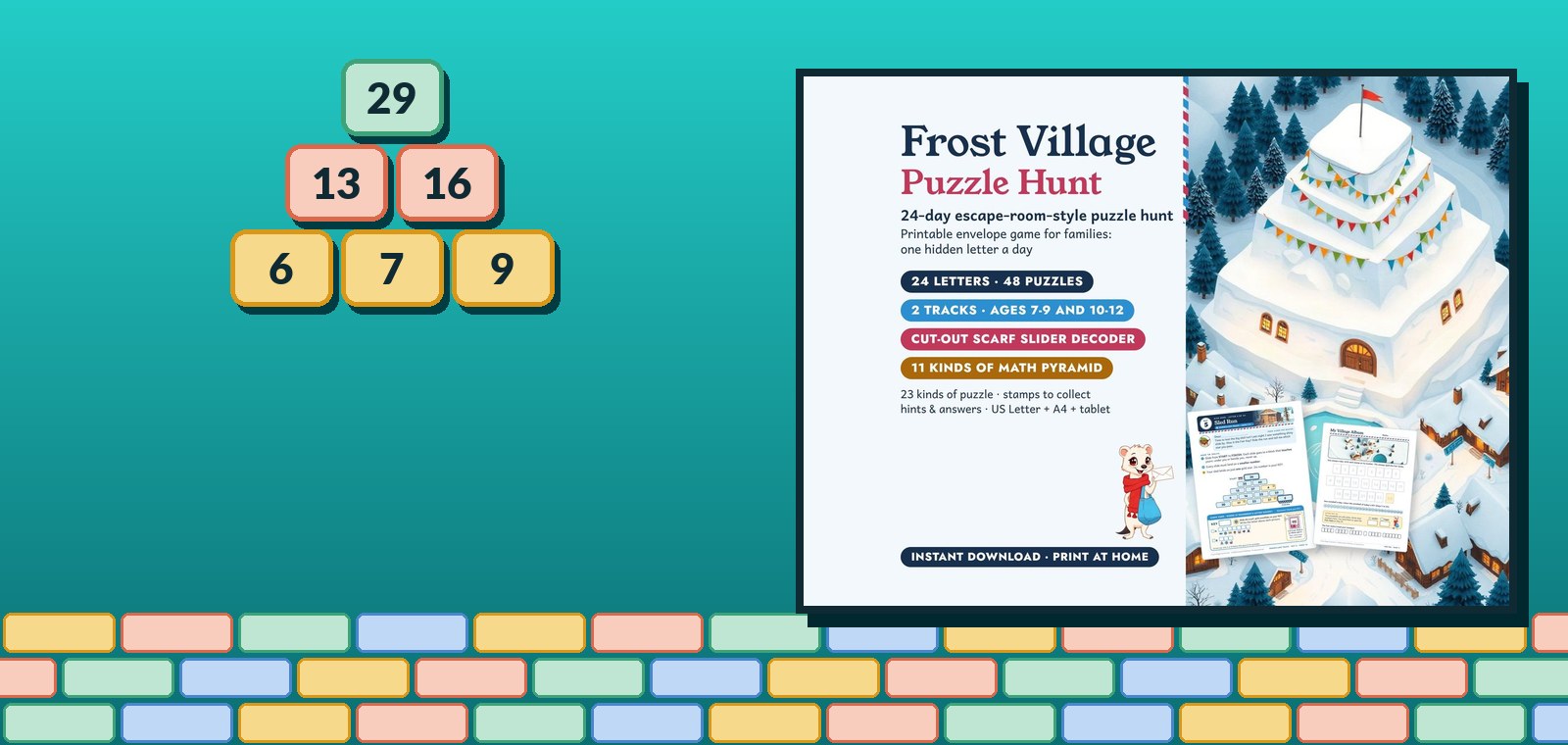
Frost Village Puzzle Hunt: What It Can Do for Players
Frost Village Puzzle Hunt (Ages 7 to 12): what is in it, what players can get out of it and how to run it.
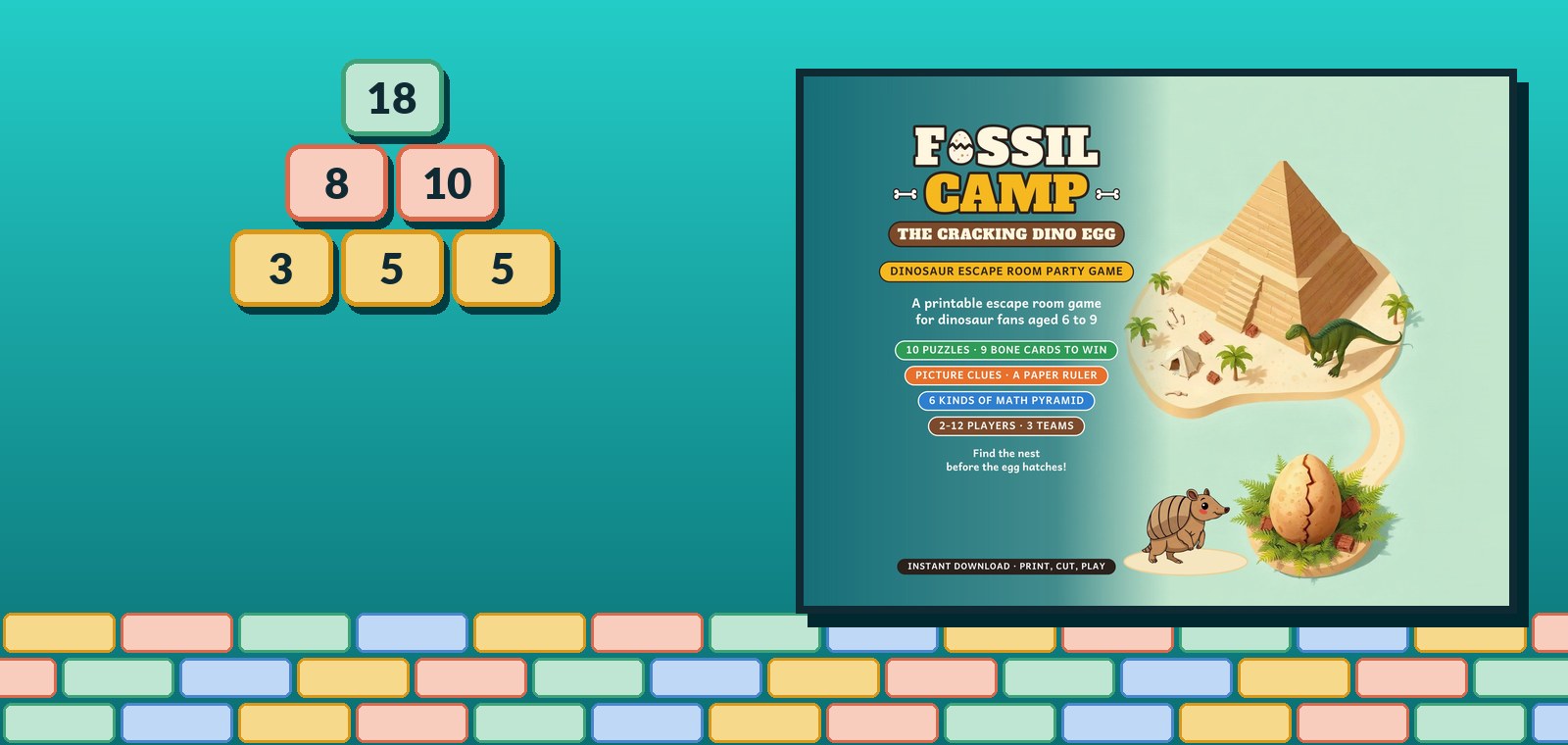
Fossil Camp: Nine Sites, Nine Bone Cards, One Cracking Egg
A dinosaur egg is about to hatch and the nest is behind the Bone Gate. A tour of the Fossil Camp kit for ages 6 to 9, with its video.
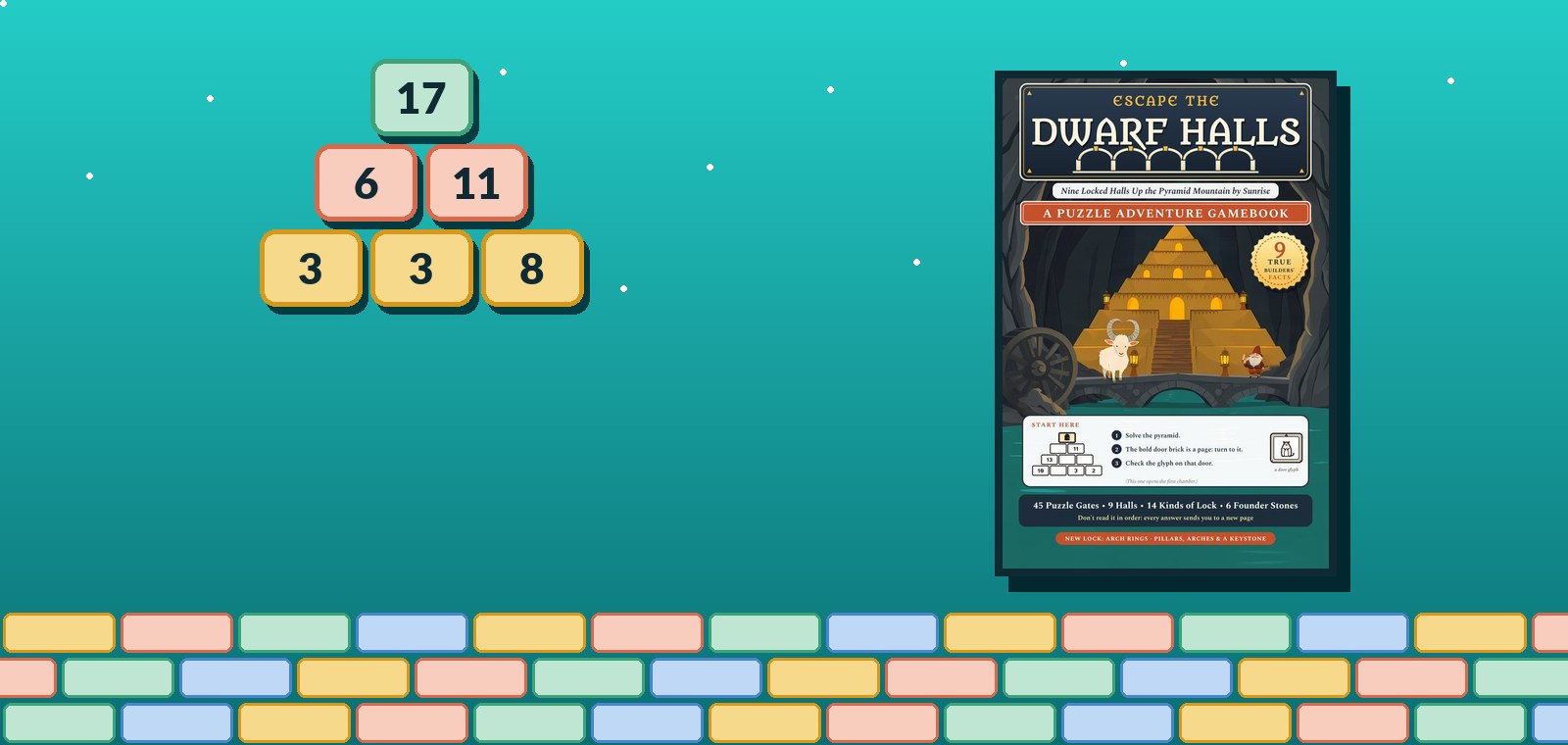
Escape the Dwarf Halls: The Story and a Look Inside
Escape the Dwarf Halls: the story, how a chamber plays and a look at a real page.
Creouts Publishing
Puzzle books, printable games and, soon, games you can play here.
As an Amazon Associate we earn from qualifying purchases.
Amazon and Etsy are trademarks of their owners. Creouts is not affiliated with Etsy.