
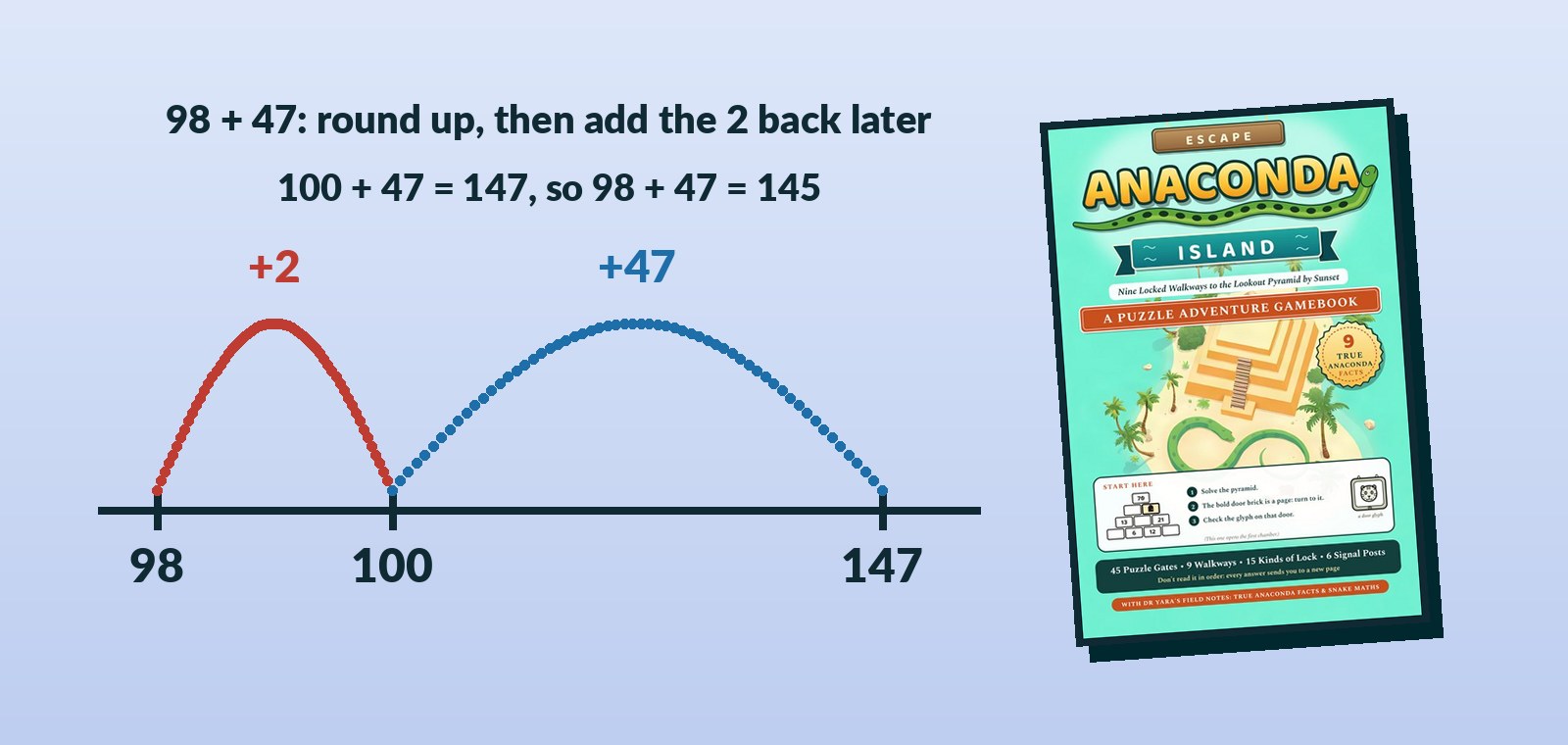
Most of us were taught one written method for each operation and told to use it every time. Mental arithmetic rewards a different habit: look at the numbers first, then bend the problem into one that is easy. Below are four such moves, each worked through with a drawing. (Younger children building the first steps of this should start with make-ten; see Better Ways to Learn Addition and Subtraction. This post is for teens and adults.)
1. Round and compensate: 98 + 47
98 is awkward and 100 is easy. So add 100, then give back what you borrowed.
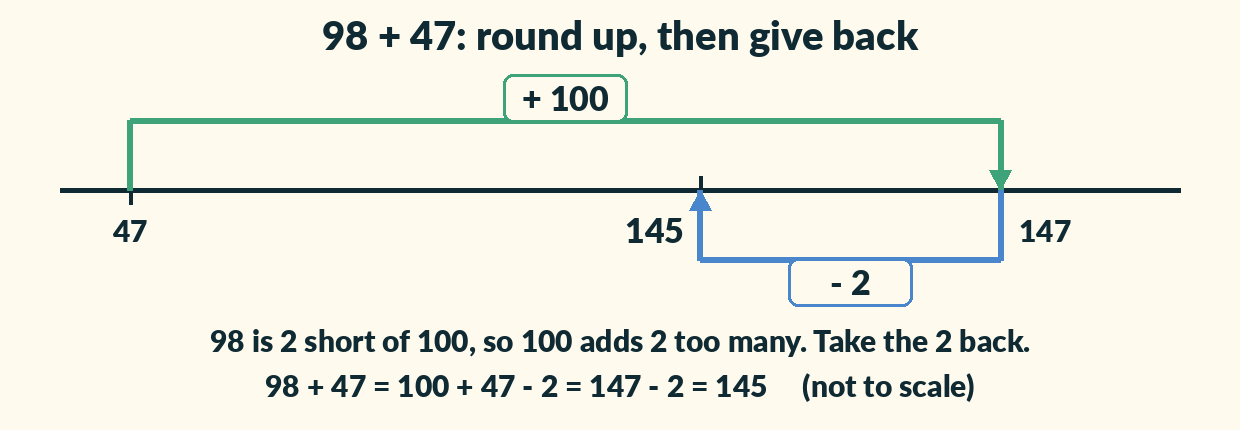
- Round: 98 is 2 less than 100, so work with 100.
- Add: 100 + 47 = 147.
- Compensate: you added 2 too many, so take 2 off: 147 - 2 = 145.
Why the last step goes the way it does: if you round up a number you are adding, the answer comes out too big, so you subtract the extra. In a subtraction it depends on which number you rounded: rounding up the number you subtract from makes the answer too big, while rounding up the number you subtract makes it too small. Always ask which way you moved.
2. Split into parts: 47 x 6
Six 47s is hard to hold in your head. Six 40s and six 7s are two easy facts.
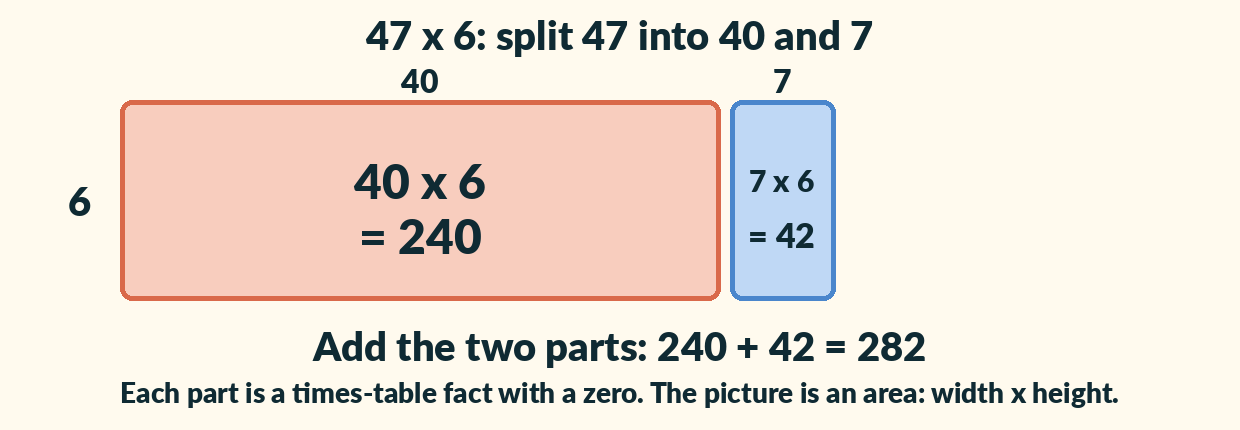
- Split 47 into 40 and 7 (tens and ones).
- Multiply each part: 40 x 6 = 240 and 7 x 6 = 42.
- Add: 240 + 42 = 282.
The picture shows why it is allowed: the whole rectangle is the two smaller rectangles side by side. The same split works for bigger numbers; you just have more parts.
3. Halve and double: 25 x 36
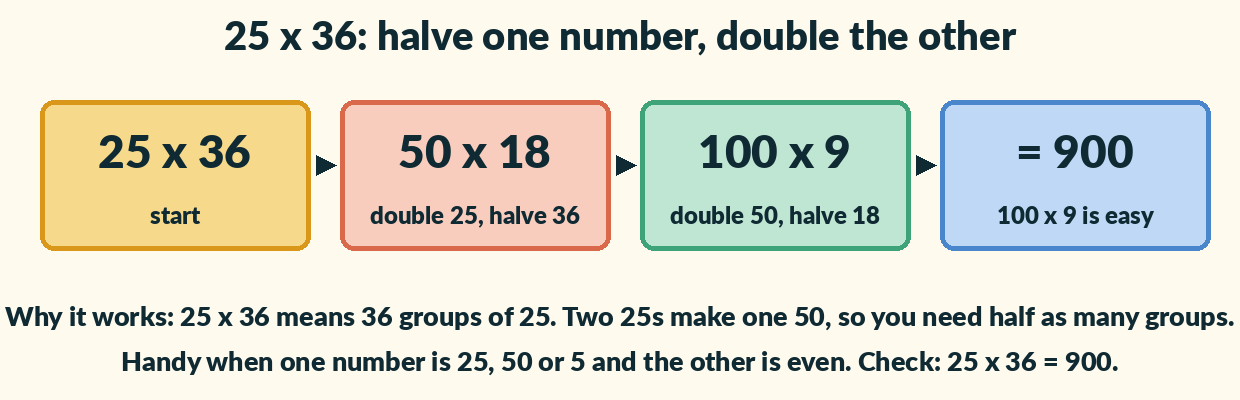
- Double one number, halve the other: 25 x 36 becomes 50 x 18.
- Do it again: 50 x 18 becomes 100 x 9.
- Finish: 100 x 9 = 900.
It works because the answer does not change: 36 groups of 25 hold the same total as 18 groups of 50. Use it when one number is even and the other is something like 5, 25 or 50. It is a poor choice for, say, 47 x 6, where doubling 47 does not help; picking the method to suit the numbers is the real skill.
4. Count up to find a difference: 203 - 187
Subtracting across a hundred (203 - 187) is where mistakes creep in. Treat it as a gap and hop across it instead.
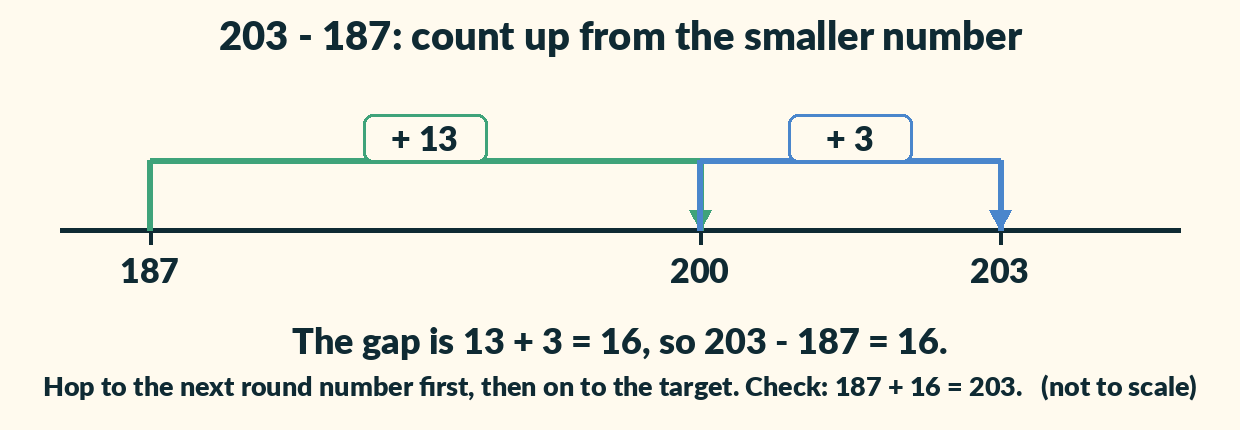
- Hop to a round number: 187 to 200 is 13.
- Hop to the target: 200 to 203 is 3.
- Add the hops: 13 + 3 = 16. Check: 187 + 16 = 203.
What research says about choosing a method
Two findings, kept to what the authors reported. Jon Star and Bethany Rittle-Johnson studied grade 7 students solving linear equations; those who compared two worked solutions side by side were more likely to use the demonstrated shortcuts afterwards than those who studied the solutions one at a time (summary from Harvard Graduate School of Education; the study is Star and Rittle-Johnson, 2008, Learning and Instruction). That was equation solving, not mental arithmetic, so treat it as a hint about comparing methods, not proof for the four above.
For mental calculation itself, Joanna Threlfall (2002, Educational Studies in Mathematics) argued that "strategy choice" is a misleading description of efficient mental calculation, and described it instead as an interaction between noticing and knowledge (ERIC record). In plain terms: the knack is spotting that 98 is close to 100, or that 25 and 36 suit halving and doubling. A list of tricks helps only if you also look at the numbers.
We are not claiming these methods make you faster or smarter. The aim is smaller: fewer slips, and a way to check your answer by a second route.
A five-minute practice
- Pick three sums from a receipt, a bill or a timetable.
- For each, look first: is a number near a round one? Does it split into tens and ones?
- Solve it one way, then check it a second way (for example 98 + 47 by rounding, then by splitting 90 + 40 and 8 + 7).
- If the two answers differ, find which step slipped. That is the useful part.
Where a puzzle adventure fits
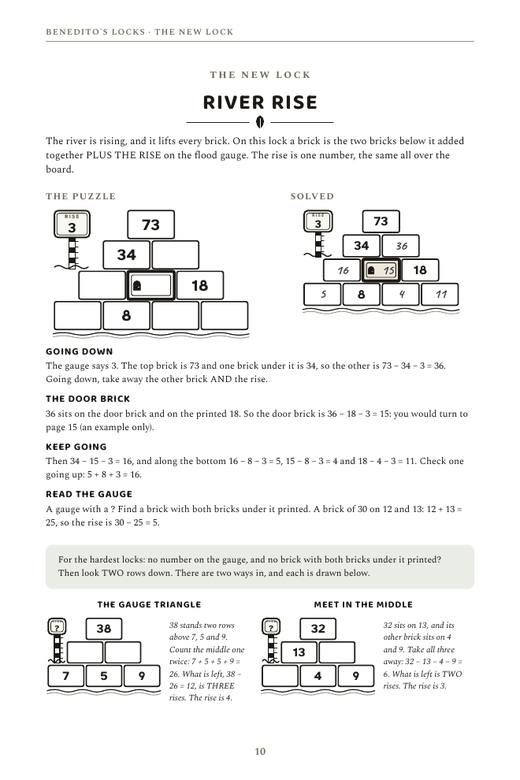
Number-pyramid locks make you add and subtract many small numbers in a row, so they are good places to try these moves. Both books below are puzzle adventure gamebooks: you do not read them in order, and each solved lock tells you which page to turn to. They are books of puzzles, not a maths course, and they do not teach these strategies step by step. Escape the Pyramid, Level 2 (Medium) has 45 locked chambers and 6 treasure rooms, with hints and full answers in the back. In Escape the Labyrinth you choose your road through 45 locked chambers and the puzzle kind changes from door to door.
Books mentioned
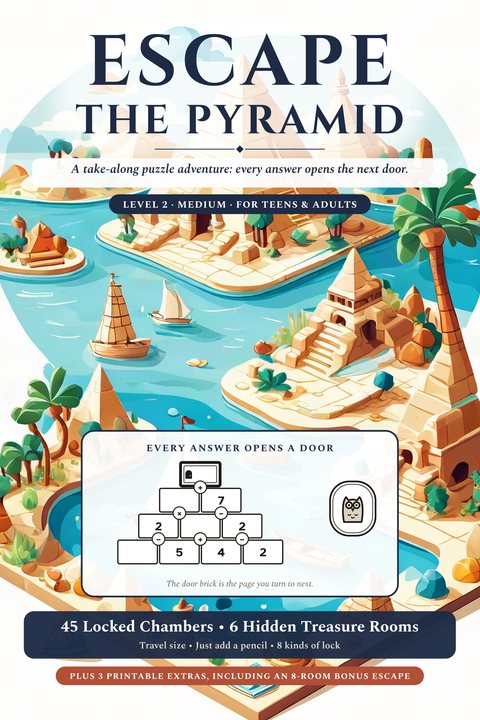
Escape the Pyramid, Level 2 (Medium)
A puzzle adventure gamebook with 45 locked chambers and 6 treasure rooms, hints and full answers in the back.
View on Amazon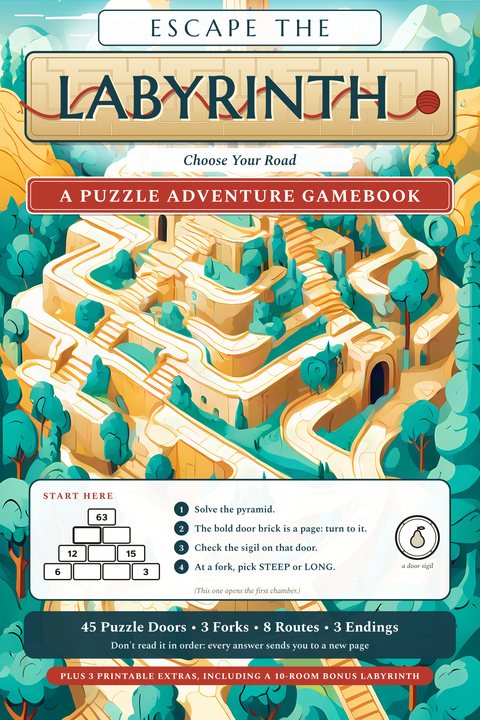
Escape the Labyrinth
A puzzle adventure gamebook with 45 locked chambers. You choose your road, and the puzzle kind changes from door to door.
View on Amazon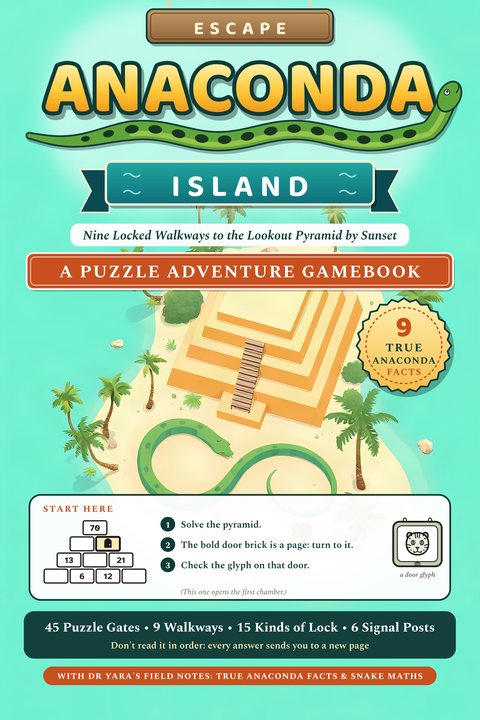
Escape Anaconda Island
Cross nine locked walkways to the Lookout Pyramid, with true snake facts. A puzzle adventure gamebook.
View on AmazonAs an Amazon Associate we earn from qualifying purchases. Cover images are the ones we have on file; the book you receive may show a slightly different cover.
More field notes
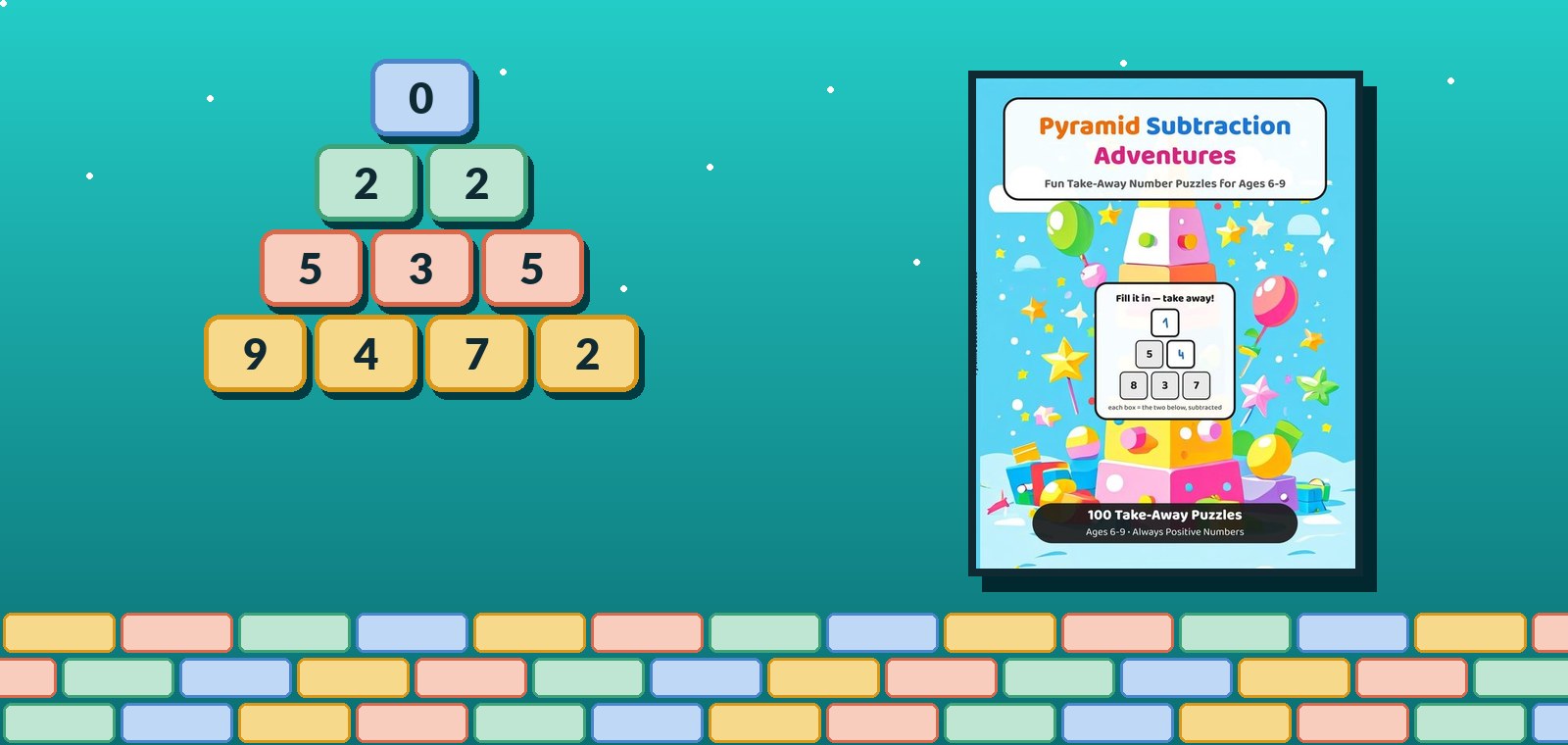
Subtraction Pyramids: Take Away Your Way to the Top
Each brick is the difference of the two bricks under it, so nothing ever goes negative. A worked sample, a 20-second video and a pyramid to try yourself, with the one rule you need to read the hidden digits.
Do Escape Rooms Help Students Learn? What the Research Says
A 2020 review of 39 studies found students loved educational escape rooms, but very few studies tested learning. What that means, plus practical tips for teachers and parents.
Escape the Wildlife Sanctuary After Dark: The Story and a Look Inside
Escape the Wildlife Sanctuary After Dark: the story, how a chamber plays and a look at a real page.
Frost Village Puzzle Hunt: A 24-Day Countdown, One Hidden Envelope a Day
24 letters, 48 puzzles and a Scarf Slider that decodes tomorrow's hiding place. A countdown that two children of different ages can play together.
Escape the Crystal Mine: The Story and a Look Inside
Escape the Crystal Mine: the story, how a chamber plays and a look at a real page.
Friendship Bracelet Puzzle Hunt: What It Can Do for Players
Friendship Bracelet Puzzle Hunt (Ages 6 to 10): what is in it, what players can get out of it and how to run it.
Four Operations Pyramids: Undo Times With Divide
Add, take away, times and divide, all in one pyramid. A worked sample, a 20-second video and a pyramid to try yourself, with the one rule you need to read the hidden digits.
Escape the Labyrinth: The Story and a Look Inside
Escape the Labyrinth: the story, how a chamber plays and a look at a real page.
Fossil Camp: The Cracking Dino Egg: What It Can Do for Players
Fossil Camp: The Cracking Dino Egg (Ages 6 to 9): what is in it, what players can get out of it and how to run it.
Twelve Isles, One Hunt: A Tour of The Grand Pyramid Hunt
Twelve isles in a ring, a new kind of lock on each, and a day that runs from 7 am to sunset. What a big puzzle hunt feels like, without spoilers.
Escape Through Time: The Story and a Look Inside
Escape Through Time: the story, how a chamber plays and a look at a real page.
The Great Gear Jam: What It Can Do for Players
The Great Gear Jam (Grades 3 and 4): what is in it, what players can get out of it and how to run it.
Mixed Operation Pyramids: Undo the Sign
Every brick has its own operation: add, subtra